

Why “Sales” Alone Cannot Tell You What a Small Business Is Worth
Many small business owners look at sales first.
Sales are important, but sales alone do not show the real value of a business.
A business can have high sales and still be weak. Another business can have lower sales but stronger profit, better cash flow, fewer debts, and more stable operations.
That is why business valuation is useful.
Business valuation helps you estimate what a business may be worth before making decisions such as selling a business, buying a business, bringing in a partner, discussing investment, checking whether a business is financially healthy, or planning future growth.
What is business valuation?
Business valuation means estimating the value of a business.
For small businesses, this does not need to be complicated at the beginning. You do not always need advanced finance models to get a basic idea.
A simple valuation usually looks at three main things: adjusted profit, asset value, and valuation multiple.
1. Adjusted Profit
Normal profit is useful, but it may not show the full picture.
Adjusted profit means taking the business profit and adjusting it for things like owner salary, one-time expenses, or unusual costs.
Example:
Net Profit
+ Owner Salary
+ One-Time Expenses
- Required Replacement Owner Salary
= Adjusted Profit
This helps show the real earning power of the business.
2. Asset Value
A business may also have valuable assets, such as cash, inventory, equipment, furniture, fixtures, deposits, and other business assets.
But we also need to subtract liabilities, such as loans, unpaid taxes, unpaid supplier bills, and other debts.
A simple asset-based value looks like this:
Total Business Assets - Total Business Liabilities = Asset-Based Value
This gives a basic “floor value” of the business.
3. Valuation Multiple
A valuation multiple is a simple number used to estimate business value based on profit.
Example:
Adjusted Profit × Valuation Multiple = Estimated Business Value
A stable business may receive a higher multiple.
A risky or unstable business may receive a lower multiple.
For small businesses, the multiple depends on things like revenue stability, profit stability, owner dependency, quality of records, debt level, repeat customers, and growth potential.
Why this matters
If you are buying a business, valuation helps you avoid overpaying.
If you are selling a business, valuation helps you understand a reasonable asking price.
If you are bringing in a partner or investor, valuation helps make the discussion more structured.
If you are not selling or buying anything yet, valuation can still help you understand the financial strength of your business.
A simple example
Imagine a small business has:
Annual Sales: ¥30,000,000
Net Profit: ¥3,000,000
Owner Salary: ¥2,400,000
One-Time Expenses: ¥500,000
Required Replacement Owner Salary: ¥3,000,000
Adjusted profit would be:
¥3,000,000
+ ¥2,400,000
+ ¥500,000
- ¥3,000,000
= ¥2,900,000
If we use a 2.0x valuation multiple:
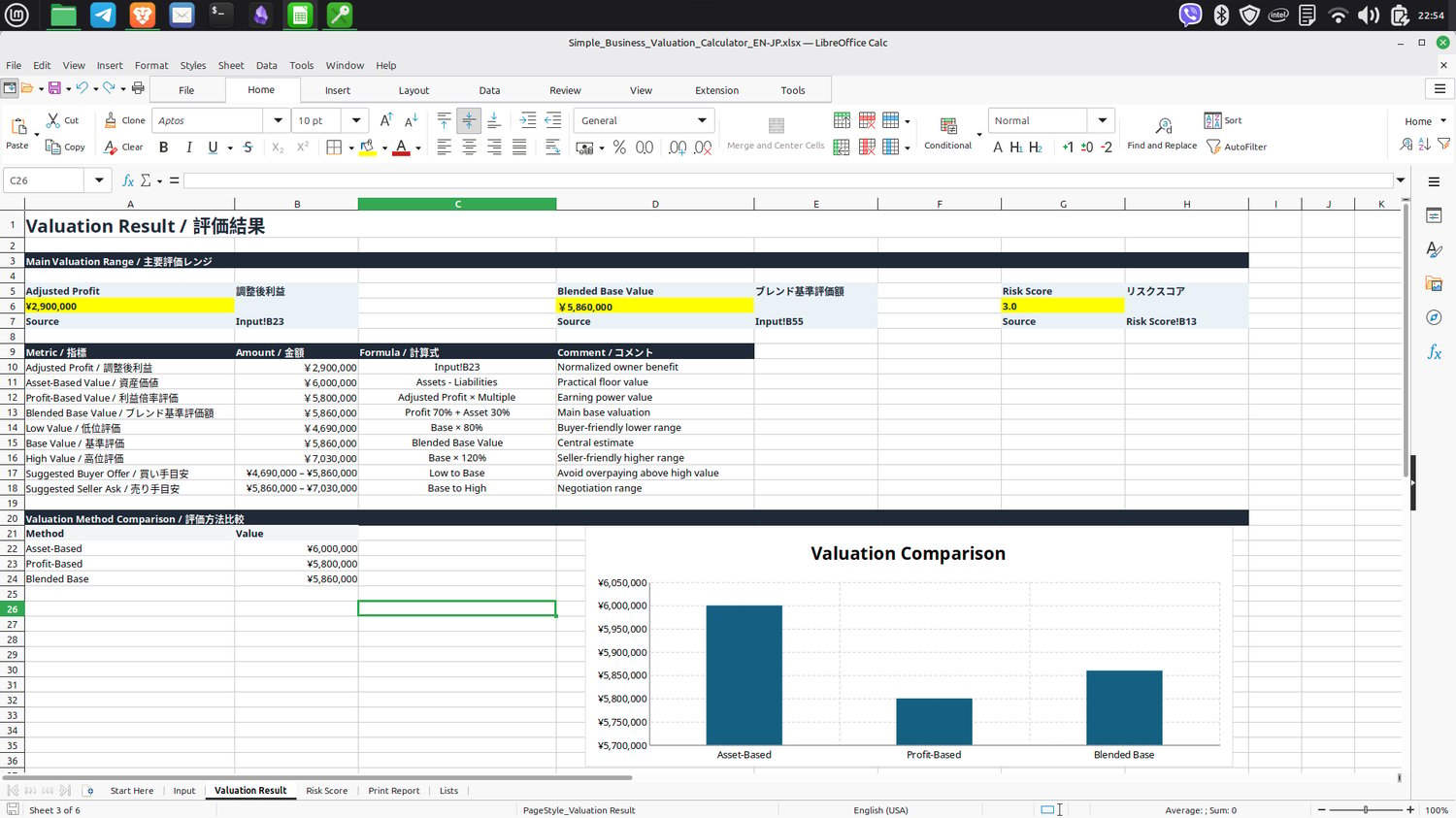
¥2,900,000 × 2.0 = ¥5,800,000
This gives a simple profit-based valuation.
Then we can also compare it with the asset-based value to understand whether the business value is supported by actual assets.
Free template
I created a free Excel template called:
Simple Business Valuation Calculator
かんたん事業価値計算表
It helps you estimate the value of a small business using adjusted profit, asset-based value, profit multiple valuation, blended valuation, low / base / high valuation range, simple risk score, and a print-ready summary report.
This is a simple beginner-friendly version. It does not include advanced valuation methods such as DCF, EBITDA valuation, loan repayment modelling, investor return analysis, or monthly forecasting.
It is designed as a starting point for small business owners, freelancers, café owners, restaurant owners, local shop owners, and anyone thinking about buying, selling, investing, or bringing in a partner.
Important note
This template provides an estimate only. It is not legal, tax, accounting, investment, or M&A advisory advice.
For formal business sales, purchases, tax matters, legal decisions, or investment decisions, please consult a qualified professional.