
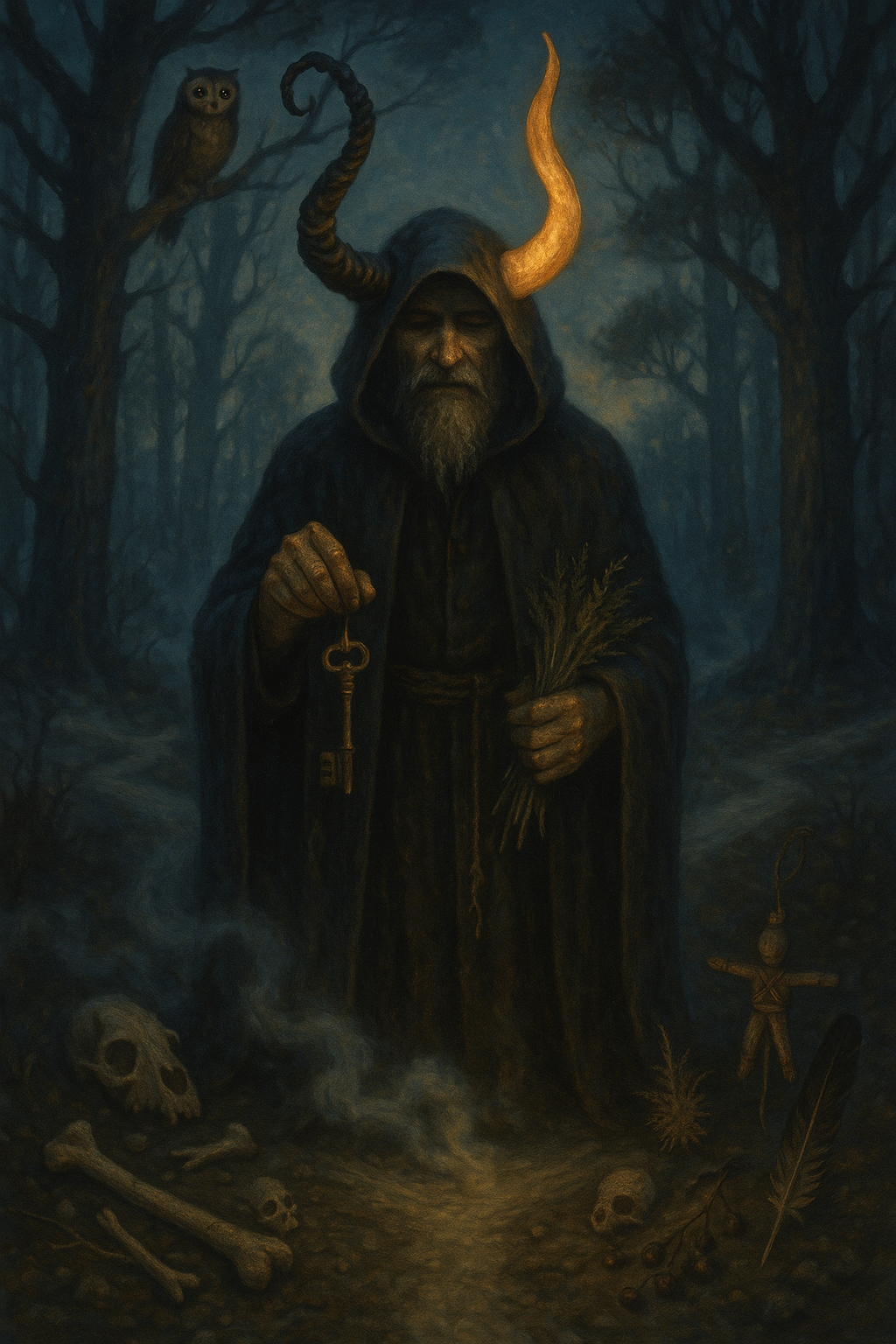
The spirit I follow wears two horns—but they are not alike.
One bends and twists like blackthorn in winter, gnarled as a serpent wound in sleep.
The other rises sharp, straight as ashwood, a taper of flame.
These are not ornaments. They are the marks of his nature, and the two ways he teaches.
One horn is crooked—turning toward the moon and wind and thorn. It is the horn of banes: storm and sickness, poppet and pestilence, shadow-walking and the gift of fear.
The other is straight—growing with the sun, with grain, and with breath. It is the horn of blessings: herb-lore and healing, divining and dream-sight, mending and midwifing.
These two virtues are not moral twins. They are not “good” and “evil.”
They are the witch’s inheritance—curse and cure, both.
In the old stories—the ones dragged from the mouths of cunning folk and accused witches alike—there is no pure magic.
In 1610, Jeanne Harvilliers said the Horned One gave her powders to heal and to harm.
In 1580s Lorraine, witches gathered beneath a man in horns to learn potions for health and rites for ruin.
He was not God. He was not Devil as the priests say.
He was the teacher, both root-digger and reaper.
(And the land remembers.)
The crooked horn is the hedge-rider’s path, moon-swept and thorn-tangled. It walks backward over the threshold, speaks in riddles, rides storms.
It is the briar pulled for pain-work, the bone-handled blade.
It is the part of craft that takes.
The straight horn is the cunning path through the greenwood. It gives with one hand while the other stays hidden.
It blesses cattle, stops blood, lays spirits to rest.
It is not holy. It is not clean.
It is just as wild.
It is the part of craft that gives.
You’ll find both horns in the lore of the English cunning folk—men and women who served their folk with charms and curses alike.
John Walsh of Dorset, in 1665, named the Black Man his master. This horned spirit taught him to find what was lost, to speak healing over the sick, and to bring ruin on thieves.
Two horns. Two hands. One spirit.
The Horned One—whether you call him Devil, Black Man, Master, Man in the Hedgerow—teaches the whole of the art.
He is not split in half like a church window.
He is root and branch. Flame and ash. Wither and bloom.
Robin Goodfellow wears his horns for laughter and for mischief, for lust and for wildness. Herne stalks the forest, not as guardian or predator alone—but as both.
The horned ones in our lore can lead you to treasure or to madness. That is their nature.
And that is the craft.
This is why I have no need to cleave my heart between Heaven and Hell.
I don’t offer my healing work to saints, or beg blessings from a god of light.
The spirits I serve walks with me in both wrath and mercy.
He gives me balm when I ask for it, and blight when I need it.
I do not divide my magic. I do not fear its shadow.
I do not serve a divided master.
Comments ()