
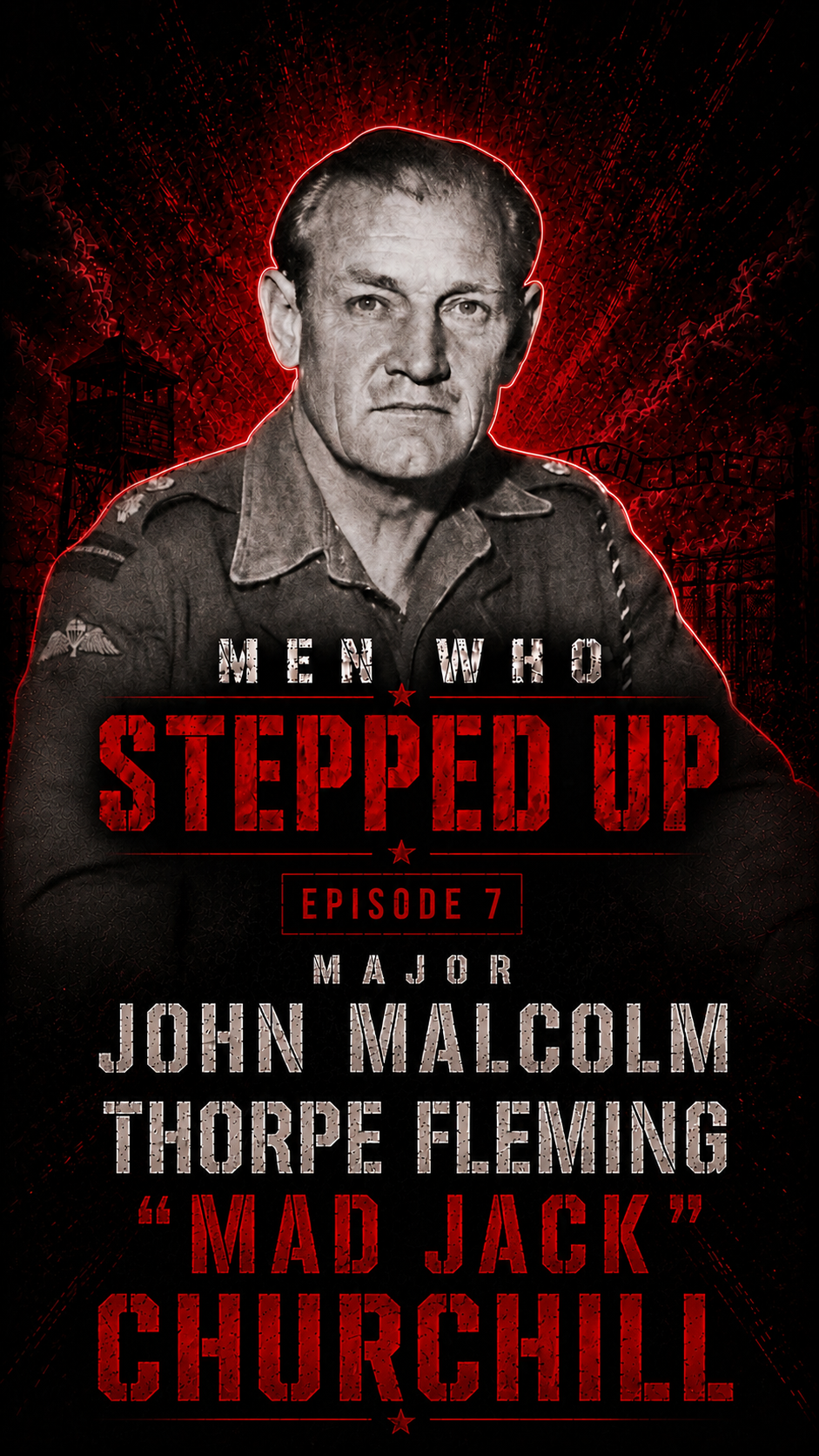
In 1940, as the most mechanised war in human history tore Europe apart, a British officer walked onto the battlefield carrying a longbow, a Scottish claymore, and a set of bagpipes.
His name was Jack Churchill. And he was not eccentric. He was not performing. He was entirely, deliberately, himself — and that turned out to be one of the most dangerous things the German Army ever encountered.
Who Was Mad Jack Churchill?
John Malcolm Thorpe Fleming Churchill was born in 1906 and spent his early career as a military officer, a model, a bit-part actor, and — improbably — a professional bagpipe player. He represented Great Britain in the 1939 World Archery Championships. He had mastered the medieval Scottish broadsword. He was, by any conventional measure, a man who had wandered in from a different century.
When the Second World War began, he wandered straight into it.
The Arrow That Started It All
The first extraordinary fact about Jack Churchill is also the one that stops people mid-sentence when they hear it.
He is believed to be the only soldier in the Second World War to have killed an enemy combatant with a bow and arrow.
In May 1940, during the retreat to Dunkirk, Churchill stood in a French village and loosed an arrow at a German sergeant. The sergeant fell. Churchill picked up his bagpipes and kept moving.
It was not a stunt. It was not a gesture. It was Jack Churchill doing what Jack Churchill did — bringing whatever he had to the fight, regardless of what century it belonged to.
The Claymore of Vaagso
If the arrow established Churchill as extraordinary, the raid on Vaagso in December 1941 made him a legend.
As his commando unit approached the Norwegian coastline under fire, Churchill stood at the bow of the landing craft playing Will Ye No Come Back Again on his bagpipes. When the ramp dropped, he leapt onto the shore, threw a grenade, and drew his claymore.
He led the assault personally, sword in hand, through burning streets and close-quarters combat that would have been familiar to a Highland warrior three centuries earlier.
He was awarded the Military Cross. He would add a bar to it before the war was over.
Capture, Escape, and the End of the War He Didn't Want to End
In 1944, Churchill was captured in Yugoslavia when his position was overrun. He was sent to Sachsenhausen concentration camp, then transferred as the war neared its end. He escaped twice. The second time, he walked over a hundred miles through the Austrian mountains before being liberated by American forces.
When the war ended, Churchill was reportedly furious.
"If it wasn't for those damn Yanks," he is said to have remarked, "we could have kept the war going another ten years."
Whether he said it exactly that way is disputed. That he felt it is not.
What Jack Churchill Actually Tells Us
It would be easy to treat Jack Churchill as a curiosity — a colourful footnote, a piece of trivia about a man who brought a sword to a gunfight.
That reading misses the point entirely.
Churchill was not confused about what war was. He was not unaware of machine guns or artillery or the industrial scale of the conflict around him. He made a choice — deliberate, considered, repeated across six years of combat — to bring his whole self to the fight. The bow. The sword. The pipes. Not despite the war, but inside it.
There is something in that which cuts deeper than eccentricity. Churchill understood something that the mechanised, systematised, bureaucratised war around him was in danger of losing — that the individual still mattered. That one person, fully committed, fully present, fully themselves, could still walk onto a beach playing bagpipes and change what happened next.
He was right. The men who followed him onto that beach at Vaagso did so because of what he was, not what he carried.
The TheDuskScribe Verdict
Jack Churchill is not a footnote. He is a thesis.
The thesis is this: that the Second World War was not only fought by armies and governments and industrial complexes. It was fought by individuals — people who brought everything they had, in whatever form that took, to moments that history would otherwise reduce to statistics.
TheDuskScribe exists to tell those stories. Churchill's is one of them. There are twenty-nine others like it — or close enough — in the reading list below.
If you believe these people deserve to be remembered, the list is a place to start.
Real stories. Real people. Real courage.
📖 Get the TheDuskScribe WW2 Reading List
30 hand-picked biographies and memoirs — complete with synopsis, author, and Amazon buy link.
Follow TheDuskScribe
Watch the story, stay connected, and explore more forgotten histories: