
Because the scammers are professionals. And most of us are not.
Think about the last time you got a text from a delivery company, an email from your bank, or a phone call from a government agency.
Did you stop to wonder - even for a second - whether it was real?
If you did, you are not alone. And if you didn't, that's exactly what scammers are counting on.
Online scams are no longer the clumsy, obvious emails full of spelling mistakes that were easy to spot. Today's scams are sophisticated, well-scripted, and specifically designed to target people who are careful, trusting, and unlikely to hang up.
The people most at risk are not naive.
They are intelligent adults who simply have never seen the script before the day it's used on them.
That is the problem ScamShield was built to solve.
What ScamShield Is
ScamShield is an interactive online safety guide - not a PDF you read once and forget, not an app that needs updating, not a subscription that charges you every month.
It is a single HTML file. You download it once. You open it in your browser. It works completely offline, on any device, for as long as you need it.
And it contains everything a person needs to recognise, respond to, and recover from an online scam.
$14.90 USD. One payment. Yours forever.
Five Editions — One for Every Country
Here is what makes ScamShield genuinely different from every other online safety resource available today.
Most scam awareness tools are generic. They talk about "phishing" and "fraud" in abstract terms that could apply anywhere. They rarely name the specific agencies, banks, and services that scammers impersonate in your country. They almost never give you the real phone numbers to call when something goes wrong.
ScamShield is built the other way around.
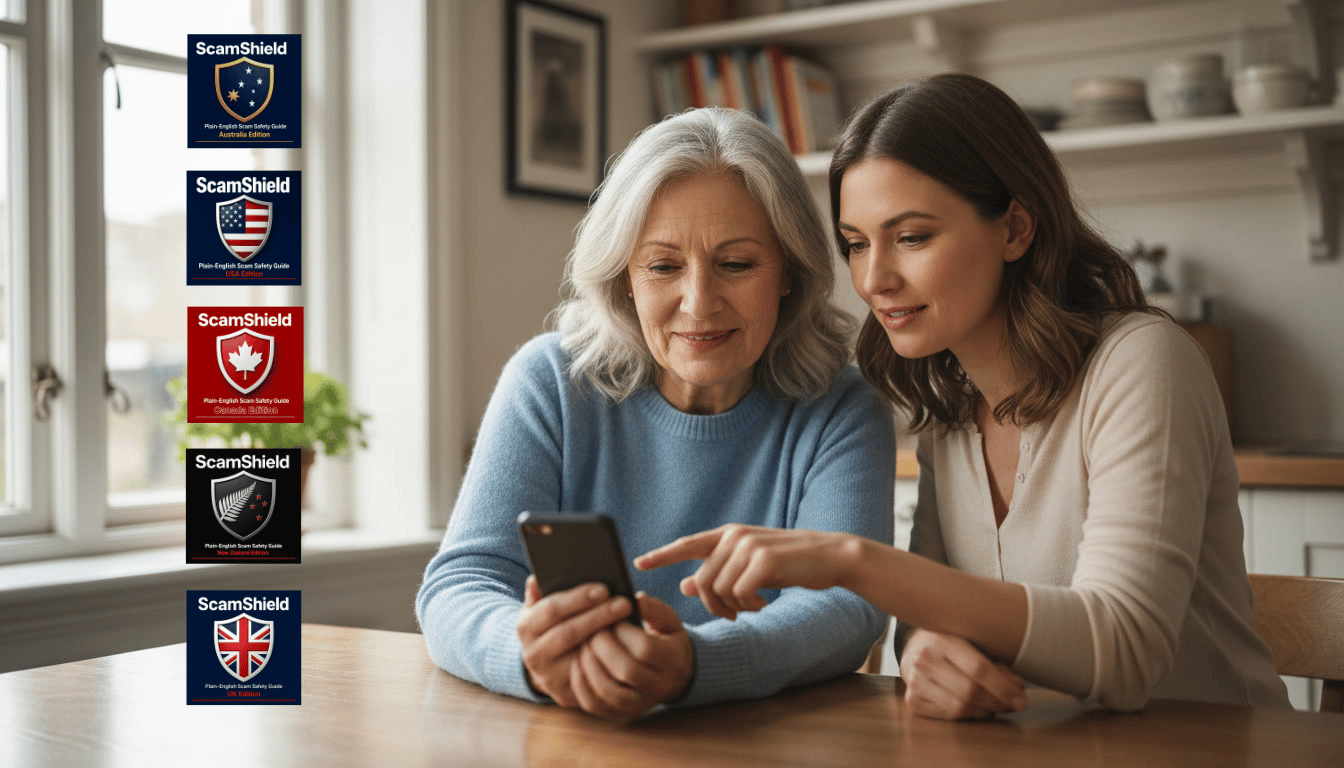
There are five fully localised editions — for Australia, the USA, the UK, Canada, and New Zealand.
Each edition is built from the ground up for its specific country. The scam scenarios use the real agencies that scammers impersonate in that country.
The red flags reference the real banks, postal services, and government departments your readers will recognise.
The emergency action guide contains verified, current contact numbers and resources for that country specifically.
No generic advice.
No "contact your local authorities." Real, specific, actionable guidance - finally, a comprehensive interactive tool created specifically for each country's agencies, services, and scam landscape.
Everything Inside ScamShield
📧 Spot the Scam — 7 Interactive Scenarios
Seven of the most common scam types, presented as realistic examples with the red flags highlighted directly in the text. Bank phishing emails. Government tax threat calls. Postal delivery texts. Health agency impersonation. Romance scams. Prize wins. Tech support pop-ups.
Each scenario shows you exactly what the scam looks like — the email, the text, the phone script — and then reveals every warning sign with a plain-English explanation of why it works and how to spot it.
The more examples you see, the more automatic recognition becomes. This is the core of what makes ScamShield work: it gives people the exposure they need before the real call comes.
✅ Is This a Scam? — Quick Checker
You just received something and it feels off. But you are not sure.
The Quick Checker is what you open in that moment. Tap what kind of contact you received — email, text, phone call, website, or online contact — and work through a plain-English checklist.
Each item is colour-coded: red for danger, orange for warning, green for reassurance.
At the end, a clear verdict. And exactly what to do next.
This is the section people will reach for most often. It is calm, clear, and gives a definitive answer when someone is standing in the kitchen holding their phone wondering whether to call the number back.
🎯 Scam Risk Score
Answer eight yes/no questions about a suspicious contact and receive an overall risk rating:
- Low Risk - few warning signs, stay alert
- Caution - some flags, don't act yet
- High Risk - Likely a Scam - stop all contact immediately
- Almost Certainly a Scam - stop everything right now
The score updates in real time as you answer. Answering yes to a critical red flag — being asked to pay with gift cards, being told to keep the contact secret — immediately pushes the score to the highest warning level.
It gives people the one thing they most need in that moment: someone telling them what to think.
🧠 Red Flags Quiz
Five real-world scenarios. Tap whether each one is a scam or a legitimate contact.
The answer and a full explanation reveal immediately — whether you got it right or wrong. Each explanation tells you exactly why the scenario is or isn't a scam, and what the specific red flags are.
This is the section people share. It is genuinely engaging, and it builds the pattern recognition that makes scam spotting instinctive rather than effortful.
Run through it with a parent or grandparent and it becomes a conversation - one of the most useful conversations you can have with someone you care about.
🆘 What To Do Now — Emergency Action Guide
This is the section that could save someone's life savings.
If you have just realised you have been scammed — or you think you might have been — you need to know what to do in the next ten minutes. Not tomorrow. Not after you've calmed down. Right now.
ScamShield gives you five emergency pathways based on exactly what happened:
- Sent money - who to call first, in what order, and what to say
- Gave bank details - how to protect your accounts immediately
- Gave computer access - what to do before you reconnect to the internet
- Shared personal details - which agencies to contact and in what order
- Clicked a link - whether you need to worry and what to check
Each pathway gives a numbered action sequence in priority order. The most urgent steps are clearly marked. And every step is in plain English - no jargon, no assumptions, no "contact the relevant authority." In every edition, this section contains the actual, verified contact numbers for that country's key agencies - the scam reporting service, the identity theft support line, the tax authority, the cybercrime centre, and the credit bureaus.
You will not be told to search for a number at the moment you most need it.
📋 Golden Rules
The eight things you should never do. The eight things you should always do.
Simple. Clear. Printable. These rules cover the vast majority of scam situations if followed consistently. They work as a standalone reference - laminate them and put them on the fridge — but they are most powerful as a summary of everything the guide has taught.
🔐 Passwords and Account Safety
Plain-English advice on the one habit change that prevents more account compromises than anything else: using a different password for every account.
The three-word formula: memorable, strong, and dramatically better than a birth date or a pet's name. Why adding a number and a symbol matters.
And a plain-English introduction to password managers, and the built-in password manager on Apple devices — with a practical suggestion on how to set one up.
📞 Who To Call
A complete, verified contact directory for every key agency in the guide's specific country edition.
Your bank.
The national scam reporting service.
The identity theft support line.
The tax authority.
The cybercrime centre.
The credit bureaus.
Every number is current and verified at time of publication. And the disclaimer is honest: details change, and readers are encouraged to verify through official government websites if any time has passed since purchase.
Who ScamShield Is For
Seniors are the primary audience - and the primary beneficiary.
Adults over 60 are consistently the most targeted group by scammers, and consistently the group that loses the most per incident. Not because they are naive. Because they are polite, trusting, and unlikely to hang up on someone who sounds official.
ScamShield respects that. The design is built for phone screens: large text, high contrast, tap targets that are easy to use. The language is plain English throughout - no jargon, no condescension, no assumption of technical knowledge. It is the kind of tool a trusted family member would hand someone and say:
"This will help."
But ScamShield is genuinely useful for everyone. If you have ever wondered whether an email was real, whether a text was legitimate, or whether a call was from who it claimed to be - this guide will make you better at answering those questions. Faster. More confidently. And with less anxiety.
The Best Way to Use ScamShield
Buy it. Open it yourself first. Work through the Red Flags Quiz - it takes about ten minutes and will probably surprise you at least once.
Then sit down with a parent or grandparent and go through the Spot the Scam scenarios together.
Read the scripts out loud. Talk about the red flags. Run through the Quiz together.
This is the most effective way to transfer the knowledge — not by handing someone a guide and hoping they read it, but by having the conversation.
ScamShield is designed to be that conversation starter. The scenarios are realistic enough to be genuinely unsettling. The explanations are clear enough to make the patterns stick.
One sitting. Ten years of scam resistance.
Why This Is Different From Free Resources
Free scam awareness resources exist - government websites, consumer protection pages, nonprofit articles. They are genuinely useful. And none of them are with you in the parking lot when you're about to read out gift card numbers to someone who sounds like a government officer.
ScamShield works offline. It is on your phone. It gives you a verdict when you need one. And it gives you a step-by-step action plan for the moment after - when you have just realised what happened and you have no idea where to start.
No free webpage does all of that. No PDF does all of that. No generic awareness campaign does all of that.
ScamShield does.
Five Editions. One Price.
🇦🇺 ScamShield - Australia EditionFully localised for Australian agencies, scams, and contacts |
🇺🇸 ScamShield - USA EditionFully localised for US agencies, scams, and contacts
🇬🇧 ScamShield - UK EditionFully localised for UK agencies, scams, and contacts
🇨🇦 ScamShield - Canada EditionFully localised for Canadian agencies, scams, and contacts
🇳🇿 ScamShield - New Zealand EditionFully localised for NZ agencies, scams, and contacts
Each edition: USD $14.90. One payment. No subscription. Works offline forever.
The Number That Makes This an Easy Decision
Scammers targeting older adults are professionals. They run scripts they have used thousands of times. The average financial loss when a scam succeeds can reach tens of thousands of dollars.
ScamShield costs USD $14.90.
One prevented scam - one moment where someone recognises the script, puts down the phone, and calls a family member instead, pays for this guide more times than you can count.
Buy it for yourself. Buy it as a gift. Forward the download link to someone you care about.
It might be the most useful USD $14.90 you spend this year.
ScamShield is a resource by The Ideas Bunker · theideasbunker.com · © The Ideas Bunker 2026