
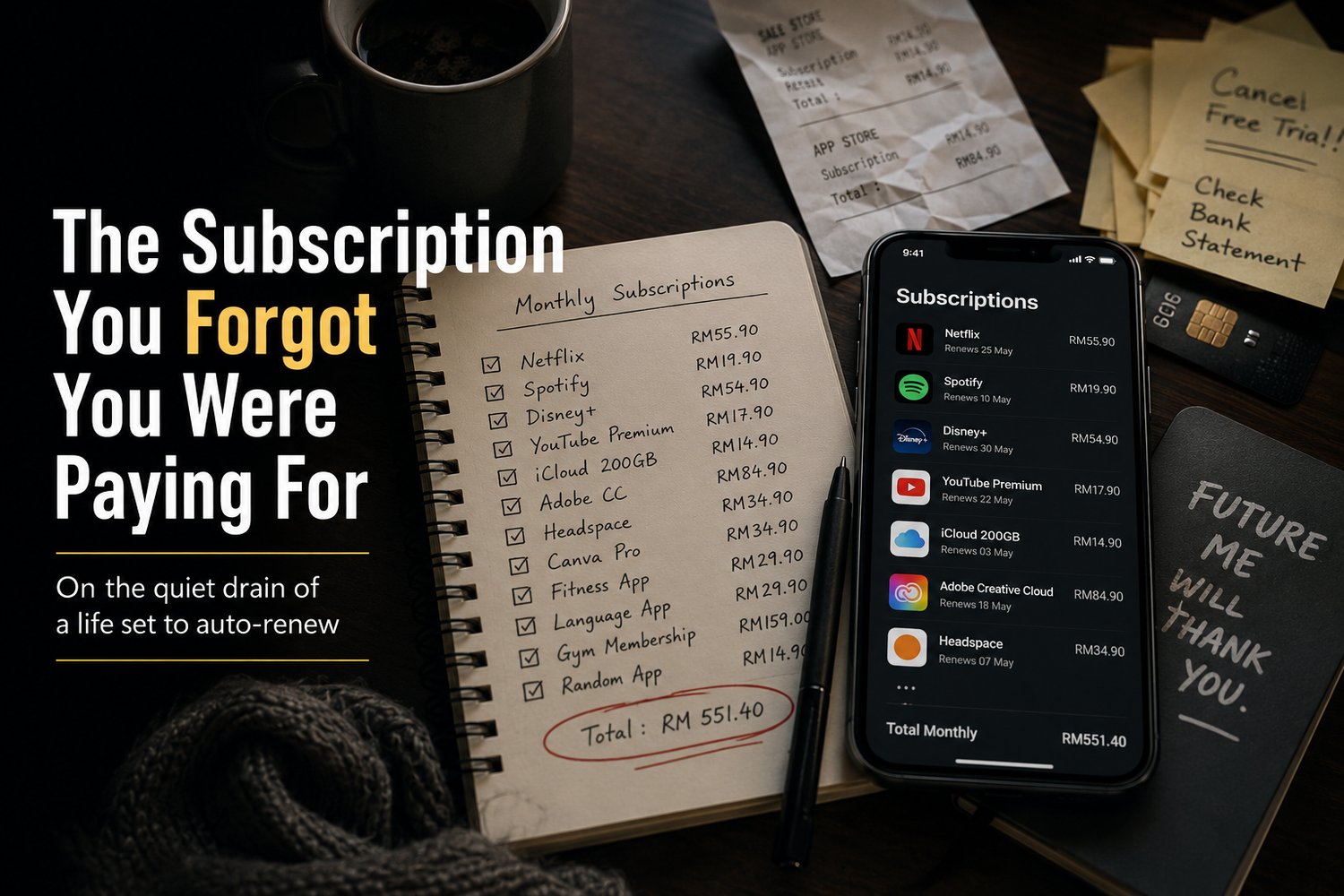
The Subscription You Forgot You Were Paying For
On the quiet drain of a life set to auto-renew
Somewhere on your phone right now there is an app you are paying for that you have not opened since March.
You know this.
Not in a clear, conscious way. More in the way you know your car needs a service or that there is something in the fridge you should probably deal with. A background awareness that sits just underneath the surface of daily life, never quite urgent enough to act on, never quite dismissible enough to fully ignore.
You have not done the thing where you sit down and count them all up.
Because the thing where you sit down and count them all up requires a specific kind of calm administrative energy that modern life does not consistently produce. It requires a Tuesday evening where you are not exhausted, not behind on something else, not telling yourself you will do it properly at the weekend when you have more headspace.
The weekend comes. The headspace does not.
So the app renews. Quietly. Automatically. While you do other things.
Think about what you paid for last month.
Not the obvious ones. Not the rent or the groceries or the things you actively chose and consciously spent. The other ones. The ones that left your account without a decision being made, because the decision was made a long time ago in a different life phase and has simply been continuing on your behalf ever since.
The streaming service you added for one specific series. The series ended. The subscription did not.
The music app you signed up for during a free trial that required a card number and which you meant to cancel on day six and did not, because day six was a Thursday and you had a difficult meeting and by Friday you had forgotten the trial existed.
The cloud storage upgrade you bought when your phone ran out of space two years ago. The storage is still there. You are not entirely sure what is in it.
The meditation app. The language learning app. The fitness app from the productive phase in February that lasted eleven days and cost you fourteen dollars a month for the eight months following it.
The gym.
The gym deserves its own paragraph.
Not because it is the most expensive subscription. But because it is the most specifically, universally understood one.
There is almost no one with a gym membership who is fully honest about how often they go. The membership exists in a strange quantum state where you are technically a person who goes to the gym while simultaneously being a person who has not gone since before your friend's wedding in September.
The monthly charge is not really for the gym at this point.
It is for the version of yourself that goes to the gym. The one who wakes up at 6am with genuine intention rather than the kind that disappears the moment the alarm actually goes off. The one who has a bag packed the night before and a routine and some level of consistency that the current version of you recognises as admirable and aspirational and not yet real.
At twelve dollars a month, this is a fairly affordable self-image.
At sixty, it starts to feel like an expensive relationship with a building that does not know you exist.
The streaming situation has become its own particular kind of comedy.
Five years ago the pitch was simple and genuinely compelling. Everything in one place. One reasonable monthly fee. The end of cable television and its hundred channels of nothing.
Then the content got divided up. Then every studio decided it needed its own platform. Then the exclusives arrived and the price went up and the thing you actually wanted to watch moved to the one service you do not have and you added it temporarily and then forgot to remove it and now you have four services and spend twenty minutes every evening deciding what to watch across all four before settling on something you have already seen or giving up entirely and looking at your phone instead.
You are paying for the paralysis. Every single month.
There is a specific moment most people have had at least once.
You are checking your bank statement. Not because you do this regularly and with discipline. Because something made you look. A balance that seemed lower than expected. A number that did not quite add up.
And you see a charge you do not immediately recognise.
You stare at it for a moment. You think. And then slowly, like something surfacing from a long way down, it comes back to you.
Oh. That.
Something you signed up for during a specific life phase that has since ended. A version of yourself that needed that particular thing for reasons that made complete sense at the time and which now require a moment of archaeology to even recall. Something that has been quietly renewing in the background of your life while your life was busy becoming something else.
You feel a brief, specific embarrassment. Not about the money exactly. About the time. About how long it was renewing without you noticing. About the fact that you are a reasonably intelligent adult who has somehow been paying for something for seven months without once being reminded it existed.
Then you cancel it. And you feel, genuinely and briefly, good.
Which is interesting in itself. That small act of looking clearly at something and dealing with it produces a satisfaction disproportionate to the size of the action. Not because of the money saved, though that is real. Because you looked at something you had been avoiding and it turned out to be manageable. It was never as difficult as the energy spent not doing it.
The subscription economy did not make you careless.
It was specifically designed for you to not notice.
Signing up takes thirty seconds. The free trial requires a card number. The charge is small enough to pass below the threshold of conscious attention. The cancellation process involves three confirmation screens and a question asking if you are sure and a final screen offering you a discounted rate that you have to actively decline.
The asymmetry is not accidental. It is business strategy. The industry even has a name for the gap between your intention to cancel and your actual cancellation. Passive churn prevention. You are not forgetful. You are being kept.
Every subscription that runs past its usefulness is not a personal failing. It is a product working as designed.
Here is the thing about the audit nobody does.
It takes about twenty minutes. One cup of tea. A bank statement or a card statement going back three months. A piece of paper or a notes app.
Write down every recurring charge you find. Every one. Including the ones you recognise and definitely want to keep. Get the full picture first before you start making decisions.
For most people, the number at the bottom of that list is surprising. Not catastrophic. Just larger than expected. A number that, if it arrived as a single annual bill rather than twelve small monthly ones, would have caused genuine reconsideration before being agreed to.
Then go through the list and ask one question about each item.
If I had to sign up for this again today, knowing what I know about how much I use it, would I?
Not whether it was a good idea at the time. Not whether you might use it more in future. Whether, today, with clear information and a calm moment, you would choose it.
The ones that survive that question are the ones worth keeping.
The ones that do not survive it have been surviving on inertia. On the gap between your intention and your calendar. On a business model that depends on you never quite getting around to this exact exercise.
The relief of the audit is not primarily financial.
Though it is financial. Cancelling two or three things you genuinely do not use is real money back. Over a year, meaningful money.
But the feeling that follows is something slightly different from financial satisfaction. It is the feeling of having looked at something clearly instead of letting it run in the background indefinitely. Of having made an active choice rather than letting the default continue.
Modern life is full of defaults. Subscriptions that renew. Habits that continue. Arrangements that persist because stopping them requires a decision and the decision keeps getting deferred. The subscription audit is a small act but it is a conscious one. And conscious, in a life that generates a great deal of unconscious expenditure of time and money and attention, is worth something.
You are not disorganised.
You are living in an economy that was deliberately structured to benefit from your disorganisation. That designed its products to be easy to acquire and effortful to release. That priced its charges below the threshold where they register as worth dealing with individually and above zero, so they accumulate quietly into something significant.
Understanding that changes the way the embarrassment sits.
You were not careless. You were in an environment engineered for exactly this outcome.
The difference between those two things matters. Because careless is a character assessment. Engineered environment is a condition you can simply decide to examine more often.
Once a year. One Tuesday evening. One cup of tea and a bank statement.
It will not fix everything.
But it will fix this one thing. And this one thing, quietly, is costing more than it should.