

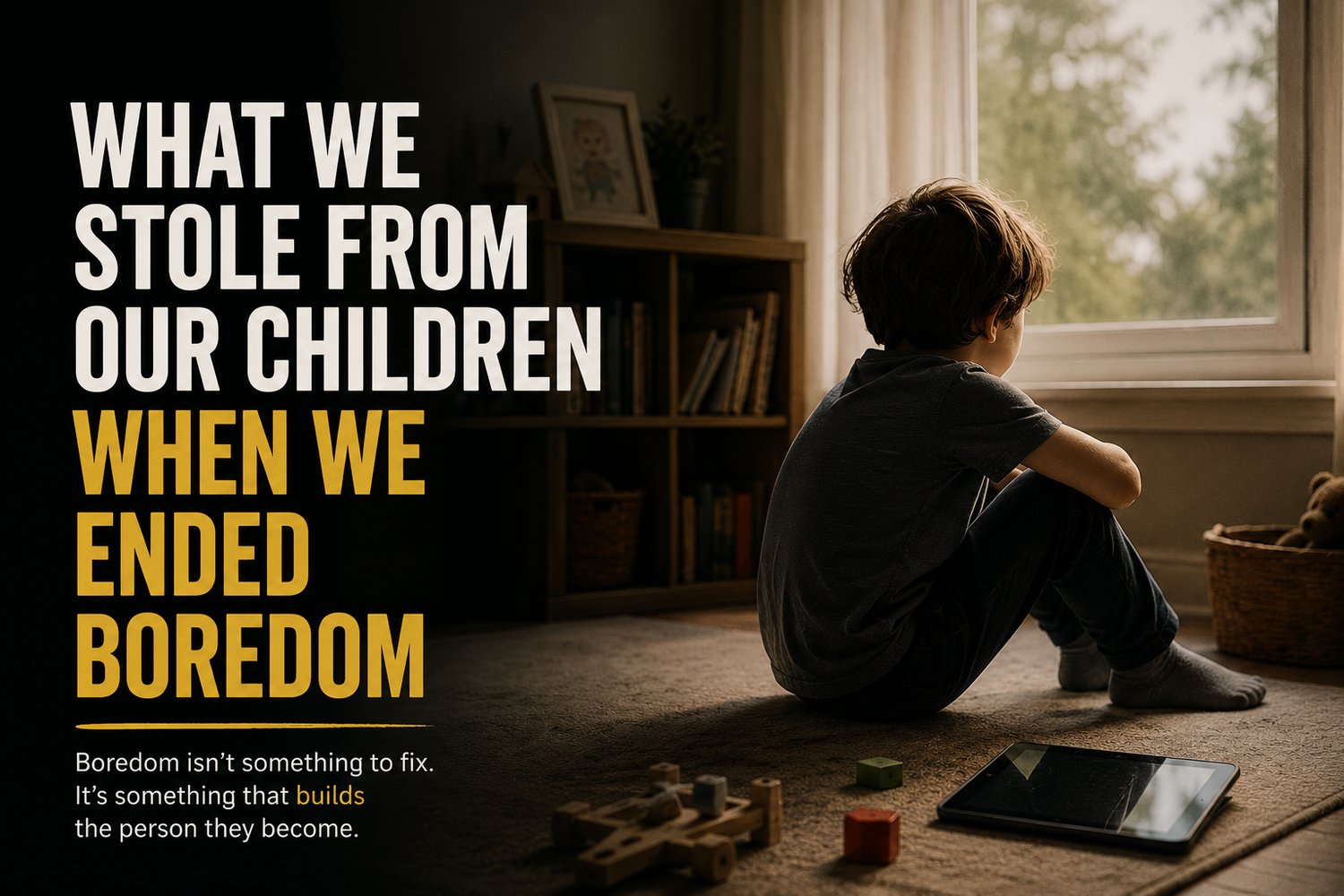
There is a moment every parent knows.
Your child is bored. You have suggested the garden, a book, going outside, anything. The suggestions have been rejected. The complaints have escalated. The mood in the house is deteriorating, and you are tired and the solution is sitting right there on the coffee table.
So you hand them the device.
And the boredom stops.
And for a moment, everything is peaceful.
That moment feels like a small victory. A practical solution to a manageable problem. Nobody in that moment is thinking about developmental psychology or the long-term architecture of a child’s inner life. You are thinking about the next ten minutes. And for the next ten minutes, everything is fine.
What I want to talk about is what happened in the ten minutes before you handed it over. And what was building there, quietly, that we interrupted without knowing what it was.
Boredom was never the problem
We have spent the last fifteen years treating boredom as something to be solved.
An unpleasant state. A gap to be filled. An inconvenience that modern technology has mercifully made easier to manage.
But developmental psychology tells a different story entirely.
Boredom is a motivational state. When the mind finds its current environment insufficiently engaging, it generates increasing internal pressure toward something more meaningful. It is not the absence of something. It is the presence of something. A developmental push. A signal that the brain is ready to create, to invent, to reach inward and find something that was not there before.
The neuroscience confirms this in a way that should give every parent pause.
When a brain is bored, the default mode network becomes highly active. This is the network responsible for consolidating memory, processing emotional experience, generating creative thinking, and constructing the ongoing narrative of selfhood that underlies psychological identity. It is not a secondary or peripheral function. It is among the most important things the brain does.
And it happens primarily in conditions of quiet, undemanding, unstimulated time.
The kind of time that used to be called a boring afternoon.
What a summer without screens looked like
Imagine a seven-year-old boy sent to stay with his grandparents at a farmhouse one summer. No television. No video games. No friends nearby.
For the first five days, he is in agony. He follows his grandmother around the kitchen asking when they are going home. He lies on the porch and stares at the sky as though it has personally offended him.
On the sixth day, something changes.
He finds a box of old magazines in the basement and spends two days cutting out photographs of cars and aeroplanes, building an elaborate imaginary world on the floor. He discovers a creek behind the property and spends a week constructing and rebuilding dams. He starts a journal, not because anyone suggested it, but because ideas have begun accumulating faster than he can hold them.
He cries when they go home.
This is not a story about a simpler time. It is a case study in what boredom does to a developing brain when it is allowed to run its full course. The agony first. Then the creativity. And the creativity was only possible because of the agony that preceded it.
The empty afternoon is almost gone
For the entirety of human history until approximately 2010, boredom was simply part of childhood. Not a problem to be designed away. A fact, as unremarkable as hunger or fatigue.
Children were regularly and unavoidably bored. They had long stretches of time with nothing structured to fill them. They waited. They sat. They invented things to do because there was nothing else to do.
Today, children aged eight to twelve spend an average of five hours per day on entertainment screens. Teenagers exceed eight hours. After sleep, school, and basic daily activities, almost no discretionary time remains.
The long, directionless afternoon a feature of every childhood until very recently has become a rarity approaching extinction.
And with it, something that cannot easily be replaced has quietly disappeared.
Three things boredom was building
The first thing boredom was building was distress tolerance.
The ability to sit with discomfort without immediately seeking relief is one of the strongest predictors of adult psychological wellbeing. A person who can tolerate uncomfortable feelings, who does not require instant escape from every difficult emotion, is a person who can persist through difficulty, maintain relationships through conflict, and pursue long-term goals in the face of short-term frustration.
Boredom was the training ground for this. The repeated experience of feeling uncomfortable and discovering, without intervention, that the discomfort eventually passes and you are still intact on the other side.
The second thing boredom was building was intrinsic motivation.
A bored child with no device must eventually generate an internal solution. They must reach into themselves and find something. An idea. An impulse. An interest that belongs entirely to them. This process of reaching inward is the foundation of the capacity to want to do something for its own sake rather than for an external reward. It is, arguably, the foundation of a satisfying life.
The third thing boredom was building was the capacity to be alone.
The ability to find your own company sufficient. To sit with your own thoughts without panic. To be temporarily unconnected from others and discover that this is survivable and sometimes surprisingly rich. This capacity is increasingly rare in the connected age, and its absence shows up in adults who cannot eat a meal without a screen, cannot wait ten minutes without a phone, cannot sit quietly with themselves for any length of time without a creeping anxiety they cannot name.
That anxiety was supposed to be practiced away in childhood. In all those long afternoons that no longer exist.
The device was designed for that exact moment
Here is the thing that matters most about the moment of surrender.
The device was not a neutral alternative to boredom. It was engineered specifically to be handed over at exactly that moment.
The apps on that phone were built by talented engineers and behavioral scientists. They were built specifically to outcompete every boring alternative, every time. They were calibrated to provide immediate, compelling reward at the precise moment a child’s boredom peaks.
You were not choosing between a phone and a book. You were choosing between a phone engineered by billions of dollars of research to be maximally compelling, and a book that simply sits there requiring effort and offering delayed reward.
It was not a fair fight. It was never designed to be.
Every time a child’s boredom is resolved by a device rather than by the child themselves, something small is lost. The distress tolerance muscle, which can only be built by tolerating distress, remains unexercised. The capacity for intrinsic motivation, which can only develop when it is required, does not develop.
These are small losses individually.
They are significant losses accumulated over years of daily moments of surrender.
The hopeful truth
Children have not lost the capacity for creative boredom. It has simply been suppressed by an environment that has never required it.
Remove the environment, even briefly, and the capacity returns with remarkable speed.
Studies of family holidays in device-free environments, schools with comprehensive technology bans, and summer camps that prohibit smartphones all document the same arc. Day one or two: restlessness, complaints, aimless searching for stimulation. Day three or four: something changes. The restlessness settles. Children start finding things to do. They seek each other out. They invent games. They explore physical environments with a curiosity that was absent when a device was available. By the end of a week, the children who complained loudest are often the most resistant to leaving.
The creativity was always there. It was simply crowded out.
This matters enormously. It means the task ahead is not to repair something broken in our children. It is to remove an obstacle that has been placed in front of something intact.
One thing worth trying
Leave one thirty-minute stretch in your child’s day genuinely empty this week.
No suggestions. No device. No rescuing. Just thirty minutes of nothing to do.
Notice what happens after the first ten minutes of complaints.
You might be surprised what they build.