
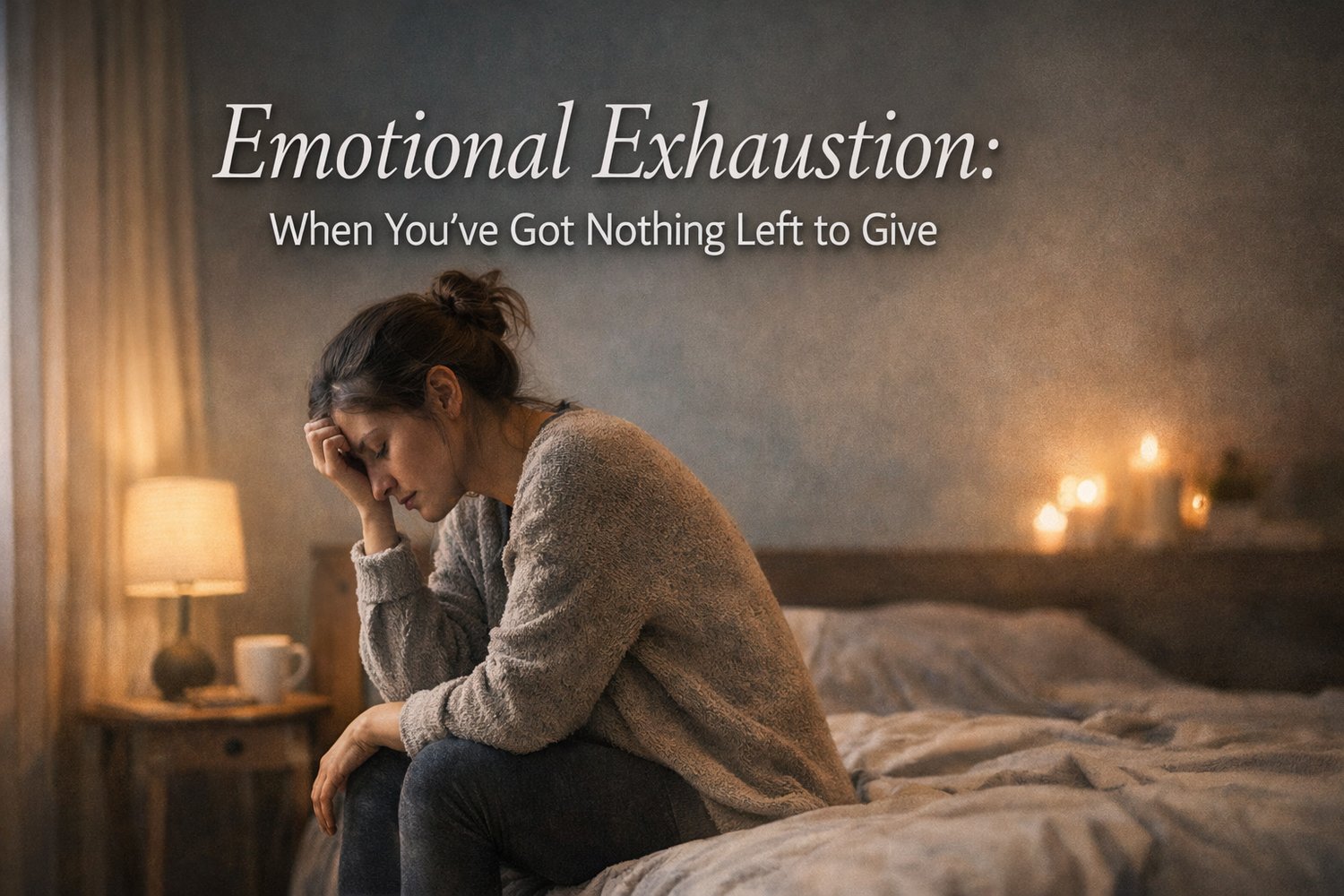
There’s a particular kind of tired that sleep doesn’t fix. You wake up after eight hours and still feel heavy. You look at your to-do list and feel nothing—not motivation, not resistance, just a blank numbness. Someone asks how you’re doing and you can’t even muster the energy to pretend anymore.
This isn’t laziness. It isn’t weakness. This is emotional exhaustion, and it’s your whole system waving a white flag.
What Emotional Exhaustion Actually Is
Emotional exhaustion is what happens when you’ve been running on fumes for so long that you’ve burned through your reserves and started consuming the infrastructure itself. It’s a state of depletion so profound that even basic emotional responses feel impossible.
You’re not sad, exactly. You’re not even necessarily anxious, though anxiety might have brought you here. You’re just… empty. Depleted. Done.
It’s different from physical tiredness, though the two often overlap. Physical exhaustion responds to rest—sleep, sitting down, taking a break. Emotional exhaustion is deeper. It’s a kind of tiredness that lives in your bones, that colors everything gray, that makes you feel disconnected from yourself and everyone around you.
Psychologists recognize emotional exhaustion as a core component of burnout, but it can exist on its own too. It’s what happens when your emotional resources have been stretched too thin for too long without adequate replenishment.
What It Feels Like
Emotional exhaustion wears different faces, but some experiences are common:
Everything feels harder than it should. Tasks that used to be automatic—responding to messages, making dinner, having conversations—now require enormous effort. You find yourself staring at your phone, unable to summon the energy to type a simple reply.
You feel disconnected from things you used to care about. Hobbies don’t interest you. Plans with friends feel like obligations. You can’t remember the last time you felt genuinely excited about anything. The flatness is sometimes more disturbing than sadness would be.
Your patience is gone. You snap at people you love. Small annoyances feel catastrophic. You have no buffer left between stimulus and reaction, so everything gets an outsized response or no response at all.
You can’t access your feelings properly. You might cry at commercials but feel nothing during actually significant moments. Or you might feel completely numb, like you’re watching your life through thick glass. Your emotional responses feel either excessive or absent, never quite right.
Decision-making becomes overwhelming. Should you have coffee or tea? It feels impossible to decide. Every choice, no matter how small, feels like it requires energy you simply don’t have.
You fantasize about escape. Not necessarily anything dramatic, but you catch yourself daydreaming about disappearing, quitting everything, moving somewhere nobody knows you, or just sleeping for a month straight.
Physical symptoms show up. Headaches, muscle tension, digestive issues, frequent illness. Your body is participating in the exhaustion because emotional depletion is physical depletion.
How You Got Here
Emotional exhaustion doesn’t typically come from a single source. It’s cumulative—the result of too much demand and too little recovery over an extended period. Some common contributors:
Caretaking without support. Whether you’re caring for children, aging parents, a sick partner, or simply being the person everyone leans on, caretaking is emotionally intensive work. When you’re constantly attuned to others’ needs while your own go unmet, exhaustion is inevitable.
High-stress work environments. Jobs that require constant emotional regulation—healthcare, teaching, customer service, social work—drain your emotional resources. So do workplaces with unrealistic demands, toxic dynamics, or a culture that glorifies overwork.
Ongoing grief or loss. Loss isn’t always about death. It can be divorce, friendship breakups, health changes, dreams that didn’t pan out. When you’re navigating grief while still maintaining normal life, the emotional load is enormous.
Chronic anxiety or depression. Living with ongoing mental health challenges is exhausting even when you’re managing them well. The constant effort to regulate, cope, and function takes a toll.
Lack of boundaries. When you can’t or don’t say no, when you absorb everyone else’s emotions, when you take responsibility for things that aren’t yours to carry, you leak energy constantly.
Trauma or chronic stress. When your nervous system has been in survival mode for extended periods, it burns through resources at an unsustainable rate. Eventually, there’s nothing left.
Absence of joy and restoration. Maybe life has been wall-to-wall responsibility with no space for play, pleasure, creativity, or rest. You’ve been producing and managing and coping with no time to simply be.
Why Rest Isn’t Enough
People often tell the emotionally exhausted person to “just rest” or “take a vacation.” While rest is necessary, emotional exhaustion requires more than a weekend off or even a week at the beach.
Physical rest helps with physical tiredness. Emotional exhaustion needs emotional restoration, which is different. It requires safety, space to feel without performing, connection that doesn’t demand anything from you, and time to let your nervous system actually settle rather than just pause before revving up again.
A vacation where you’re still checking work emails, managing family dynamics, or worrying about everything waiting for you when you return isn’t restorative. Neither is time off spent feeling guilty about resting or anxious about falling behind.
True restoration requires removing or reducing the sources of depletion while simultaneously adding genuine nourishment. That’s a much bigger ask than a long nap.
What Actually Helps
Recovery from emotional exhaustion isn’t quick or linear, but it is possible. Here’s what makes a difference:
Acknowledge the exhaustion without judgment. Stop telling yourself you should be able to handle more, do better, push through. You’re exhausted because you’ve been handling too much for too long. That’s not a moral failing—it’s a consequence of being human in challenging circumstances.
Radically reduce demands wherever possible. Look at your life and ask: what can be eliminated, delegated, postponed, or simplified? You need to create breathing room, and that means letting some things go or be imperfect. The dishes can wait. Plans can be canceled. Standards can be lowered temporarily.
Protect your energy fiercely. If someone or something consistently drains you without replenishing anything, consider whether that relationship or commitment needs to change. This isn’t selfish—it’s survival. You’re in triage mode, and triage means prioritizing what keeps you alive.
Find moments of genuine ease. Not productivity disguised as rest, but actual ease. Lying in the sun. Petting an animal. Listening to music you love. Watching something that makes you laugh without thinking about what you should be doing instead. These moments might feel insignificant, but they’re deposits in an empty account.
Let yourself feel what you’re feeling. Emotional exhaustion often includes a backlog of unfelt feelings. When you have even a bit of space, emotions might surface—grief, anger, disappointment, loneliness. Let them. Not performing or bypassing your feelings is part of restoration.
Seek co-regulation. Spend time with people who help you feel calm and safe, not people who need you to be “on.” Sometimes this is a quiet conversation. Sometimes it’s just sitting together. The human nervous system regulates through safe connection, and exhaustion responds to this in ways nothing else can match.
Consider professional support. A therapist can provide the kind of space and support that helps you process what’s underneath the exhaustion. Sometimes we need help from someone whose job it is to hold space for us, not someone we also have to take care of.
Address the root causes when you can. Once you have a bit more capacity, look at what got you here. What needs to change long-term? Maybe it’s a job situation, a relationship dynamic, your approach to boundaries, or untreated mental health concerns. Sustainable recovery requires addressing the sources, not just managing symptoms.
Practice micro-restorations throughout your day. You don’t need an hour for meditation. Ten conscious breaths. A moment with your face to the sun. Stretching between meetings. These tiny moments of return to yourself add up.
The Permission You’re Waiting For
If you’re emotionally exhausted, you might be waiting for permission to do less, to prioritize yourself, to admit you can’t keep going at this pace. Here it is: you’re allowed to be tired. You’re allowed to have limits. You’re allowed to stop performing wellness or resilience or capability when you feel none of those things.
You’re allowed to cancel commitments, to say no, to take up space, to need more than you’re currently getting. You’re allowed to be a human with finite resources rather than an endless well everyone else draws from.
The world will tell you to push through, to be grateful, to remember others have it worse, to hustle harder. The world is often wrong about what humans actually need to survive and thrive.
What Recovery Looks Like
Recovery isn’t a straight line back to your old self. You might not return to who you were before the exhaustion, and that’s okay. Sometimes emotional exhaustion breaks you open in ways that, eventually, allow you to rebuild more sustainably.
You’ll have good days where you feel almost normal, followed by days where you’re back in the exhaustion. That’s not failure—it’s how recovery works. Your capacity is rebuilding gradually, and there will be setbacks.
Eventually, you’ll notice small shifts. A hobby sounds mildly interesting again. You laugh without it feeling forced. You make a decision without agonizing. You feel something—maybe just a flicker, but something.
These moments are evidence that your system is remembering how to do more than just survive. Trust them, even when they’re brief.
The Deeper Truth
Emotional exhaustion is often treated as an individual problem requiring individual solutions. But frequently, it’s a reasonable response to unreasonable circumstances. To systems that demand too much. To cultures that offer too little support. To expectations that humans should function like machines.
Yes, you need to take care of yourself and make changes where you can. But you also need to know that your exhaustion makes sense. It’s not a personal failure. It’s what happens when people are asked to carry more than humans are designed to carry without adequate rest, support, and replenishment.
You’re not broken. You’re depleted. And depletion, with time and care and significant changes, can heal.
The exhaustion is information. Listen to it. It’s telling you something important about what you need, what needs to change, and what you deserve. And you deserve so much more than running on empty while pretending everything is fine.