
Struggling with weight loss despite motivation? Learn how fear, secondary gain, and subconscious self-protection sabotage change — and how to release it safely.
You’ve done it again.
Monday morning, you swore this was the week. You meal-prepped. You bought the gym membership. You cleared the pantry. By Wednesday night, you’re elbow-deep in a bag of chips, asking yourself:
“What is wrong with me?”
You tell yourself you lack willpower. Discipline. Strength. That you’re broken somehow.
But here's what most weight-loss advice gets wrong:
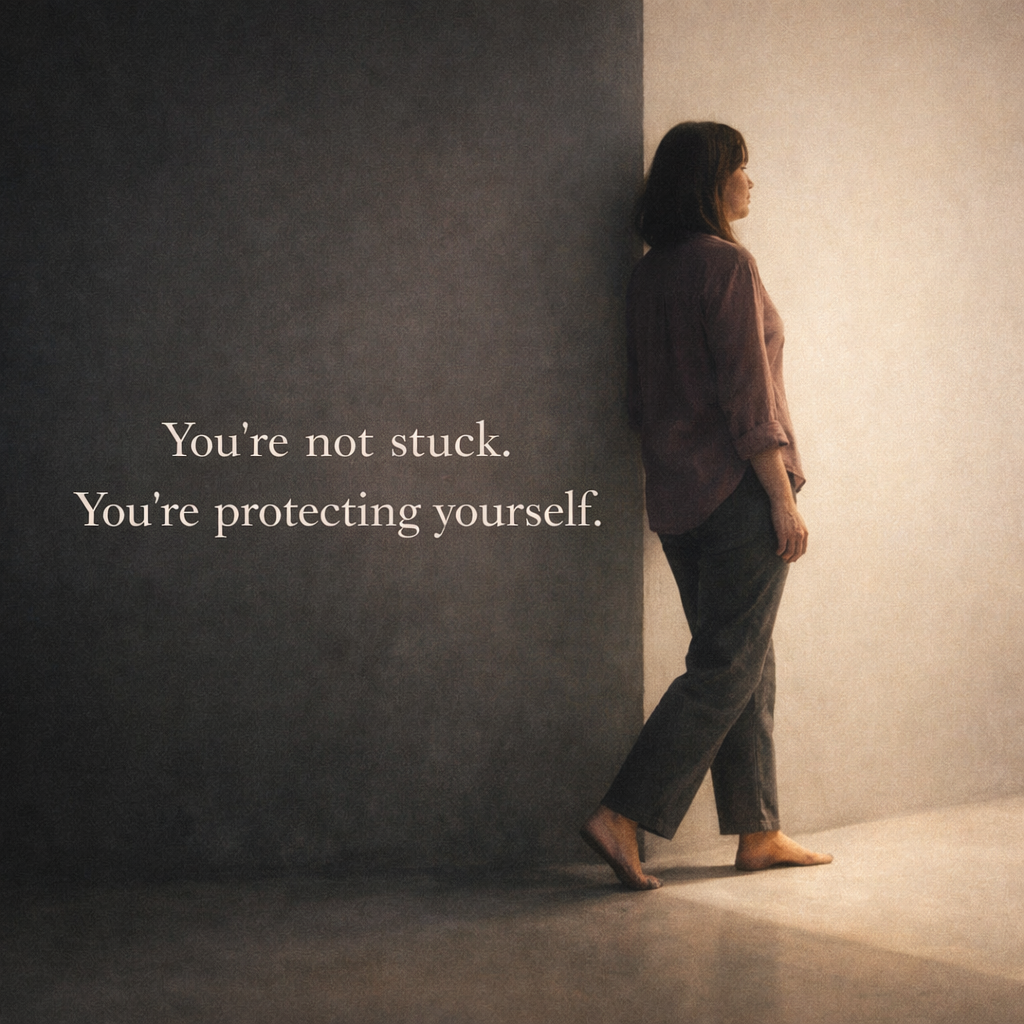
You’re not broken. You’re protecting yourself.
And until you understand what you’re protecting yourself from, motivation will never be enough.
The Pattern Behind Weight Loss Self-Sabotage
If this feels familiar, you’re not alone:
Week 1: You’re focused and committed.
Week 2: Progress. Compliments. Hope.
Week 3: Stress, a social event, one “exception.”
Week 4: You’re off track again. Shame creeps in.
Week 5: “I’ll start over on Monday.”
This cycle isn’t caused by laziness or lack of discipline. It’s driven by fear-based self-protection.
Your conscious mind wants change. Your subconscious mind wants safety.
And safety almost always wins.
What Self-Sabotage Really Is (And Why Willpower Fails)
Self-sabotage isn’t a flaw in your character.
It’s a protective strategy. Your nervous system isn’t designed to make you thin, confident, or successful.
It’s designed to keep you safe.
Safe often means familiar — even when familiar hurts.
So your system runs this equation:
- Current body = known territory = predictable = safe
- Weight loss = unknown territory = uncertainty = threat
When you start changing, your system senses risk and pulls you back.
Not because you’re weak. Because you are human. You were created to evolve, grow, adapt.
The Hidden Driver: Secondary Gain
In psychology, this pattern is often referred to as secondary gain, the unconscious benefit you receive from staying stuck, even when you consciously want change.
Your weight isn’t just weight.
It’s serving a purpose.
I know - totally contrary to what makes sense, right? But, remember, the purpose is safety, and safety isn't speaking from a place of logic.
The 5 Most Common Secondary Gains Around Weight
And, no, this is not a full, exhaustive list. The more aware you become of these patterns, the more you begin to recognize some of the other hidden beliefs that we adopt, no matter how contrary they are to what we want.
1. Protection From Being Seen
Visibility can feel unsafe when attention has meant judgment, pressure, or harm.
Hidden belief: If I stay invisible, I’m safe.
2. Protection From Intimacy
Closeness can trigger fear when vulnerability hasn’t felt safe before.
Hidden belief: If I’m not desirable, I don’t have to risk getting hurt.
3. Protection From High Expectations
Success removes excuses — and raises the bar.
Hidden belief: If I stay “almost there,” no one expects too much.
4. Protection From Facing Deeper Problems
Weight becomes the explanation for dissatisfaction.
Hidden belief: If I fix my body first, I won’t have to face the rest.
5. Protection From Your Own Power
Succeeding forces responsibility and choice.
Hidden belief: If I never fully succeed, I never have to find out what I’m capable of.
This is why self-sabotage often appears right before a breakthrough.
How to Identify Your Own Secondary Gain
This is where real change begins. This is your pivot point.
Exercise 1: “If I Lost the Weight…”
Complete this sentence repeatedly:
If I lost the weight, __________ would change.
Write without filtering.
Exercise 2: Follow the Fear
For each answer, ask:
What am I afraid would happen then?
Keep going until you reach the emotional truth underneath the surface response. You know you are getting close if you start to feel tired, foggy, drained, or if you suddenly have the urge to go clean the house and fold the laundry (among other things). When you follow the fear, it will start to resist. Be aware...be very aware.
Exercise 3: Radical Honesty
Complete this sentence:
My weight protects me from __________.
This is uncomfortable — and incredibly clarifying.
Once you see it, you can’t unsee it.
What to Do After You Identify the Pattern
Step 1: Name It Without Shame
“Part of me doesn’t want to lose weight because it protects me from ______.”
Awareness loosens unconscious control.
Step 2: Validate the Protection
Your system adapted for a reason.
Protection made sense then.
That doesn’t mean you need it now.
Step 3: Identify the Real Need
You can’t remove protection without replacing it.
If weight protects you from:
- intimacy → you need emotional safety and boundaries
- expectations → you need self-worth beyond performance
- visibility → you need gradual, supported exposure
Step 4: Create New Safety
Change becomes possible when safety is built inside, not forced from the outside.
Choose one small behavior that meets the underlying need more honestly.
Step 5: Make a New Agreement
“Thank you for protecting me. I’m choosing a different way to feel safe now.”
This is the pivot. You allow yourself to see that original protection for its original purpose, and choose whether or not it is currently working for you.
What Changes When the Protection Is Released
Weight loss doesn’t become effortless. If only I could wave a magic want and have the pounds suddenly go away every time I had these moments of healing and release. The magic happens in recognizing and allowing yourself to make the new choice! The internal brakes come off.
Cravings often soften. All-or-nothing patterns lose intensity.
Self-sabotage no longer has a job, because you’re no longer fighting yourself.
This Pattern Isn’t Just About Weight
The same fear-based protection shows up in:
- relationships
- career ceilings
- creativity
- leadership
- decision-making
Once you recognize secondary gain, it changes how you see everything. Imagine the possibilities if you acknowledged the power you hold in that choice, and then gave yourself permission to choose differently.
The Framework Behind Sustainable Change
This work is a cornerstone of This Is Where You Pivot — not a diet book, not a mindset hack, but a framework for understanding how fear quietly shapes your choices. It’s written for women who are tired of forcing change and ready to rebuild self-trust so decisions no longer come from protection, pressure, or self-control. 👉 Get This Is Where You Pivot here!
One Last Truth
You’re not sabotaging yourself because you’re weak.
You’re doing it because you learned how to survive.
But survival isn’t the same as freedom, and protection isn’t the same as safety.
You don’t need armor anymore.
You need choice.
Now go do the work — not perfectly, not dramatically — but honestly.
That’s where everything changes.
Author Bio
Elizabeth Miles is the author of This Is Where You Pivot and a fear-to-self-trust mentor for women navigating self-sabotage, emotional safety, and sustainable change. After decades on the weight-loss roller coaster, she now helps women address what’s actually underneath — so change can finally last. Read more about Elizabeth over at The Power to Pivot Collective.