

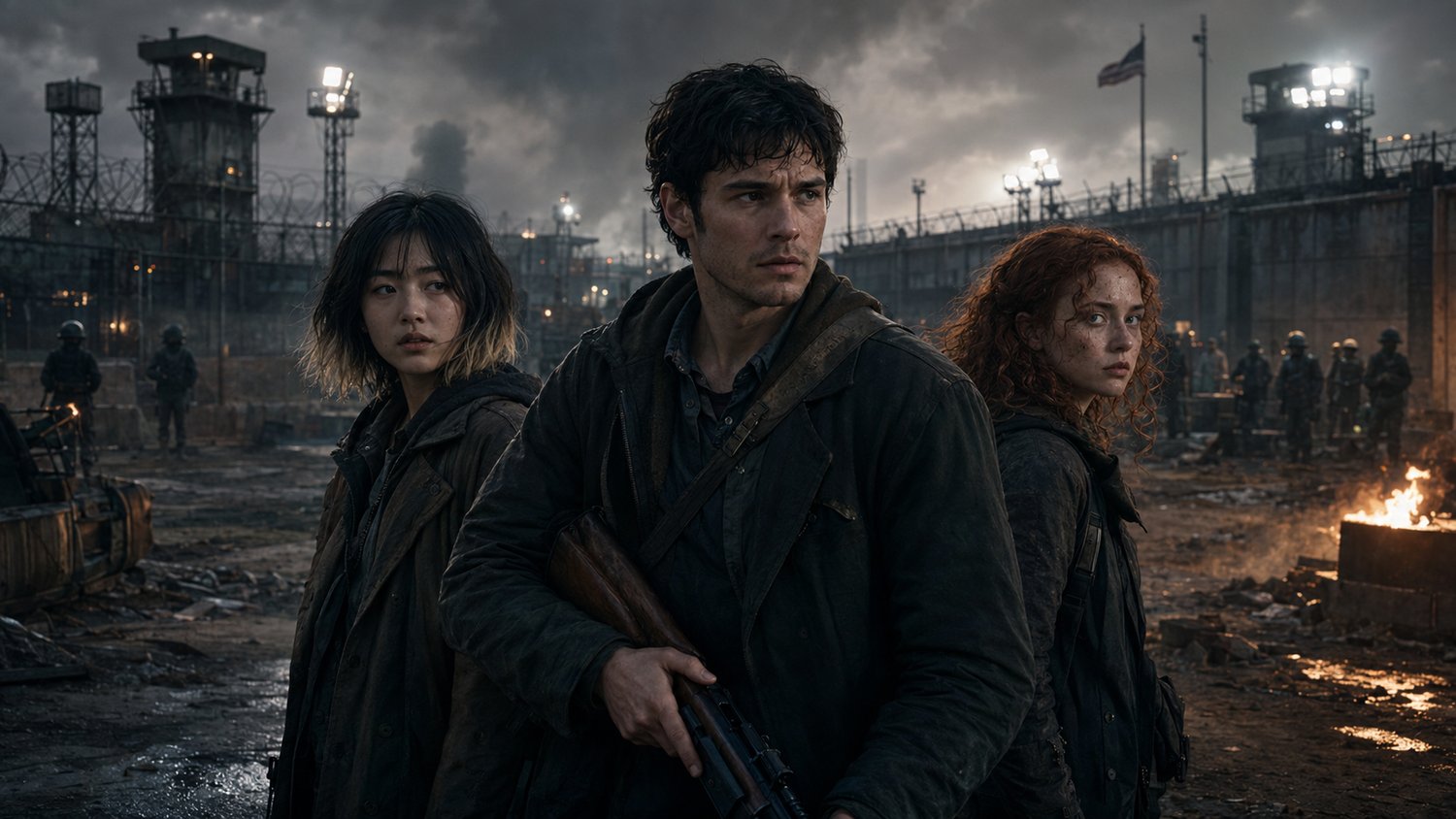
Quinn knows governments turn violence into virtue. Beyond the Lost tests if he’ll do the same thing once the gun lands in his hand.
Quinn Cozens enters Beyond the Lost with an argument already loaded:
America’s defenders insist the country kills to protect people, preserve freedom, maintain stability, and defeat evil. Its enemies receive no such moral complexity. They kill because they’re fanatics, savages, terrorists, communists, fascists, or whatever designation lets the public quit asking what happened before the first explosion appeared on television.
Our side kills reluctantly, and their side kills naturally.
Quinn sees through that lie long before civilization collapses. He understands how politicians, schools, historians, and media institutions turn State violence into humanitarian action through the language they attach to it.
When America does it, bombing's intervention, occupation's stabilization, civilian deaths are collateral damage, theft's confiscation, forced obedience is national unity, and the winning faction doesn’t need to hide every body. It only needs to control the explanation surrounding it.
That makes Quinn the ideological center of Beyond the Lost Fates. It also creates the pressure threatening to destroy him.
Quinn can recognize the propaganda used to excuse institutional violence. The harder question is if he can recognize the same machinery forming inside his own head.
>>>> Catch Quinn in Beyond the Lost
His principles survive until someone he loves is bleeding
Quinn’s political beliefs aren’t decorative character traits pasted onto a survival story. The collapse forces him to apply them.
It’s easy to condemn aggression while sitting behind a screen, reading revisionist history, criticizing American foreign policy, and explaining why governments shouldn’t invade other countries. Quinn can make that argument all day because history gives him piles of evidence.
Then Yui’s life falls into his hands.
A drifter attacks them, Yui gets shot, Quinn kills the man, leaves weapons behind, carries her toward Martin’s colony, and refuses to care if his choices inconvenience the community waiting ahead.
When Martin reprimands him for abandoning supplies that could endanger everyone else, Quinn’s answer carries the entire pressure file:
It was either the weapons or Yui.
That decision tells us more about Quinn than any ideological speech could.
He doesn’t think a collective claim automatically outranks an individual life. He won’t sacrifice Yui because Martin’s emerging authority considers weapons more strategically valuable. Quinn chooses the person in front of him over the colony’s abstract calculation.
That’s the best part of Quinn. It’s also where the danger lives.
Once violence is connected to protecting Yui, Ajay, Erika, or anyone else Quinn loves, he gains the strongest justification a person can carry. He isn’t fighting for territorial expansion, national prestige, military contracts, or a politician’s approval rating. He’s fighting people who attacked, imprisoned, tortured, trafficked, or threatened those around him.
His force has a clear defensive foundation, but righteous motives can still get addicting.
Quinn doesn’t enjoy killing, but he adapts to it
Yui struggles after helping take another person’s life. Even after everyone reminds her that she acted in self-defense, the knowledge doesn’t settle cleanly inside her.
Quinn responds differently.
He doesn’t celebrate the deaths, but he rarely sits around questioning if the people who attacked him deserved another chance. Once someone crosses the line into immediate aggression, Quinn acts. Survival taught him that hesitation can leave Yui bleeding, put Ajay under someone else’s control, or send prisoners into Martin’s machinery.
That decisiveness makes him effective, but it separates him from Yui.
She carries the emotional aftermath of violence, but Quinn carries the tactical lesson.
Someone attacked, he responded, the threat ended, and he moved forward. That approach worked until the definition of “threat” started expanding.
Quinn shows us that concern during a supply run when he finds Martin’s people standing over three bodies inside a grocery store. His first question's if they killed those people for being there.
One of Martin's men renders the answer irrelevant. They needed food, and the dead strangers stood in the way. They might belong to another colony, but it only makes them potential rivals.
Quinn refuses that logic.
Survival hasn’t erased the distinction between defensive force and conquest in Quinn's mind. He understands that another group occupying a grocery store doesn’t owe Martin’s colony its supplies, obedience, or its lives.
That’s why Martin’s project alarms him.
“Taking back the country” sounds heroic until someone asks who gets to define the country, who owns what's left, and what happens when another settlement declines the invitation.
Martin already has an answer, and Quinn recognizes the process because it’s the same one governments used before the collapse.
>>>> Catch Quinn's struggle with justifying violence in Beyond the Lost
Martin's Quinn’s warning, not his opposite
Martin and Quinn share more ground than either man would enjoy admitting.
Both know the old system failed, they understand that force will be necessary, and they're stubborn, politically driven, protective of their people, and convinced they see dangers others ignore.
The divide appears in what each man thinks violence lets them do.
Martin wants hierarchy, discipline, military expansion, forced mergers, and enough centralized control to rebuild the country according to his design. He can justify almost anything by pointing toward the terrorists who destroyed America.
They attacked first. Therefore, Martin becomes the defender in his mind. Anyone resisting his reconstruction project risks aligning themselves with the enemy, whether they had anything to do with the original attack or not. A typical power play from the American Right to justify their version of a strong central State.
Quinn rejects that leap. An atrocity committed against America doesn’t give Martin ownership over every survivor left standing. That makes him as bad as the old George W. Bush administration.
Yet Quinn faces his own version of the same temptation. Martin can say the terrorists forced his hand, and Quinn can respond that Martin’s people forced his. Martin can claim he’s protecting the country, and Quinn would respond that he's protecting Yui and Ajay.
The scale and moral circumstances differ dramatically, but the psychological seduction's recognizable: the belief that an enemy’s aggression transfers permanent moral innocence to whatever you do next.
Quinn understands how dangerous that belief gets when governments embrace it. He also has to learn how dangerous it is when he does.
Yui keeps necessity from turning into Quinn's identity
Yui’s role in Quinn’s arc extends far beyond romance. She’s the most capable of seeing the human cost hiding behind his certainty.
Quinn can explain why killing might be necessary, even if that definition differs from Martin's "kill even if they're in the way point of view." He can list the people Martin hurt, the authority he abused, the prisoners he tortured, the dissent he monitored, and the theocratic dictatorship he intends to build. That said, he'd find it necessary to try and kill Martin.
Yui doesn’t have to dispute those facts to recognize what the pursuit is doing to Quinn. She reminds him that using force and letting it consume him are two different outcomes.
Once Quinn decides someone belongs to an enemy faction, he can get frighteningly certain that killing's the "right thing."
Yui keeps forcing the individual person back into his field of vision. She prevents “Martin’s people,” “the terrorists,” “the drifters,” and “the enemy” from turning into moral categories broad enough to excuse anything.
The real pressure: Will Quinn win without writing the textbook?
One Rogue Scribe deep dive examined how the winner of a conflict inherits the power to classify everyone’s violence.
The winning side calls its fighters defenders who conducted operations and protected civilization, while branding the losing side as murderers who committed atrocities and attacked civilization.
Quinn despises that mythology. He knows the ultimate winner of the conflict inside Beyond the Lost Fates will get the same opportunity every victorious faction got. Someone will explain who saved the country, who threatened it, whose deaths were necessary, and whose violence proved their inherent evil.
That narrator could become Quinn.
He could defeat Martin, help stop the terrorists, protect the people closest to him, and emerge with enough moral credibility to declare his side the good one despite the body count and a deeper set of intangibles.
Most stories would reward him for doing exactly that, but this one puts him under pressure.
Can Quinn admit when his enemies committed genuine atrocities without transforming every person associated with them into a legitimate target? Will he defend his people without claiming authority over those who never consented to follow him? Can he kill an immediate aggressor without teaching himself that every future killing must also be righteous? And will he defeat Martin without transforming into another man who thinks his superior motives give him the right to rebuild society from the top down?
Most importantly: Will Quinn survive long enough to tell the story without turning survival into proof that he was always right?
That’s the character pressure behind Quinn Cozens. His central conflict's if he can squeeze the trigger, live with the consequences, judge the action honestly, and resist the urge to convert necessity into sainthood.
Quinn knows governments claim they kill to protect while their enemies kill because killing is all they understand.
Now he has to prove he won’t tell the same story about himself.
Comments ()