

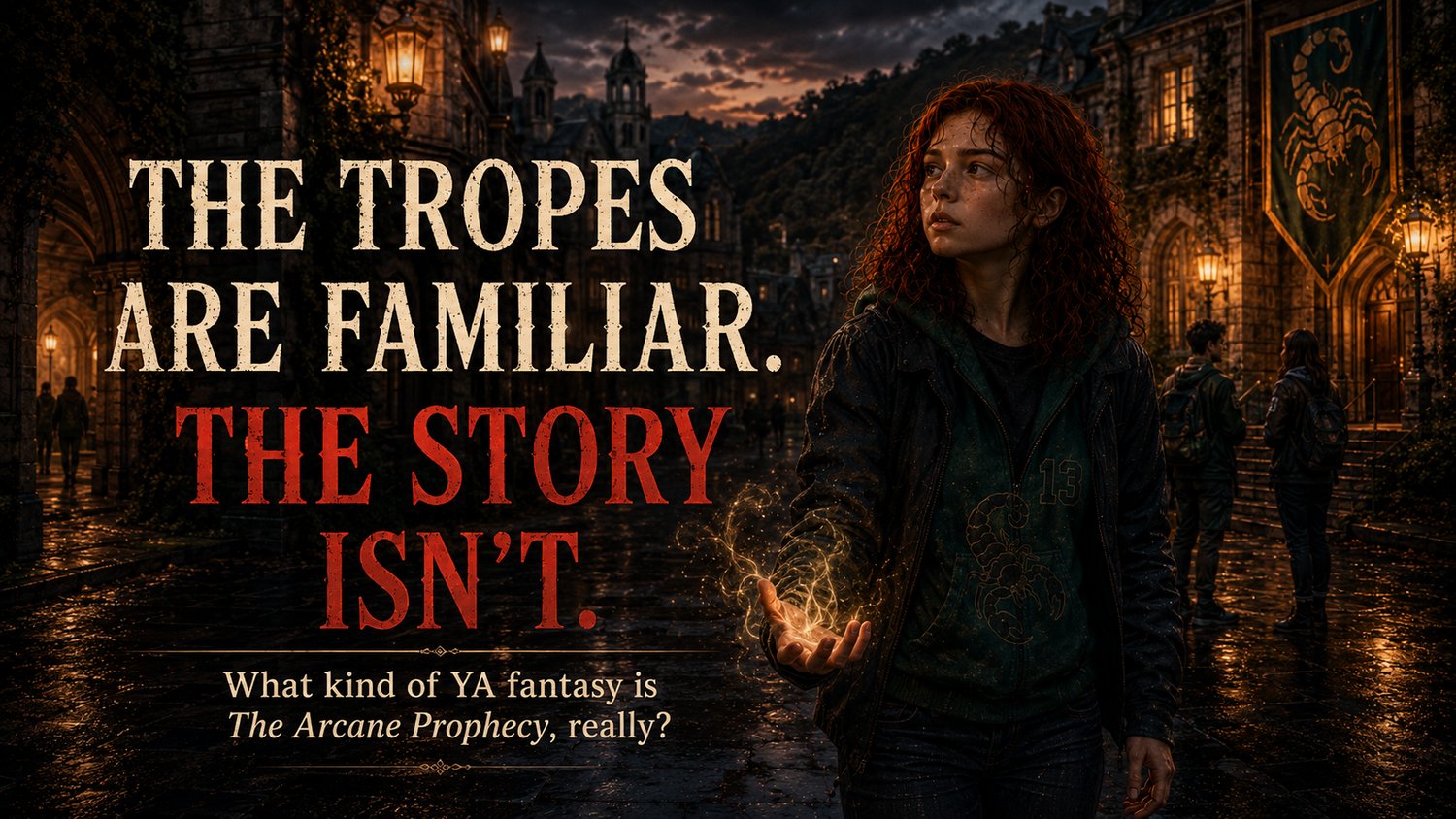
Some books tell you exactly what they are by waving the same five tropes in your face.
Tropes like the chosen girl, magical school, mean rival, creepy adult, Prophecy in the title, the glowing hallway, the suspicious teacher, and the inevitable speech about destiny.
The Arcane Prophecy has some of those pieces, but it refuses to behave like the standard version of them.
Yes, this is young adult academy fantasy. There’s elemental magic, a school system, hidden history, strange woods, family pressure, a prophecy, and a girl with a mark she doesn’t fully understand.
But if you’re expecting a clean mainstream academy fantasy where the heroine gets sorted into the correct school, finds her squad, learns three spells, blushes at the right boy, and defeats the obvious villain before finals week, this isn’t that book.
Arcane uses the familiar doorway, then it takes the reader somewhere stranger.
Check out what you're getting below.
The rejected elite-school
A lot of YA fantasy starts with the main character discovering she belongs somewhere special, but Yote Diamondback starts with that somewhere telling her she doesn’t.
Lamerth is the elite Elemental academy Yote was supposed to attend. The elite path that's family approved, the status symbol, and the school that proves the Diamondback training machine worked.
Then it rejects her.
Arcane becomes the fallback and the place she didn’t want until it starts giving her what Lamerth never could: a system that sees her as an individual instead of a résumé with legs.
That’s where the book sits closer to mainstream YA fantasy, especially when Yote quickly grows fond of Arcane.
But the angle’s different.
This isn’t “girl learns she was secretly better than everyone," even if Yote's gifted. It’s “girl realizes the institution she worshiped may have been the wrong goal from the start," and it gives the academy setup a sharper edge than the usual prestigious-school fantasy.
Catch The Arcane Prophecy today
The magical school
Arcane Elemental Academy absolutely scratches the school-fantasy itch.
Readers get gatherings, elemental mastery, Scorpii (one of the schools within the school) identity, Leonid tension, teacher dynamics, campus life, training, school sports, friendships, rivalries, and all the pressure that comes with entering a place where everyone has power and no one has the same path.
That’s the mainstream hook, but the alternative part is how Arcane works.
This academy doesn’t exist to be a prettier version of the same old credential factory. It customizes, sorts students into one of its 32 schools by fit, and gives Yote room to grow because it doesn’t treat one prestige path as the only path.
That’s a big reason the book doesn’t read like standard academy fantasy with a magic coat of paint. Arcane is a school, but it’s also an argument that starts quiet before growing louder.
The rival sister
Jett Diamondback could’ve been a flat mean-girl sister, but she isn’t.
She’s cruel, polished, she knows how to twist the knife, and she represents the path Yote was trained to envy: Jett's prettier, smoother, more Lamerth-shaped, and more willing to treat every family expectation like a scoreboard.
Yote and Jett’s rivalry gives the book its first emotional wound.
Before the mysterious Wisp starts pulling Yote into something bigger, there’s the basic fact that she spent her life measuring herself against someone who knows exactly which emotional buttons to push.
That’s a mainstream YA device, but the execution is more personal and uglier than the usual “sister rivalry” dressing. Jett’s there to show what the Diamondback household rewards, warps, and what Yote has to crawl out from under.
The chosen-one
The title tells you there’s a prophecy, but the book makes you wait before it lets that word mean anything.
The prophecy enters through clues, behavior, memory, the Wisp, the red book, Darkwood’s obsession, a few time warps, and the question Yote keeps circling without having the full language for it:
Why her?
That makes the chosen-one material feel less like a trophy and more like a trapdoor. Readers who enjoy prophecy stories will get the hook. But those tired of instant destiny speeches may appreciate that Yote’s path doesn’t open with someone handing her a glowing crown and a job description.
She has to stumble into the shape of the thing, and by the time she does, the word prophecy feels lethal instead of decorative.
The mysterious adult
YA fantasy loves suspicious adults, and Arcane has several.
Cassara Darkwood is the obvious pressure point: the woman in black who watches too closely, shows up where she shouldn’t, and treats Yote like a problem before Yote understands why. Dr. Rayne Grimbane carries another kind of tension. She knows more than she says, but she also isn’t written like a stock cryptic mentor whose only job is to drop riddles and vanish.
Rass Vexx gives the book a warmer presence early on, giving Yote someone outside the Diamondback pressure cooker.
The adult cast hands the story one of its strongest selling points: the world around Yote is full of people with partial truths, but nobody walks around wearing a sign that says “trust me” or “villain here.”
The magic mark trope
A strange mark on the heroine can get lazy fast. Here, it works because Yote doesn’t understand it, her family hasn’t been honest about it, and the mark ties into the larger question of what was hidden from her long before Arcane.
It’s a pressure point that Yote later finds out is a clue, and an eventual reminder that somebody knows something her life that they never explained. Readers will instantly recognize that trope, but the book uses it as a slow-burn mystery rather than instant branding.
Discover that magic mark in The Arcane Prophecy
The friend group trope
Yote gets friends at Arcane, but the book doesn’t turn them into a perfectly polished found-family poster. Storm Sharpe pushes, Loki Kahne complicates things, Imperia Frost has her own awkward edges, and Rass provides warmth, but even warmth in this world deserves scrutiny as the story keeps moving.
Then there's the fact that Storm and Loki are frenemies because they're both attracted to Yote.
The selling point here is connection without fake cleanliness.
Yote needs people. She also doesn’t magically get emotionally fluent because she found a new campus and a few friendly faces. She’s still defensive, shaped by her parents, and drawn toward the future they planned even when Arcane starts feeling like home.
That gives the friend dynamics more bite.
So is The Arcane Prophecy mainstream YA fantasy?
Genre-wise, yes.
Commercially, it has the pieces readers recognize: the academy setting, elemental magic, rival schools, family pressure, a strange mark, dangerous adult, hidden prophecy, school competition, and a heroine discovering she may be tied to something much bigger than she thought.
But in execution, Arcane leans more niche and alternative.
It isn’t romantasy with a magical-school backdrop, a court fantasy, or a rebellion story where every authority figure announces corruption in the first act like you often see in my Renegades Epic shared universe. It's not a cozy school mystery, either.
It’s academy fantasy with a stronger focus on systems, fit, status, family expectation, personal agency, and the slow realization that the “better” path may have been a leash with better branding. That makes it mainstream enough to enter easily and alternative enough to avoid feeling like the same academy book with a different crest.
Who this book is for
Read The Arcane Prophecy if you like YA fantasy where the school and family pressure raise the stakes, and the heroine’s growth comes from getting knocked off the path everyone else swore was perfect.
Read it if you like magical academy stories with sports, rival houses, hidden history, strange woods, cryptid danger, a slow-building prophecy, adults who know more than they’re saying, and if you like a book that starts with a familiar glow and then asks why that glow was there in the first place.
But skip it if you want nonstop magical battles from page one, royal court drama, a romance-first plot, or a heroine who immediately understands her destiny and charges at it with a sword in chapter two.
Yote Diamondback doesn’t begin as the girl who knows what she wants. She's a girl who thinks she does.
Check out The Arcane Prophecy today
Comments ()