

Hi teacher!
Welcome back to this final blog post in The Reality Gap series. In this series, we took a deeper look at some of the real challenges many early-career teachers face when they step into full-time classroom teaching.

Today, as we close this series, my prayer is that you will not only understand the challenges more clearly, but also begin to see that you do not have to fix everything all at once.
You can name what feels difficult. You can narrow it down to one specific place where support is needed. And you can take one steady step forward with grace, wisdom, and support.
In this post, we will walk through a simple Pause, Reflect, Proceed rhythm that helps you reset without trying to rebuild everything at once.

I remember wondering about this concept when I read a teacher wellness article early in my full-time teaching career. A reset? I thought, but I just started working full-time as a teacher. Why on earth would I already need a reset? At first, I thought a reset was only for people who had been doing something for a long time — people who were tired after years of carrying the same work, the same responsibilities, the same pressure and desperately wanted change. But as I reflected, something started to stand out. Maybe a reset is not only for the teacher who has been teaching for many years. Maybe a reset is also needed when you are still finding your feet, and you realise that you do not want to build your teaching life on pressure, panic, and constant self-criticism.
A reset does not mean quitting, escaping, or starting over because you failed. It is a mindful pause that helps you notice what is no longer working, release the pressure to fix everything at once, and choose one steady habit or practice that can support you going forward. It is an invitation to stop running on pressure alone. A chance to return to your teaching journey with more wisdom, more awareness, and more grace.
As early-career teachers, it is so easy to fall into patterns and adopt habits that can contribute to our feelings of overwhelm especially initially when we are still learning about and building systems our own systems. The perception that everything needs your attention at once — the planning, the routines, the admin, the marking, the learners who need extra support, the parent communication, the behaviour challenges. And somewhere in the middle of all of that, your own energy is running low. This is especially where a reset can become a necessity. Stopping to take stock of what is going on in our lives as early-career teachers — how we are managing our classrooms, our teaching habits and systems, how we are managing and feeling as the teacher behind all of this, is more important than we think.
Not because everything will suddenly become easy. But because you are choosing not to build your teaching life on panic, perfection, or constant self-criticism. You are choosing to build with steadiness. You are choosing to notice what needs support.You are choosing one small step that can help you teach from a place of more calm, clarity, and purpose.
So a reset is not about adding another big task to your already full plate. It is about stepping back and asking:
- What is taking too much of my energy right now?
- What habit is helping me?
- What habit is making teaching feel harder than it needs to be?
- What small change could support me before the next term begins?
- A reset is an invitation to stop running on pressure alone.
It is a chance to return to your teaching journey with more wisdom, more awareness, and more grace.
It's a process - You are building, not behind
Once you have started your teacher reset, it is important to remember that you do not need to fix your whole teaching life in one week. You need one steady next step. It is tempting to take on all the areas for growth that we identified again because of the perception of being an early-career teacher means you should already know how to manage everything. This is where we remember as we ponder why experienced teachers seem calmer, faster, or more confident and remember: even experienced teachers are not experienced because they never struggled.They are experienced because they have repeated, reflected, adjusted, and grown over time.
They have:
- tried routines that did not work.
- changed instructions that were unclear.
- learned which systems are worth keeping.
- discovered what helps them stay steady on difficult days.
- allowed to learn this profession in real time.
That does not mean you have to keep feeling as if you are missing something. It means you stop demanding perfection from yourself while you are still building your foundation. When you are tempted to compare yourself when looking at the teacher next door and start to think, “They seem to have everything together,” remember they too have their own struggles you simply cannot see, and may also be in desperate need of a reset of their own.
Here is a better starting place once you've decided to reset:
Notice what is already working and build from there.
Maybe your dismissal routine is more settled than you realise, or your learners respond well to one particular instruction style, or one page in your planner genuinely helps you stay focused. These small clues tell you something important about what can support you next.
When you focus on one thing, practise it, and build on it, your confidence begins to grow. That is why one steady step matters. Not because it solves everything. But because it gives you a place to begin.
Taking your reset step
Come back to the simple rhythm we have used throughout this series:
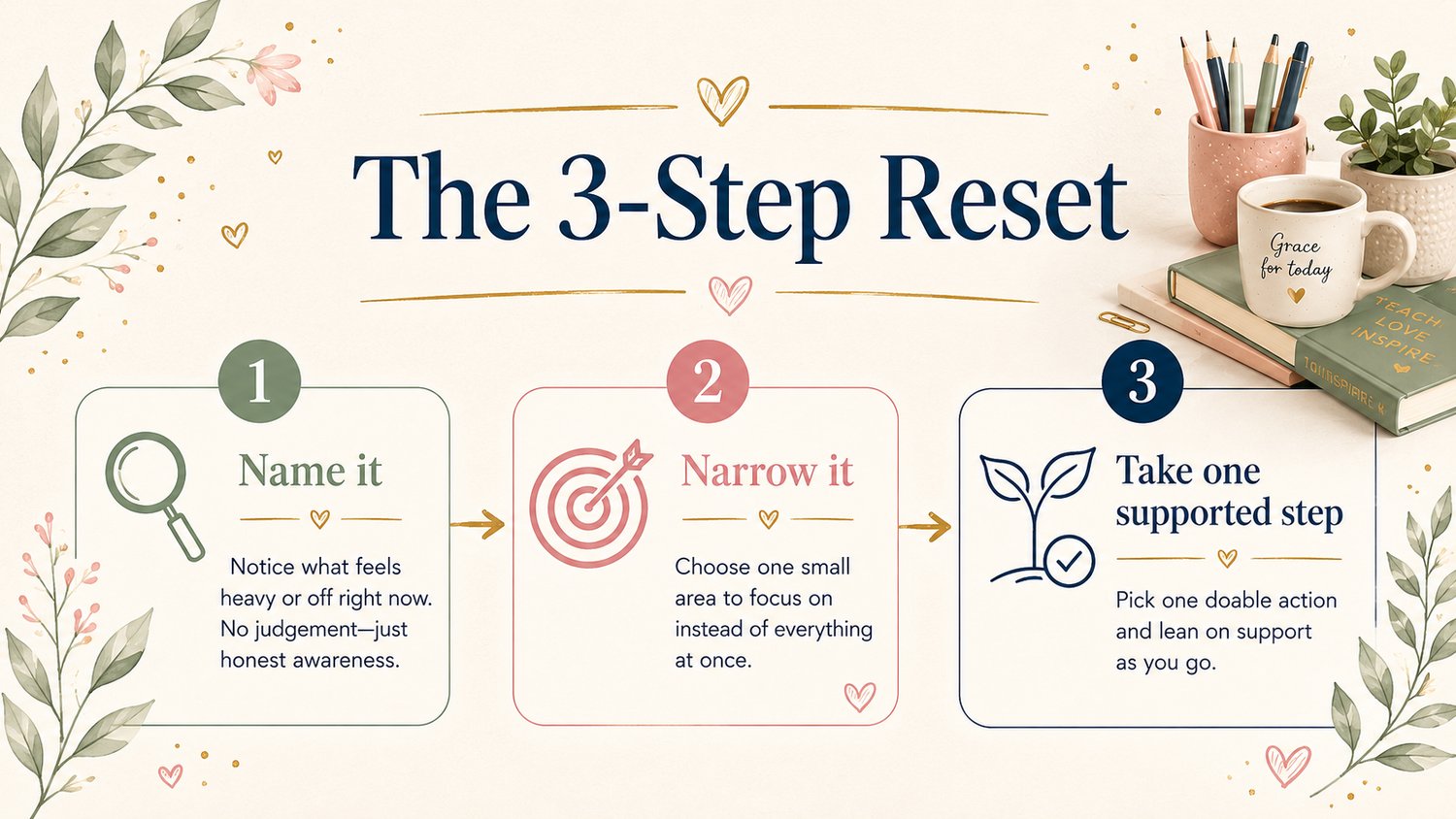
1. Name it: What feels too much right now?
Start by naming the area that feels most difficult at the moment. Not every challenge needs your attention today. Not every problem has to be solved before the next school week begins.
Ask yourself:
What is one area I can stop trying to fix all at once?
Maybe it is classroom management. Maybe it is planning. Maybe it is admin, marking, or your own energy after a long school day. Naming it helps you stop carrying everything as one big, heavy feeling. Instead of saying "I am behind with everything," you can begin to say: "This is the area that needs my attention first."
That is where your reset begins.
2. Narrow it: What is the specific moment that needs support?
Once you have named the area, narrow it down. This is where many teachers try to do too much too quickly — overhauling the whole classroom management system, redesigning the entire planning routine, organising every admin file before the next Monday arrives.But a reset works best when it becomes specific. Maybe you do not need to overhaul your whole classroom management system this week, or you only need to practise one calmer transition, or you do not need to redesign your whole planning routine, or you only need one simple lesson-at-a-glance page to help you stay focused, or you do not need to organise every piece of admin today, or you only need one tracker, one folder, or one small place to start.
Small does not mean unimportant. Small means usable. And usable systems are the ones that can actually support you on real school days.
Ask yourself:
Where exactly is this challenge showing up all the time?
Is it after break?
During transitions?
When learners start independent work?
When you sit down to plan?
The more specific you become, the easier it is to choose a step that actually helps. Ask the Lord to give you clarity especially in the areas where you might feel uncertainty or struggle to clearly define.
3. Take one supported step: What small action can I repeat this week?
Now choose ONE steady classroom action — not a complete life reset or full classroom makeover. Just one supported step that you can repeat more than once this week.
You could choose one clearer instruction to use before independent work. One phrase to help learners settle after break. One simple tracker for behaviour, parent communication, or assessment follow-up. A two-minute reflection at the end of the day. One transition routine to practise slowly. One boundary around schoolwork — a stopping time for marking, or one evening where schoolwork does not come home with you.
To make it concrete, I'll share an example from my own classroom.
After praying and reflecting through the overwhelm I was feeling for most of the time since starting to teach full-time, the realization came that end of period was the main source of my overwhelm, and that I needed an urgent reset in this area. Following the 3-step reset I prayerfully went about it like this:
- Name it prompt — My classroom challenge is... (concluding a period without chaos ensuing when the bell rings).
- Narrow it prompt — It looks like... (once the bell rings, students talking so loud my voice gets lost, others rushing to the door without being instructed to leave class and throwing books and stationery everywhere).
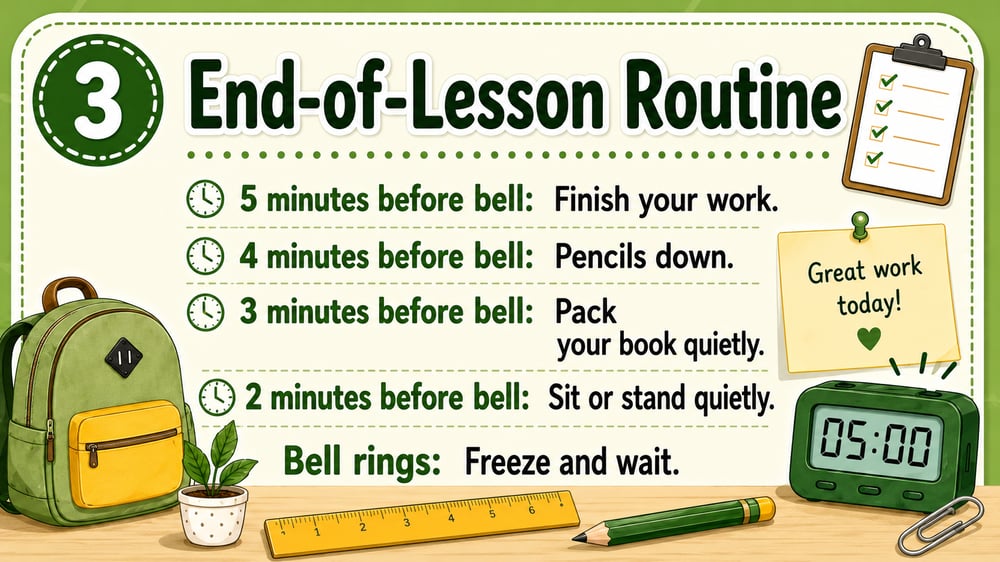
- Supported step — To avoid or minimize this I can... (become more conscious of time, and prepare learners for the bell that will ring with a five minute count down).
To help with the supported step the Holy Spirit impressed me to design this routine card (see below). Armed with this visual reminder I went to my class the next day, explained and practiced the steps with my students and committed to implementing just this routine consistently for the next week. Everyday for that week, I would watch the time closely, give them the first "5 minute warning", and then count them down and have them do the task at each step. By Friday, my lessons and even school day endings, were a lot more peaceful. My students were already anticipating and corrected each other if one or two did not do as expected. This routine became the anchor for a calmer period and school day ending , and by God's grace helped to reduce one area that caused me to feel overwhelmed as a teacher.
That is all a reset step needs to be. Simple enough to use on a real school day. Repeated enough to become a rhythm.
Before the week becomes too full, write down your step:
This week, one supported step I will practise is…
Keep it visible — on a sticky note, in your planner, on your desk, or saved on your phone. Then use it more than once. A small step becomes support when you repeat it. Not perfectly. Not dramatically. Just steadily.

Zechariah 4:10 reminds us not to despise the day of small things. That is such a powerful reminder for teaching! Small beginnings after deciding to reset can feel unimpressive. Small routines can feel too simple. Small progress can feel easy to overlook.
But God can work in small places. He can meet you in the quiet reset before the next lesson. He can strengthen you when you choose a calmer response. He can give wisdom when you try again. He can help you build slowly, faithfully, and with grace.
This does not mean every school day will suddenly become easy. It means you are not building your teaching life alone. Your small steps matter. The growth that goes along with it matters. The foundation being built by you (taking small faithful steps daily) and God (blessing your effort at each stage) in this season is not wasted.
Reflection prompt
Take a moment before the new week begins pray and ask yourself:
What is one area I can stop trying to fix all at once?
Then complete this sentence:
One supported step I can take this week is…
Keep it small enough to use on a real school day.
Affirmation for the week

You are allowed to pause. You are allowed to notice what needs support. You are allowed to begin with one small action that is simple enough to repeat. One steady step is enough for today.
A practical next step
Maybe you are reading this and realising: “I know I need a reset, but I still need help naming where to start and choosing one supported step.”
If that is where you are right now, I want to share something I created with early-career teachers in mind.
7 Days of God's Encouragement for Early-Career Teachers is a faith-rooted reflection and action workbook for early-career teachers who are navigating the real challenges of classroom life — and who need more than just encouragement. They need a clear way forward.
Each day walks you through a real teaching challenge — classroom overwhelm, classroom management, decision fatigue, behaviour that feels personal, feeling behind, and self-doubt — with a Bible verse, honest reflection prompts, and one practical classroom action step you can actually use.
This is not just a devotional. By the end of 7 days, you will have named your main classroom challenge, reflected on it prayerfully, and completed a simple One Steady Step Action Plan you can take into your school week. Because encouragement without direction only goes so far. This workbook gives you both.
Get Your Workbook here → https://payhip.com/b/SvVk7

One steady step at a time, teacher. You do not have to figure this out alone.
Small steady steps, teacher.
You are growing into this with grace, wisdom, and support.
Janeth | The Teacher Support Corner
Comments ()