
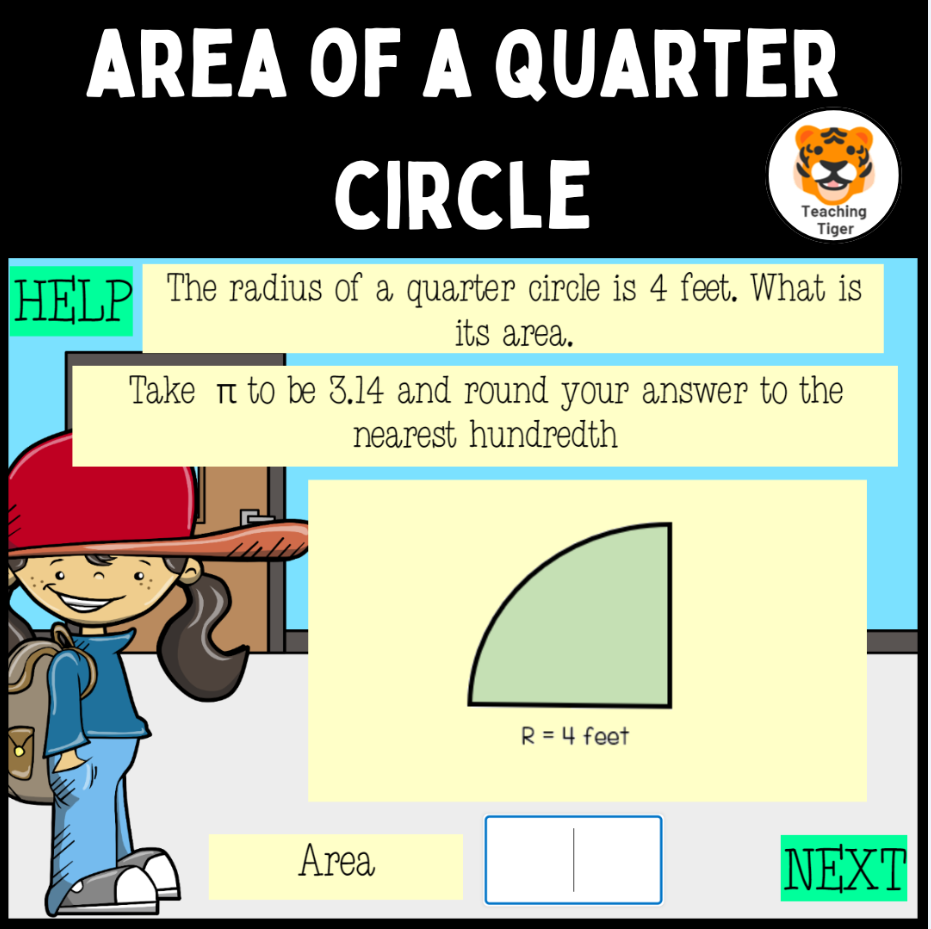
After creating an Area of Quarter Circle Boomcards Self Teach Quiz, find a preview here. I thought would be a good idea to write a post on how to teach this important skill. Teaching the area of a quarter circle can be a rewarding experience for both educators and students. This geometric concept not only reinforces basic mathematical skills but also encourages critical thinking and problem-solving. Here are some engaging strategies to help you effectively teach the area of a quarter circle.
1. Start with the Basics
Before diving into the specifics of a quarter circle, ensure that your students have a solid understanding of basic circle geometry, including terms like radius, diameter, circumference, and area. Review the formula for the area of a full circle:
Area of a Circle=𝜋𝑟2
Area of a Circle=πr2
where 𝑟
r is the radius of the circle.
2. Introduce the Quarter Circle Concept
Explain that a quarter circle is exactly one-fourth of a full circle. Show them a full circle, then visually divide it into four equal parts. Highlight that each part represents a quarter circle. This visual representation helps students grasp the concept more concretely.
3. Derive the Formula
To find the area of a quarter circle, start with the area formula for a full circle. Explain that since a quarter circle is one-fourth of a full circle, the formula for its area is:
Area of a Quarter Circle=1/4𝜋𝑟2
Walk through a few examples together, using different radii to illustrate how the formula works in practice.
4. Hands-On Activities
Activity 1: Paper Folding
Provide students with circular paper cutouts. Ask them to fold the circle into four equal parts and then cut out one of the quarters. This tactile activity reinforces the concept of a quarter circle and helps visualize the division of the area.
Activity 2: Real-Life Objects
Use real-life objects such as a quarter slice of pizza, pie, or even a clock face. Relating the concept to everyday items makes the lesson more relatable and engaging. Measure the radius of these objects and calculate the area of the quarter circles.
5. Interactive Games and Technology
Leverage technology by incorporating interactive games and digital tools. There are numerous educational apps and online resources that allow students to manipulate shapes and see the effects of changing dimensions in real-time.
Example: 15-Card Question Deck
Create a deck of 15 cards, each with a unique problem related to the area of a quarter circle. These could range from simple calculations to more complex, real-world applications. Include a help section in the deck that students can refer to if they need assistance with the formulas or concepts.
6. Collaborative Learning
Encourage group activities where students can work together to solve problems involving quarter circles. This promotes peer learning and allows students to explain concepts to each other, reinforcing their own understanding in the process.
Example: Group Problem Solving
Divide the class into small groups and give each group a different problem to solve. Afterward, have each group present their problem and solution to the class. This not only reinforces their understanding but also helps build communication skills.
7. Use of Visual Aids
Visual aids such as charts, diagrams, and models are invaluable. Create posters showing different quarter circles with labeled radii and areas. Use these as references during lessons to provide a constant visual reminder of the concepts being taught.
8. Assessment and Feedback
Regular assessment and constructive feedback are crucial. Use quizzes, homework, and in-class exercises to gauge student understanding. Provide prompt feedback to help them correct mistakes and understand the concepts better.
Example: Quiz
After teaching the topic, conduct a short quiz to assess understanding. Include a mix of direct calculation questions and word problems that require students to apply their knowledge to real-world scenarios.
9. Celebrate Success
Celebrate the achievements of your students. Whether it's solving a particularly challenging problem or showing significant improvement, recognizing their efforts builds confidence and motivation.
Example: Celebration Slide
If you're using digital tools, include a celebration slide that pops up when students correctly solve problems. This small but meaningful recognition can significantly boost morale and engagement.
Conclusion
Teaching the area of a quarter circle can be an enjoyable and enriching experience when approached with creativity and enthusiasm. By combining visual aids, hands-on activities, interactive games, and collaborative learning, you can make this geometric concept both understandable and fun for your students. Through consistent practice and positive reinforcement, students will not only master the area of a quarter circle but also develop a deeper appreciation for geometry and mathematics as a whole.