
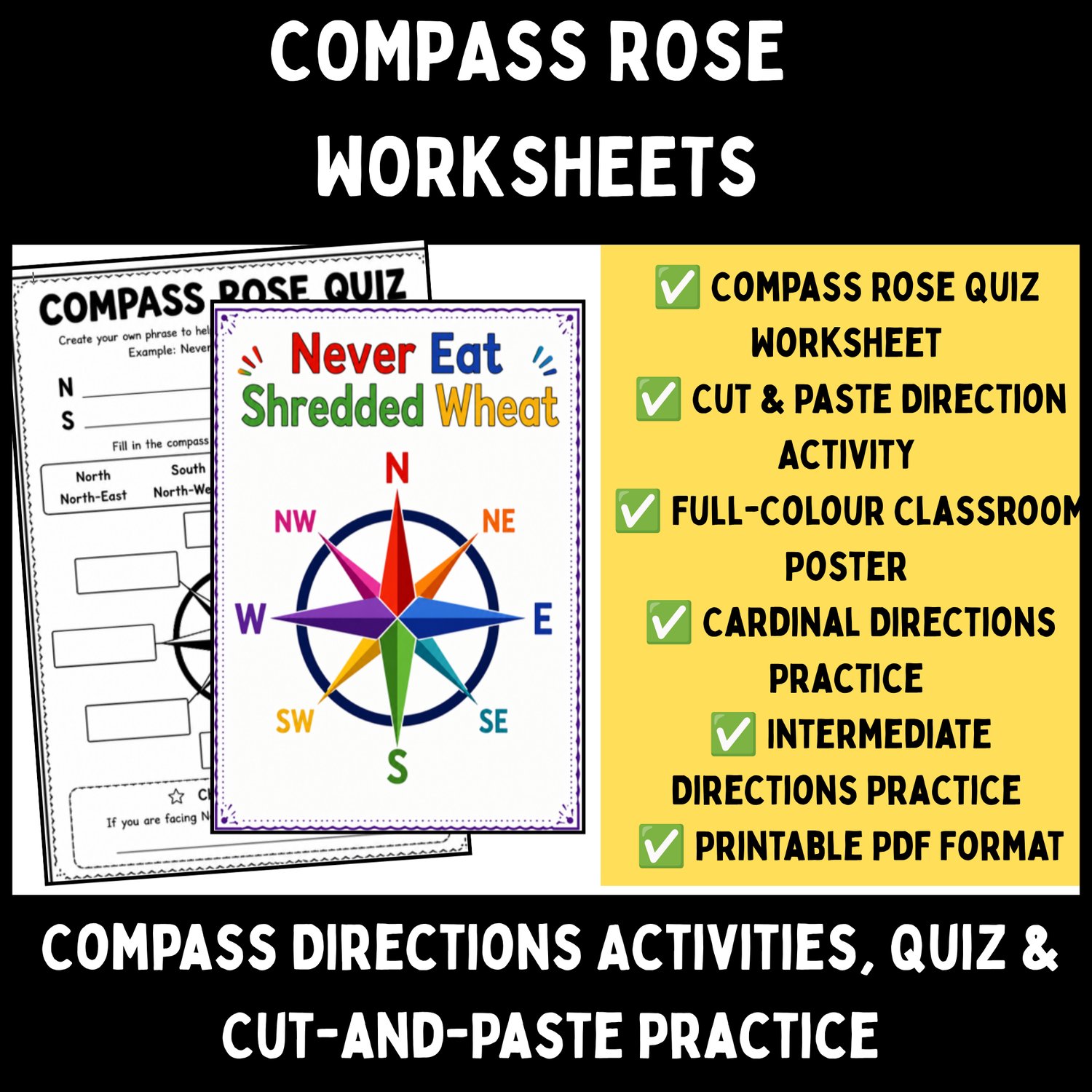
Teaching the Compass Rose in Primary School: Fun and Engaging Ways to Build Map Skills
Understanding direction is an important part of geography in primary school, and one of the first concepts children encounter is the compass rose. While it may seem like a simple symbol on a map, the compass rose helps children develop essential navigation, map-reading, and spatial awareness skills that they will use throughout their education and everyday lives.
Find a Compass Rose Activity Pack here
What Is a Compass Rose?
A compass rose is a diagram that shows directions on a map. At primary level, children usually begin by learning the four main compass points:
- North (N)
- East (E)
- South (S)
- West (W)
As their understanding develops, they can move on to the intermediate directions:
- North-East (NE)
- South-East (SE)
- South-West (SW)
- North-West (NW)
Many children remember the order of the compass points using the phrase:
"Never Eat Shredded Wheat"
This simple mnemonic provides an easy way for learners to recall the directions in a clockwise order.
Why Teach the Compass Rose?
Teaching compass directions helps children:
✓ Develop map-reading skills
✓ Improve spatial awareness
✓ Understand location and movement
✓ Build confidence when using atlases and maps
✓ Prepare for more advanced geography topics
Compass skills also connect naturally with outdoor learning, physical education, maths, and problem-solving activities.
Making Compass Directions Fun
Young learners often grasp concepts more quickly when they can move and interact with their environment.
1. Create a Human Compass Rose
Use chalk outdoors or masking tape indoors to create a large compass rose on the ground. Label each direction clearly.
Call out directions and ask children to move to the correct point. You can increase the challenge by giving instructions such as:
- Take three steps north.
- Move two steps east.
- Walk north-east.
This active approach helps children physically experience direction.
2. Compass Hunts
Hide clues around the classroom or playground.
Instead of giving exact locations, provide directional instructions:
- Walk north to the tree.
- Move east towards the fence.
- Head south-west to find the next clue.
Treasure hunts are an excellent way to reinforce directional vocabulary while keeping children engaged.
3. Use Classroom Maps
Provide simple maps of the classroom, playground, or school grounds.
Ask pupils questions such as:
- Which direction is the library from the classroom?
- What lies north of the playground?
- Which building is east of the school office?
Real-world examples make learning more meaningful.
4. Create Compass Rose Worksheets
Labelling activities are ideal for introducing compass points.
Popular worksheet ideas include:
- Label the compass rose
- Colour the compass points
- Cut-and-stick compass activities
- Complete the missing directions
- Draw your own compass rose
These activities help children become familiar with directional language while developing fine motor skills.
Common Misconceptions
Many children confuse left and right with compass directions. It is helpful to remind them that compass directions stay the same regardless of which way they are facing.
Using maps consistently and encouraging children to orient themselves to north can help overcome this misunderstanding.
Extending Learning
Once children understand the basic compass rose, try introducing:
- Eight-point compass directions
- Grid references
- Simple map coordinates
- Ordnance Survey symbols
- Navigation challenges
These activities provide a natural progression into upper primary geography skills.
Final Thoughts
The compass rose is one of the building blocks of geographical understanding. By combining practical activities, movement, games, and map work, teachers can make learning directions both memorable and enjoyable.
Whether you are introducing north, south, east, and west for the first time or helping children master eight-point compass directions, a well-planned compass rose lesson can spark curiosity about maps and the wider world.
After all, every great explorer starts by knowing which way is north!