
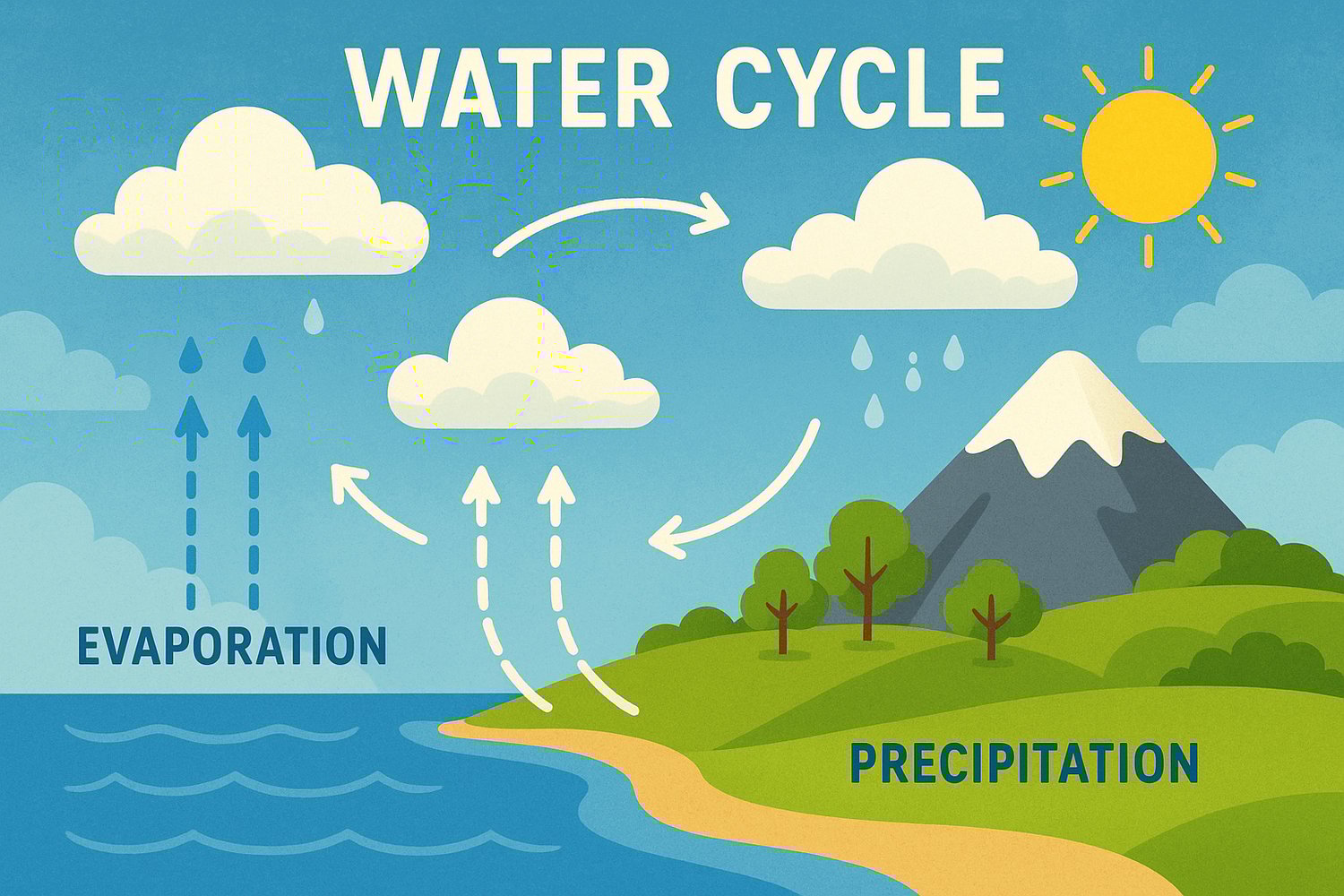
Title: Teaching the Water Cycle to 5th Graders: Tips That Actually Work
Hey fellow educators,
If you’re prepping your water cycle unit for 5th grade, I’ve got your back. After several years of teaching this topic, I’ve picked up a few strategies that make the lesson more engaging, more hands-on, and—most importantly—more memorable for students.
Before we look at what’s worked best in my classroom, check out my boomcards quiz on the Water cycle, students love these quizzes
See a preview here
Find the full resource here
Boom Cards - Water Cycle Boom Cards – 5th Grade Science Quiz
1. Start With What They Already Know
Before diving into vocabulary, start with a simple question:
“Where do you think rain comes from?”
You’ll get a mix of serious and silly answers, but that’s okay—it sparks curiosity and gives you a baseline. Use their ideas as a springboard to introduce the real players: evaporation, condensation, precipitation, and collection.
2. Make It Visible With a Mini Water Cycle
One of my favorite activities is the classic plastic bag experiment.
Have students:
- Draw clouds, the sun, and water on a ziplock bag.
- Pour a little water inside and seal it.
- Tape it to a sunny window.
Within a day or two, you’ll start seeing condensation and droplets. It’s an easy, low-cost visual that gets them to see the cycle happening—plus it sparks tons of questions.
3. Incorporate Movement: Water Cycle Simulation
Get kids out of their seats with a water cycle relay or role-playing activity.
I like to create stations: Ocean, Clouds, Mountains, Ground, etc. Students "travel" as water droplets, rolling dice or flipping cards to determine their next step. It helps reinforce that the water cycle isn’t linear—it’s a constant, looping system.
4. Use Music and Storytelling
There are some great water cycle songs on YouTube—find one that sticks and sing it daily during the unit. Yes, they’ll roll their eyes. Yes, they’ll sing it under their breath during the test. That’s the point.
You can also have them write a story from the perspective of a water droplet. This taps into creativity and reinforces science vocabulary in a narrative format.
5. Anchor Vocabulary With Visuals
Create a word wall or anchor chart with terms and images. Every time a student uses a word like evaporation or condensation in conversation, point to the chart. Use hand motions or call-and-response cues to keep it interactive.
6. Wrap Up With Choice-Based Projects
Give them options for a final project:
- Build a 3D model
- Make a poster or comic
- Create a stop-motion video
- Present a short skit or weather report
Letting them choose gives them ownership and boosts engagement.
Bonus Tip: Tie It to the Real World
Discuss how the water cycle affects weather, droughts, or natural disasters. Connect it to where they live—rainstorms, puddles on the playground, foggy windows. When students see relevance, they remember it.
Final Thought:
Teaching the water cycle doesn’t have to feel like going in circles. With the right mix of visuals, movement, creativity, and curiosity, your students will not only get it, but they’ll remember it long after the unit ends.