
Introduction:
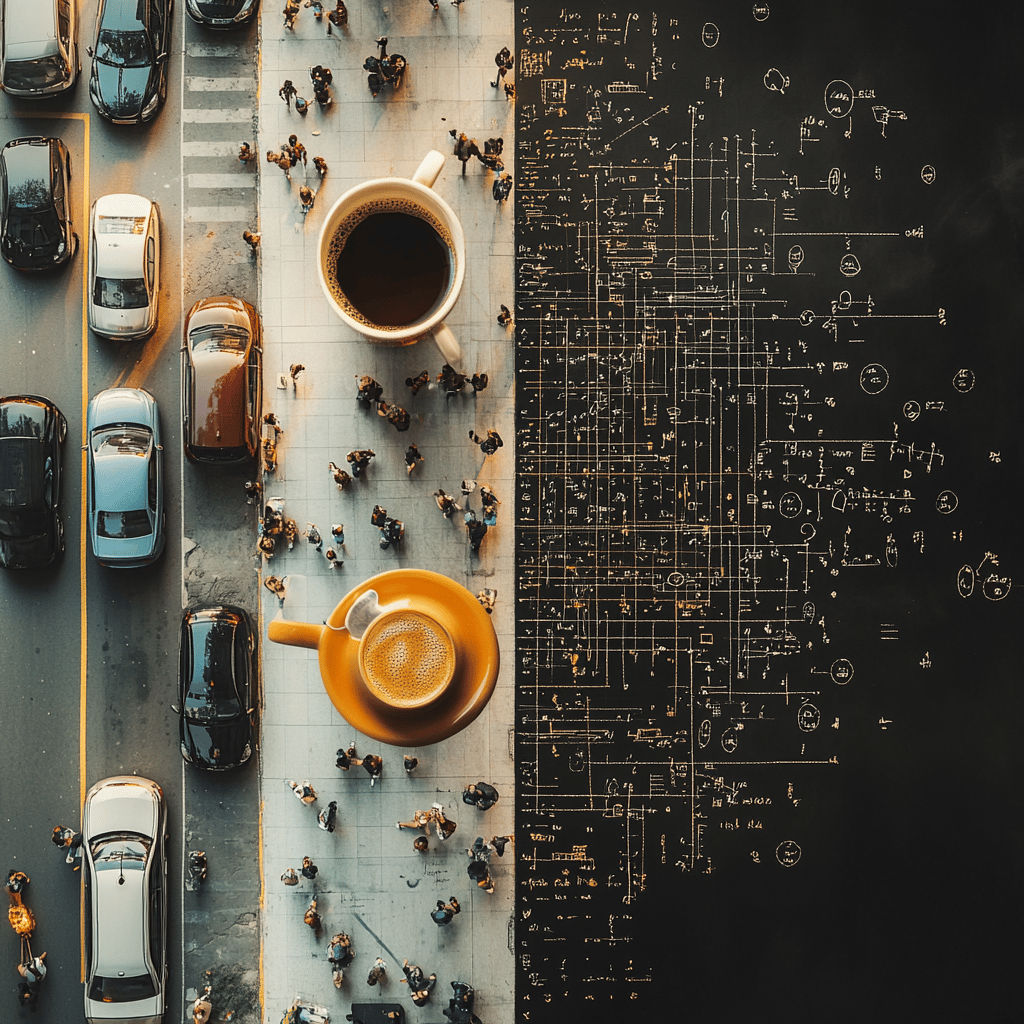
You might not realize it, but math is lurking around every corner of your day. From the moment you wake up to the time you go to bed, there’s math everywhere — in the coffee you drink, the way you drive to work, and even the way you sleep! Let’s dive into the hidden world of math in everyday life and uncover the secrets behind the scenes.
1. The Geometry of Your Morning Coffee
The Math: The shape of a coffee cup is more than just aesthetic. It’s a result of geometry. When you pour coffee into a cup, it follows a curve that minimizes the surface area of the liquid. Why? Because liquids naturally tend to minimize their surface area in a process known as surface tension. So, the classic cylindrical shape of a coffee cup is actually efficient in terms of maximizing volume while minimizing the surface area exposed to air (and cooling down too quickly!).
How It Works: The surface area-to-volume ratio is important in many real-world applications, like designing containers, brewing, and even in biological cells! So, next time you sip your coffee, know that geometry is keeping it hot (or cold, if that’s your preference!).
2. The Math Behind Your Phone’s Battery Life
The Math: We’ve all been there: your phone’s battery is at 100%, and you think you’re good for the day — but a few hours later, it’s at 30%. What's going on? Exponential decay is the culprit. Battery life decreases exponentially as the battery discharges. It's not a straight-line decrease, but rather it drops off more sharply as time goes on.
How It Works: Batteries in your phone (and many other devices) follow the principles of exponential decay, meaning the rate of discharge isn’t constant. Initially, the battery holds its charge fairly well, but as the charge depletes, the rate of decay increases. The math here comes from the fact that the battery’s power decreases by a consistent percentage over time, not a consistent amount.
3. The Pythagorean Theorem in Your GPS
The Math: Every time you use GPS to get from one place to another, you’re relying on the Pythagorean theorem — even if you don’t realize it. GPS coordinates are based on a system of longitude and latitude, which can be treated as a coordinate plane. To find the shortest distance between two points, the Pythagorean theorem (a² + b² = c²) often comes into play.
How It Works: When your GPS calculates the distance between two places, it uses the Cartesian coordinate system (just like the x-y axes in algebra) to figure out the direct “straight-line” distance. So, even if you're traveling along curvy roads, the GPS still uses the Pythagorean theorem in the background to calculate the most direct route. Magic? Nah — just math!
4. The Math of Traffic Jams
The Math: Ever wonder why traffic seems to slow down for no reason, even when there’s no obvious obstacle? That’s chaotic behavior at work. Small disturbances (like one car braking) can cause a ripple effect that leads to bigger slowdowns — and, eventually, a traffic jam. This phenomenon is known as traffic flow theory.
How It Works: Traffic jams can be modeled mathematically using queueing theory and fluid dynamics. It’s like liquid moving through a pipe: the more cars on the road, the slower the flow. If a car brakes suddenly, it creates a “wave” that travels back through the traffic, causing a chain reaction that leads to congestion. By studying the math behind this, cities can optimize traffic light timings and road designs to reduce jams.
5. The Math of Cooking (Perfect Timing)
The Math: Cooking might seem like an art, but it’s also science — and math. For instance, when you’re baking, you’re dealing with temperature gradients. The rate at which heat spreads through the food determines how long it takes to cook properly. This is related to Fourier’s Law of Heat Conduction, which describes how heat moves through materials.
How It Works: When you bake a cake, the heat from the oven moves through the batter from the outside in. The thicker the cake, the longer it takes for heat to reach the center. The math behind this involves calculating how heat spreads over time and distance, ensuring that your cake is perfectly cooked without burning on the outside or being raw on the inside. So, next time you wait for that timer to go off, know that it’s not just luck — it’s the heat transfer equations working their magic.
6. The Probability of Getting a Seat on the Subway
The Math: Ever wondered about the chances of getting a seat on a crowded subway? It’s all about probability theory. If the train is packed and there are a limited number of seats, your chances of snagging one depend on factors like the time of day, how many people are getting on, and how quickly you can spot a vacant seat.
How It Works: Probability theory can model this situation with binomial distribution (if the subway is “full,” how many people can still get a seat?), or more complex Poisson processes (how many people are likely to board in a given time frame). If you're traveling during rush hour, your chances of getting a seat are slim — but once the crowd thins out, your odds improve. Now you can impress your fellow commuters with some math if they ask why you’re so lucky!
7. The Math of Sleep: The 90-Minute Sleep Cycle
The Math: Ever wonder why sleep experts recommend a 90-minute sleep cycle? This is based on the fact that we cycle through different stages of sleep every 90 minutes: light sleep, deep sleep, and REM sleep. Getting in sync with these cycles can help you wake up feeling more rested.
How It Works: The periodicity of the sleep cycle follows a roughly 90-minute rhythm. If you wake up in the middle of a cycle, especially during deep sleep or REM sleep, you’ll feel groggy and tired. But if you wake up at the end of a cycle, you’ll feel much more refreshed. Some people use math-based apps or alarms to help them time their sleep cycles and avoid waking up in the middle of deep sleep.
Conclusion:
Math isn’t just something you learn in school — it’s woven into the fabric of everyday life. From the way your phone loses battery power to the way your coffee cools, math helps make sense of the world around you. So, next time you sip your morning coffee or sit in traffic, remember that behind every little thing, there’s a hidden world of numbers and equations keeping everything running smoothly.