
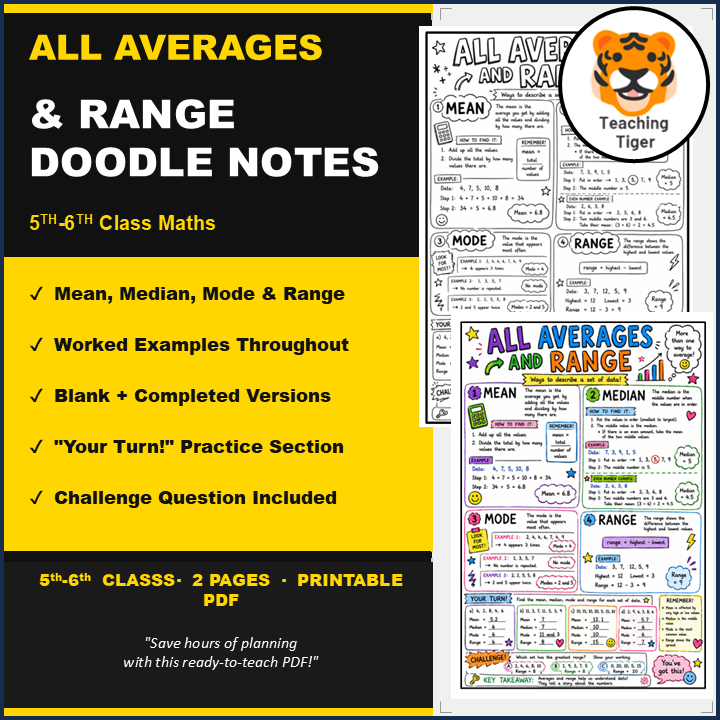
Why Maths Doodle Notes Are a Game-Changer in the Classroom
Maths can sometimes feel overwhelming for students — especially when concepts are packed with formulas, methods, and rules. That’s why more teachers are turning to doodle notes as a powerful way to make maths more visual, memorable, and engaging.
From averages and percentages to algebra and geometry, doodle notes help students organise information in a way that feels less intimidating and far more interactive.
What Are Maths Doodle Notes?
Maths doodle notes are visually organised revision or learning pages that combine:
- Handwritten-style notes
- Diagrams and symbols
- Colour coding
- Arrows and visual connections
- Worked examples
- Small illustrations and icons
- Key vocabulary boxes
- “Remember!” reminders and tips
They often look like a mix between:
- a revision poster,
- a mind map,
- and a student notebook page.
The goal is simple:
help students process information visually while actively engaging with the content.
Find my Maths Doodle Notes on Averages here
Why Doodle Notes Work So Well in Maths
1. They Reduce Cognitive Overload
Large blocks of text can overwhelm learners. Doodle notes break information into smaller chunks using:
- mini boxes,
- headings,
- symbols,
- and visual cues.
This makes difficult maths concepts feel more manageable.
For example, instead of a full paragraph explaining mean, median, mode, and range, students see:
- a quick definition,
- a worked example,
- and a visual reminder.
That’s much easier for the brain to process.
2. Students Remember Visual Information Better
Many students remember:
- colours,
- shapes,
- diagrams,
- and doodles
far more easily than plain text notes.
A student may not remember a written definition of range — but they will remember:
- a large arrow showing “biggest − smallest”
- highlighted numbers,
- or a funny doodle beside the example.
Visual memory is incredibly powerful in maths revision.
3. They Encourage Active Learning
Doodle notes are not passive worksheets.
Students:
- colour sections,
- complete examples,
- draw arrows,
- fill in missing steps,
- highlight key methods,
- and annotate ideas themselves.
This active participation improves retention and understanding.
Instead of simply copying notes from the board, students are building their own revision resource.
4. Perfect for Revision and Retrieval Practice
One-page doodle sheets work brilliantly for:
- starter tasks,
- homework,
- revision lessons,
- intervention groups,
- and exam preparation.
Because information is condensed visually, students can quickly revisit topics before tests.
Popular maths doodle note topics include:
- Mean, median, mode, and range
- Fractions, decimals, and percentages
- Ratio
- Probability
- Algebra basics
- Area and perimeter
- Angles
- Circle formulas
- BIDMAS
- Negative numbers
5. They Help Lower-Attaining and Anxious Learners
Some students struggle with traditional note-taking or dense textbook layouts.
Doodle notes can:
- reduce maths anxiety,
- improve confidence,
- and make learning feel more approachable.
The informal “hand-drawn” style often feels less pressured than formal textbook pages.
For many learners, especially visual learners, this can make a huge difference.
How Teachers Can Use Doodle Notes in Maths Lessons
Guided Lesson Notes
Use partially completed doodle notes during teaching so students fill in examples and methods as you go.
Revision Booklets
Create printable revision packs with one doodle page per topic.
Interactive Notebooks
Students glue doodle notes into maths books and add their own annotations.
Exit Tickets
Ask students to complete one section at the end of the lesson.
Homework Tasks
Students finish colouring or complete missing worked examples at home.
Display Resources
Large doodle posters make excellent classroom displays or revision walls.