

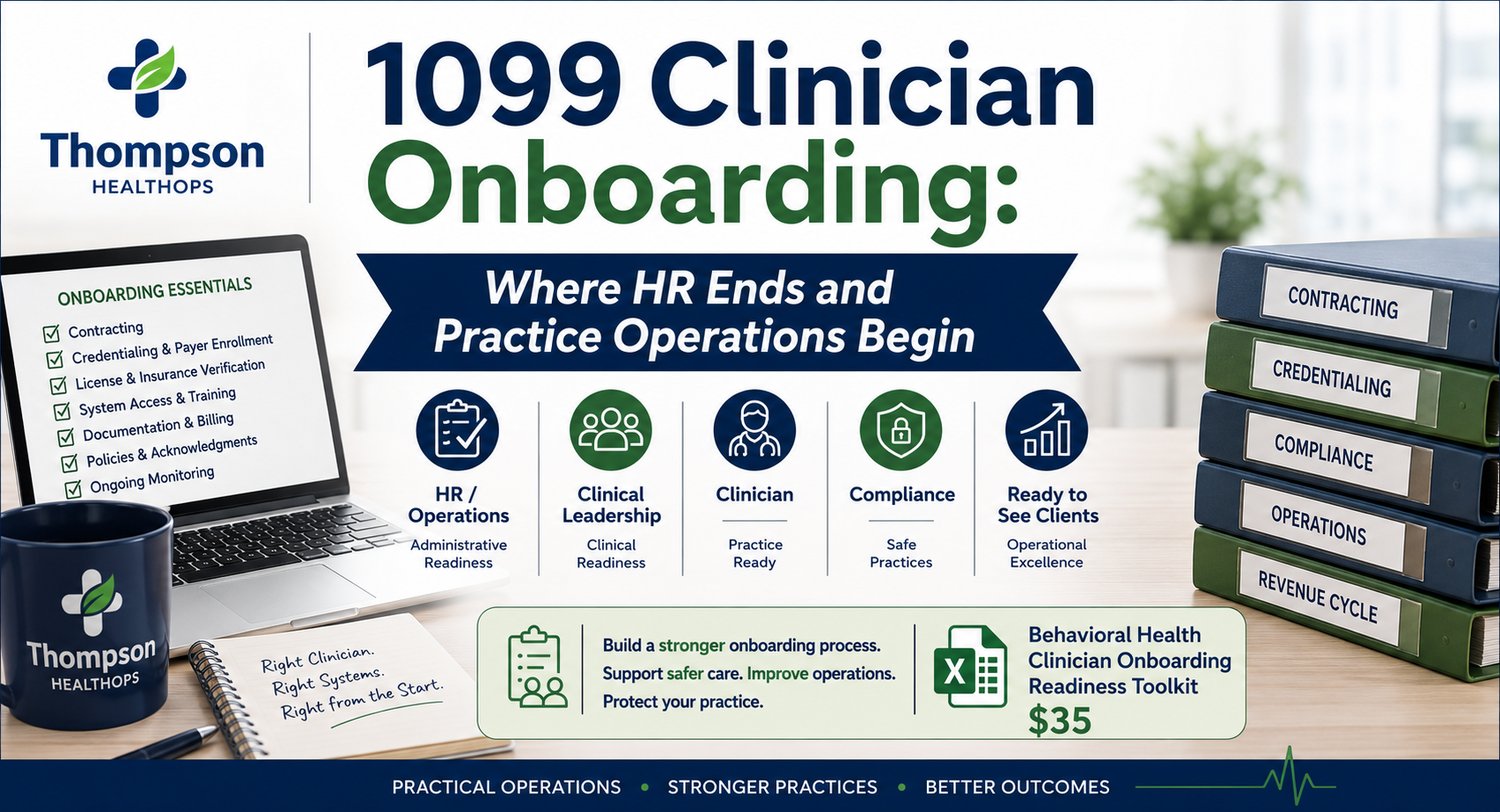
Hiring a 1099 therapist, psychologist, or other behavioral health clinician can feel deceptively simple.
You sign an independent contractor agreement, collect a W-9, give the clinician access to your systems, and start filling their schedule.
Except clinician onboarding isn't just an HR function.
For a behavioral health practice—especially one that accepts insurance—onboarding sits at the intersection of contracting, credentialing, compliance, clinical operations, technology, and revenue cycle management.
A clinician can be fully contracted with your practice and still not be ready to see clients.
Understanding that distinction can prevent compliance problems, billing delays, frustrated clinicians, and avoidable administrative cleanup.
A Signed Contract Is the Beginning, Not the Finish Line
The independent contractor agreement establishes the business relationship, but it doesn't answer all of the operational questions that determine whether a clinician is ready to practice.
Before assigning clients, a practice may need to address areas such as:
- Professional license verification
- Malpractice insurance
- NPI and taxonomy information
- Exclusion and sanction screening
- Payer credentialing and enrollment
- HIPAA and privacy training
- EHR and practice-management system access
- Telehealth requirements
- Documentation and billing expectations
- Administrative workflows
- Emergency and escalation procedures
- Practice policies and acknowledgments
The exact requirements will vary depending on the clinician's profession, state, payer contracts, services provided, and the practice's business model.
That's why a one-size-fits-all new-hire checklist often isn't enough.
HR and Practice Operations Are Not the Same Thing
Traditional onboarding tends to focus heavily on the relationship between the organization and the worker: contracts, tax documentation, policies, contact information, and workplace expectations.
Behavioral health adds another layer.
Someone also has to answer questions such as:
Is the clinician properly licensed for the services and locations involved?
Has the practice verified the credentials it relies upon?
If the clinician will see insurance-based clients, when is the clinician actually effective with the payer?
Is the clinician configured correctly in the EHR and billing systems?
Does the clinician understand the practice's documentation and charge-capture workflow?
Has appropriate access been established without providing unnecessary access to protected information?
Does the clinician know what to do when an administrative, privacy, billing, or clinical issue needs to be escalated?
Those questions move onboarding beyond paperwork and into practice operations.
Credentialed Doesn't Always Mean Ready
This distinction is especially important for insurance-based practices.
Submitting a credentialing or enrollment application does not necessarily mean a clinician can immediately begin seeing patients under a payer contract.
Practices should know the clinician's actual enrollment or participation status and applicable effective date before assigning insurance-based clients.
The same principle applies elsewhere.
Having an EHR username doesn't mean the clinician's profile is configured correctly.
Completing HIPAA training doesn't mean the clinician understands your practice's privacy procedures.
Having an active license doesn't automatically answer whether the clinician's scope, location, services, supervision requirements, or payer participation are appropriate for a particular client.
Readiness is the combination of multiple completed requirements—not a single checkbox.
Separate Administrative and Clinical Responsibilities
Another common source of confusion is deciding who owns each part of onboarding.
Operations or HR will often be responsible for administrative areas such as collecting documentation, tracking licenses and expiration dates, coordinating payer enrollment, administering compliance training, establishing system access, and explaining practice workflows.
Clinical leadership should generally retain responsibility for clinical matters such as scope of practice, clinical competency, supervision when applicable, clinical protocols, crisis procedures, and standards of care.
Some areas require both.
Documentation is a good example. Operations may establish expectations for note completion, workflow, billing deadlines, and system use. Clinical leadership determines the clinical standards governing the content and quality of that documentation.
Clearly defining ownership helps prevent important tasks from falling into the gap between “I thought HR handled that” and “I thought the clinical director handled that.”
Think in Phases, Not Just Checkboxes
A useful onboarding process also considers when something needs to happen.
Some requirements belong in pre-onboarding.
Others must be completed before the first client.
Still others should be reviewed during the clinician's first 30, 60, or 90 days.
And many requirements don't end when onboarding does. Licenses expire. Insurance policies renew. Payers recredential. Training may need to be repeated. Policies change. System access changes.
A strong onboarding process therefore becomes an ongoing readiness process.
Don't Forget the First 90 Days
Once a clinician begins seeing clients, the practice has an opportunity to identify problems before they become patterns.
An early operational review might look at:
- Documentation timeliness
- Scheduling or intake problems
- EHR access issues
- Billing exceptions
- Early claim denials
- Payer configuration problems
- Questions about administrative workflows
- Outstanding onboarding requirements
For insurance-based practices, reviewing early claims can be particularly useful. A credentialing, taxonomy, location, system configuration, or workflow problem is much easier to address after a handful of claims than after several months of services.
Build for Readiness, Not Just Completion
The goal of clinician onboarding shouldn't simply be to get every box checked.
The more useful question is:
Is this clinician ready to see clients safely, compliantly, and operationally within our practice model?
That requires looking beyond HR paperwork and connecting onboarding to credentialing, compliance, practice operations, clinical leadership, technology, and revenue cycle processes.
For a small behavioral health practice, that structure doesn't have to be complicated. It does, however, need to be intentional.
Need a More Structured Way to Track Clinician Onboarding?
The Behavioral Health Clinician Onboarding Readiness Toolkit is an Excel-based system designed for small behavioral health practices.
It includes a master onboarding blueprint, clinician readiness tracking, an Operations/HR vs. Clinical Leadership responsibility matrix, recurring-requirement tracking, and a readiness dashboard to help practices organize the process from pre-onboarding through ongoing requirements.
Behavioral Health Clinician Onboarding Readiness Toolkit — $35
This article and the Thompson HealthOps toolkit are intended for general operational and educational purposes and do not constitute legal advice. Requirements vary by jurisdiction, profession, payer, contractual relationship, and practice circumstances. Practices should verify the requirements applicable to their organization.