

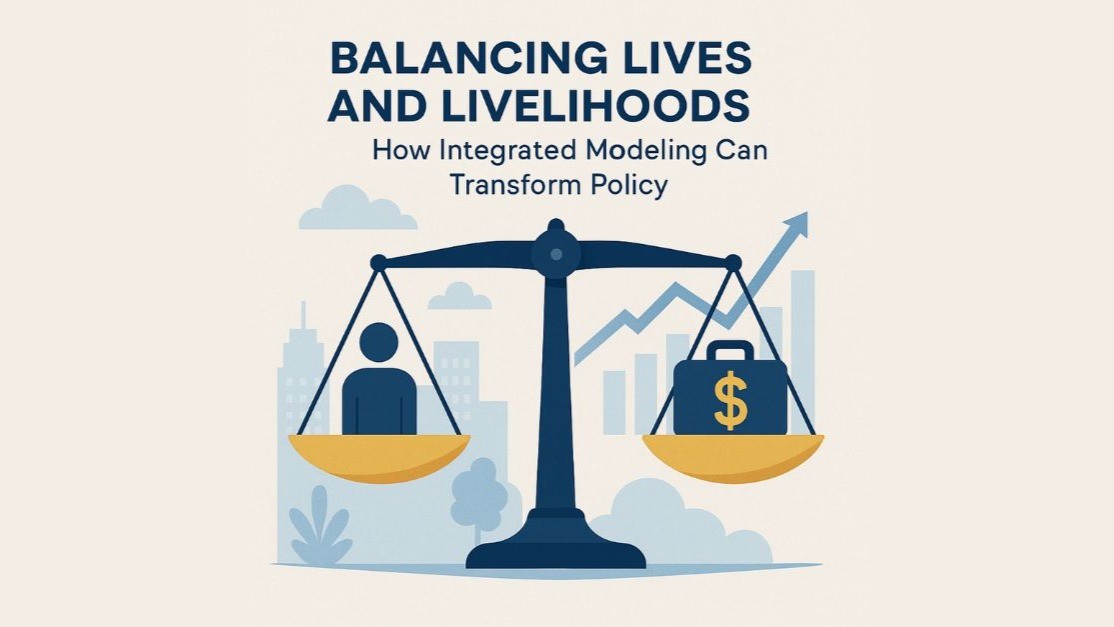
When crises strike—whether pandemics, climate emergencies, or economic downturns—policy makers face an impossible-seeming dilemma: how do we protect lives without devastating livelihoods? Too often, public health decisions are made in isolation, focusing solely on disease metrics while ignoring the ripple effects on jobs, mental health, and social stability. The result? Policies that save lives in the short term but create long-term challenges that could have been anticipated—and mitigated—with a more holistic approach.
This is where integrated modeling comes in: a powerful way to combine health, economic, and social data to support smarter, more balanced policy.
The Limits of Siloed Models
Traditional public health models excel at projecting infection rates, hospital demands, and mortality. But they rarely consider economic impact (such as unemployment spikes) or social consequences (like rising inequality or burnout among frontline workers). Meanwhile, economic models often ignore the toll of illness and healthcare strain.
When these models are used separately, decision makers are left with a fragmented picture—like trying to solve a puzzle with only half the pieces.
Why Integrated Modeling Matters
An integrated model weaves together health outcomes, economic performance, and social well-being. Instead of focusing on one domain at a time, it reveals the interdependencies:
Health ↔ Economy: A healthy workforce fuels productivity, while strong economies fund better healthcare access.
Social Stability ↔ Health Outcomes: Policies that ignore inequities risk worsening health gaps, as vulnerable groups bear the brunt of crises.
Short-Term vs. Long-Term: Integrated models highlight trade-offs, ensuring quick fixes don’t undermine future resilience.
By making these connections visible, policy makers can create strategies that protect both lives and livelihoods.
Turning Data Into Smarter Decisions
How can policy makers make the most of integrated modeling?
Scenario Planning: Test different approaches—for example, comparing the impact of partial lockdowns with targeted economic relief.
Equity Lens: Incorporate data on marginalized populations to ensure policies don’t unintentionally widen disparities.
Communication Clarity: Share insights with the public transparently. Explaining the “why” behind policies builds trust and compliance.
Cross-Sector Collaboration: Encourage health experts, economists, and sociologists to co-create models instead of working in silos.
From Crisis Response to Long-Term Resilience
Integrated modeling isn’t just a crisis tool—it’s a policy innovation strategy. By balancing health, economic, and social dimensions, it equips leaders to anticipate ripple effects, weigh trade-offs more effectively, and design policies that foster resilience.
For policy makers, the question isn’t whether to adopt integrated modeling—it’s how quickly they can embrace it. The future of effective governance lies in seeing the bigger picture, where saving lives and protecting livelihoods are not competing goals, but complementary ones.