

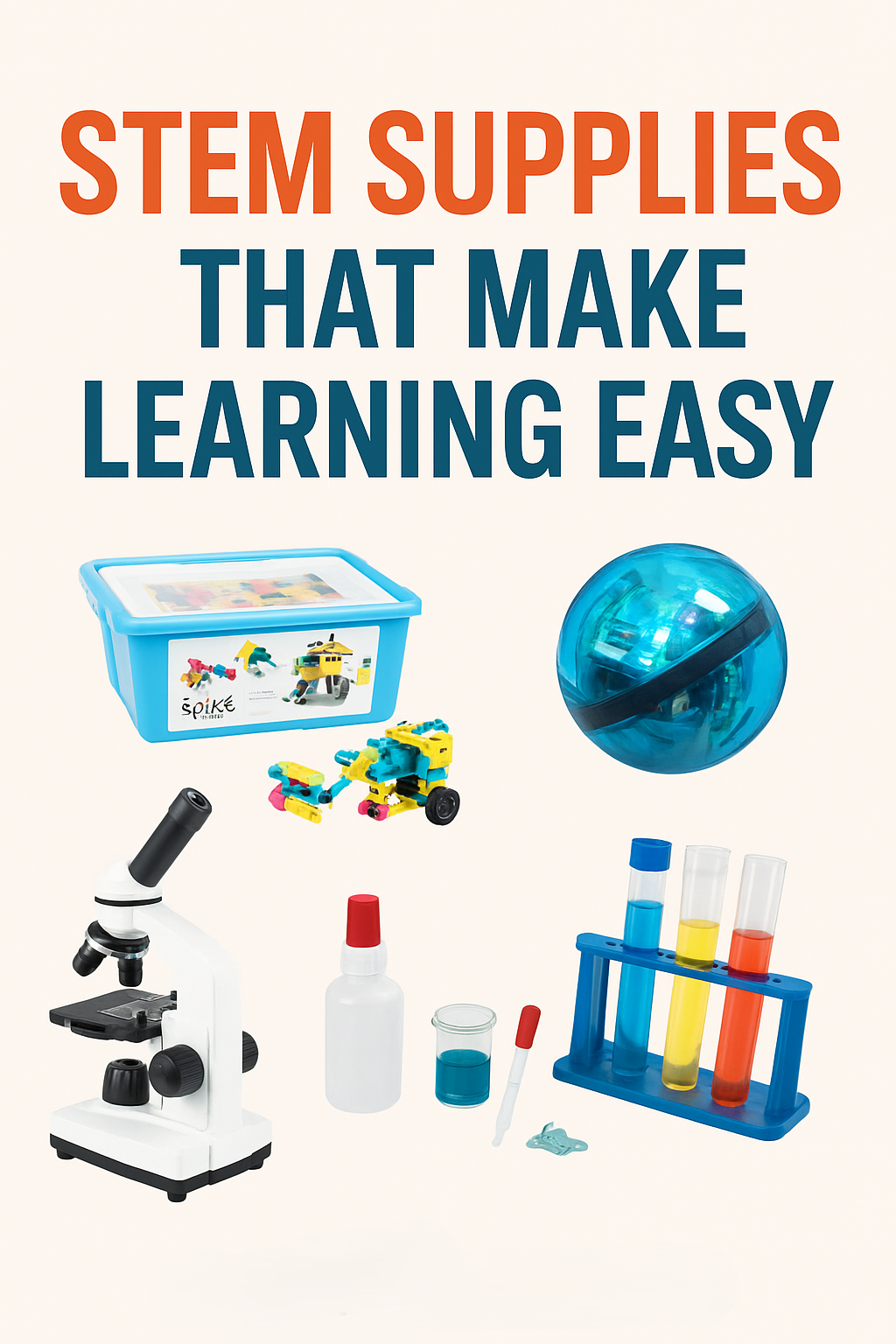
Explore the best STEM supplies that make learning interactive, hands-on, and engaging! Discover research-backed tools — from LEGO kits and microscopes to 3D printers — that bring science, technology, engineering, and math to life in your classroom.
🌟 Why STEM Supplies Matter
STEM education gives students the chance to explore how the world works through discovery and creativity. When students build, test, and solve real-world problems, they learn essential skills like perseverance, innovation, and critical thinking.
However, hands-on materials are the key to bringing these lessons to life. Students who use manipulatives, kits, and interactive tools show higher engagement and longer retention compared to those who only listen to lectures (Trundle & Saçkes, 2012).
The following STEM supplies make teaching and learning easier by creating environments where students can tinker, experiment, and make connections between theory and reality.
🧱 1. LEGO® Education Sets: Building Minds Through Play
LEGO Education sets are more than toys—they’re mini engineering labs that spark creativity. They combine the excitement of building with real-world concepts like force, motion, and design.
In the Classroom:
Teachers can integrate LEGO projects into almost any subject. In science, students can design simple machines to demonstrate motion. In math, they can calculate gear ratios or measure structural stability. LEGO bricks also build collaboration and social-emotional learning as students share roles and solve design challenges together.
Benefits:
- Strengthens problem-solving and spatial awareness.
- Encourages hands-on experimentation and trial-and-error learning.
- Supports inquiry-based instruction aligned with Next Generation Science Standards (NGSS).
- Fosters teamwork and communication in group settings.
Recommended Products:
- LEGO Education Spike Prime Set — ideal for middle school robotics.
- LEGO Simple Machines Set — great for introducing mechanical concepts to younger learners.
Research Insight:
Highfield, Ralph, and Hine (2018) found that LEGO robotics increased computational thinking and collaboration, helping students see coding and problem-solving as fun and approachable.
⚙️ 2. Circuit Kits and Coding Robots: Learning Through Technology
Technology-based kits like Snap Circuits, Sphero, and Ozobot bridge the gap between abstract ideas and hands-on learning. Students can build circuits, explore conductivity, and even code robots to navigate mazes—all while understanding real-world applications of engineering and programming.
In the Classroom:
Students can start by connecting simple light circuits, then progress to creating series and parallel configurations. With robots, they can design obstacle courses and use block-based coding to program different outcomes—turning logic and sequencing into a game.
Benefits:
- Builds computational and systems thinking.
- Promotes logical reasoning and problem-solving persistence.
- Helps students visualize electricity and coding concepts in real time.
- Easily adapts to multiple grade levels and learning abilities.
Recommended Products:
- Snap Circuits Jr. SC-100 — perfect for introducing basic electronics.
- Sphero BOLT Robot — integrates STEM and coding seamlessly for grades 3–8.
Research Insight:
Kim and Park (2021) showed that robotics-based learning significantly boosts creativity and computational thinking, especially when used in collaborative environments.
🔬 3. Microscopes and Lab Kits: Discovering the Invisible
Nothing excites students more than seeing the unseen. Microscopes and science kits transform classrooms into laboratories where curiosity thrives.
In the Classroom:
You can use microscopes to study plant cells, pond water, or even fingerprints. Chemistry kits allow students to safely explore reactions, mixtures, and chemical changes. Pairing these tools with student lab journals reinforces observation, prediction, and reflection — key parts of scientific inquiry.
Benefits:
- Promotes inquiry and experimentation.
- Enhances attention to detail and data recording.
- Helps students connect textbook concepts to real phenomena.
- Supports NGSS standards on structure and function.
Recommended Products:
- AmScope Beginner Microscope Kit — a durable choice for upper elementary and middle school.
- Thames & Kosmos Chemistry Kit — includes safe experiments aligned with classroom lessons.
Research Insight:
Trundle & Saçkes (2012) demonstrated that hands-on inquiry improves student motivation and deepens conceptual understanding in early science education.
🧮 4. Engineering Building Sets: Designing, Testing, and Learning
Engineering sets encourage students to think like real engineers. By constructing bridges, cranes, or roller coasters, they learn how math and physics apply to the structures around them.
In the Classroom:
Students can explore balance and tension by designing bridges that must hold a certain weight or use pulleys and levers to move objects. Teachers can use these sets during STEM challenges, team competitions, or cross-curricular units combining math and art.
Benefits:
- Reinforces geometry, force, and motion principles.
- Builds patience, precision, and planning skills.
- Encourages reflection through redesign and testing.
- Perfect for engineering design projects in makerspaces.
Recommended Products:
- K’NEX STEM Explorations Building Set — versatile pieces for bridges, cranes, and cars.
- Engino Discovering STEM Structures Kit — ideal for middle school physics integration.
Research Insight:
Wendell and Rogers (2013) found that when students design and test models, they develop stronger critical thinking and problem-solving abilities—skills crucial for both STEM fields and everyday life.
💻 5. Digital Tools for Data and Design: Preparing for the Future
Digital creation tools such as Tinkercad, 3D printers, and drawing tablets bring the design process to the digital world. They help students imagine, prototype, and analyze data visually—preparing them for the digital future.
In the Classroom:
Students can use Tinkercad to create 3D models of inventions or replicate real-world objects, then print them with a 3D printer. Tablets like Wacom are perfect for STEM art integration or for diagramming processes in biology and engineering.
Benefits:
- Builds digital fluency and creativity.
- Provides safe experimentation environments.
- Integrates technology seamlessly into core STEM areas.
- Helps students connect data visualization to real-world solutions.
Recommended Products:
- Creality Ender 3 3D Printer — affordable, classroom-friendly 3D printer.
- Wacom Intuos Drawing Tablet — great for digital notes and design projects.
Research Insight:
Li and Ma (2020) found that digital modeling tools improved student engagement and comprehension, especially when students could visualize and test their ideas virtually.
❓What ones do you like in your classroom?
My personal favorite is Legos. Legos can be used for so many different projects and activities. It is also fun to see what the students create. Comment your favorite STEM supplies below.
🧾 Amazon Affiliate Disclosure
As an Amazon Associate, I earn from qualifying purchases. This means if you click on a link and make a purchase, I may receive a small commission — at no additional cost to you.
I only recommend resources that I personally use or genuinely believe will benefit educators and students. This post follows FTC and Amazon Associates Program requirements for transparency and ethical marketing.
📚 References (APA Format)
- Highfield, K., Ralph, R., & Hine, G. (2018). Robotics in education: Students’ perceptions of learning through LEGO robotics. Australasian Journal of Educational Technology, 34(2), 70–85.
- Kim, S., & Park, M. (2021). The effects of coding and robotics education on students’ creativity and computational thinking. Computers & Education, 168, 104215.
- Trundle, K. C., & Saçkes, M. (2012). Science learning through inquiry-based experiences in early childhood. Journal of Science Education and Technology, 21(6), 749–758.
- Wendell, K. B., & Rogers, C. (2013). Engineering design-based science, science content performance, and science attitudes in elementary school. Journal of Engineering Education, 102(4), 513–540.
- Li, Y., & Ma, L. (2020). Digital modeling and virtual simulation in STEM education: Enhancing conceptual understanding and engagement. Computers in Human Behavior, 110, 106374.
Comments ()