

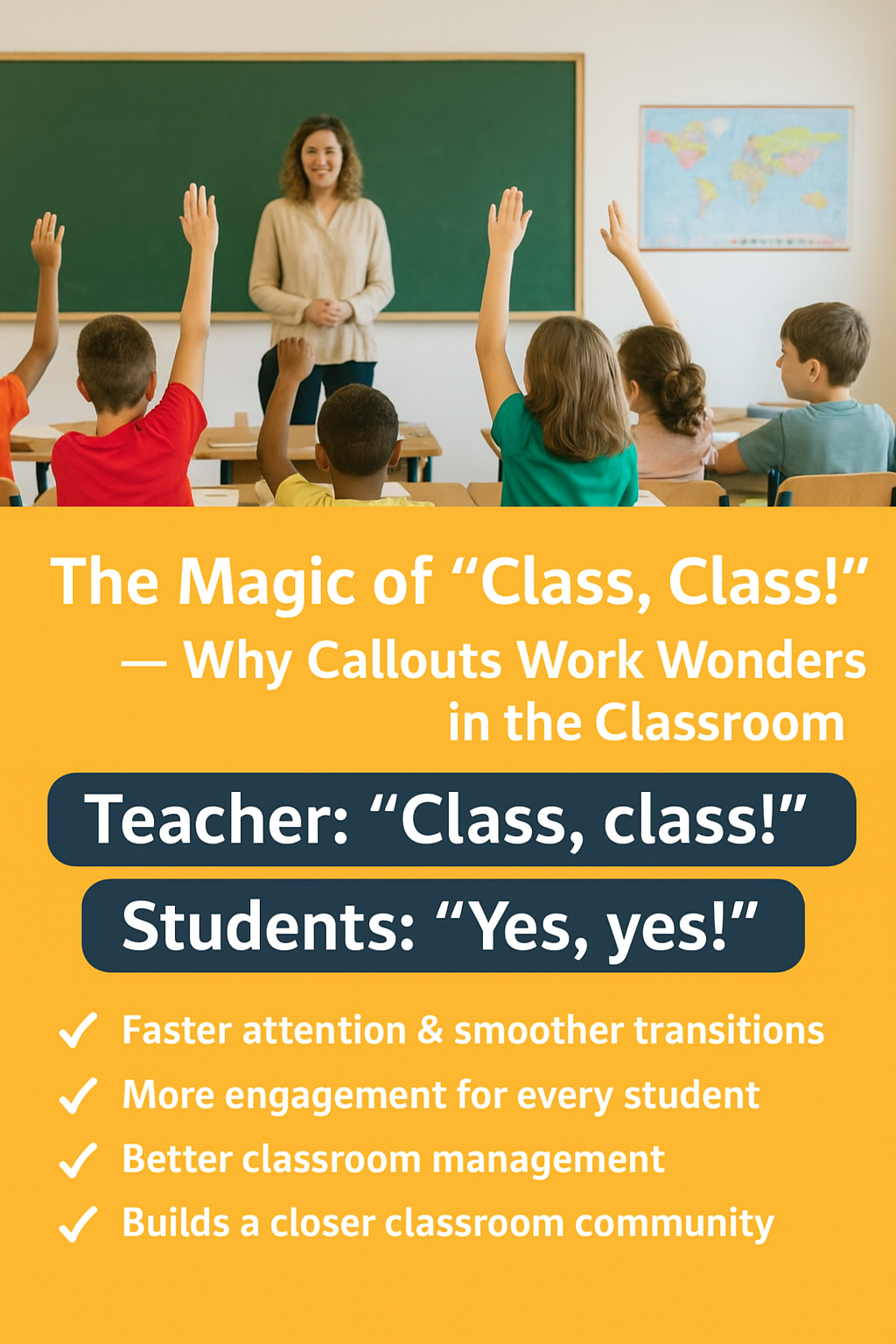
Do your students ever get a little too chatty between lessons? 😅
Try this:
👩🏫 Teacher: “Class, class!”
👧 Students: “Yes, yes!”
That’s it! A simple call-and-response cue—also known as a classroom callout—that instantly grabs attention and resets the room.
Let’s talk about why these little phrases work so well, what research says, and how to make them part of your classroom routine. 💬✨
🎯 What Are Classroom Callouts?
Callouts are quick, verbal attention-getters that build structure, routine, and focus. They’re a type of behavioral cue that helps your students stop, listen, and reset—without you ever raising your voice.
Think of them as a fun, brain-friendly way to bring everyone back together.
💡 The Benefits of Using Callouts
1️⃣ Faster Attention & Smoother Transitions
Studies show that clear, consistent cues help students transition more quickly and stay focused (Kamps et al., 2008). Instead of saying, “Okay, everyone quiet down,” ten times, one “Class, class!” does the trick!
2️⃣ More Engagement for Every Student
When students respond together, everyone gets to participate! This “choral responding” boosts engagement and helps every learner feel included (Haydon et al., 2010).
3️⃣ Better Classroom Management
Callouts build predictable routines, helping your class know exactly what’s expected. Less off-task behavior means more time for learning (Simonsen et al., 2008).
4️⃣ Builds a Stronger Classroom Community 💕
Shared verbal routines—like class callouts—build a sense of belonging and teamwork (Madsen & Sebastiani, 2022). They become your class thing!
5️⃣ Encourages Participation from Shy Students
Because everyone responds together, callouts create a safe space where quieter students can join in without feeling put on the spot (Sutherland et al., 2008).
🧠 Teacher Tips for Using Callouts
✔️ Teach and practice your callouts at the start of the year.
✔️ Keep it fun and varied—change up your tone or add hand motions.
✔️ Use them consistently so students know you mean business (in a kind way!).
✔️ Don’t overdo it—save them for when you really need attention.
🪄 Try These Callout Ideas
- “Classity class!” → “Yessity yes!”
- “One, two, three, eyes on me!” → “One, two, eyes on you!”
- “Macaroni and cheese!” → “Everybody freeze!”
- “Hands and eyes!” → “Ready to rise!”
- "Hocus Pocus" → “Everybody Focus"
You can even let your students help create their own—instant buy-in!
🏁 Final Thoughts
Call-and-response routines like “Class, class! / Yes, yes!” are more than cute classroom moments—they’re evidence-based tools that improve focus, reduce disruptions, and build connection.
When you teach with rhythm and routine, students feel safe, heard, and ready to learn. 💪✨
📚 Sources Cited (APA 7th Edition)
Haydon, T., Mancil, G. R., & Van Loan, C. L. (2010). Using choral responding to increase active student response during whole‐class instruction. Beyond Behavior, 19(2), 18–24. https://doi.org/10.1177/107429561001900204
Kamps, D., Wendland, M., & Culpepper, M. (2008). Active student responding: Reducing inappropriate behavior through increased academic engagement. Behavioral Disorders, 33(4), 239–256. https://doi.org/10.1177/019874290803300404
Madsen, C., & Sebastiani, L. (2022). Ritual and rhythm: Building classroom community through shared verbal practices. Teaching and Teacher Education, 115, 103731. https://doi.org/10.1016/j.tate.2022.103731
Simonsen, B., Fairbanks, S., Briesch, A., Myers, D., & Sugai, G. (2008). Evidence-based practices in classroom management: Considerations for research to practice. Education and Treatment of Children, 31(3), 351–380. https://doi.org/10.1353/etc.0.0007
Sutherland, K. S., Alder, N., & Gunter, P. L. (2008). The effect of varying rates of opportunities to respond to academic requests on the classroom behavior of students with EBD. Journal of Emotional and Behavioral Disorders, 11(4), 239–248. https://doi.org/10.1177/106342660301100405
Comments ()