

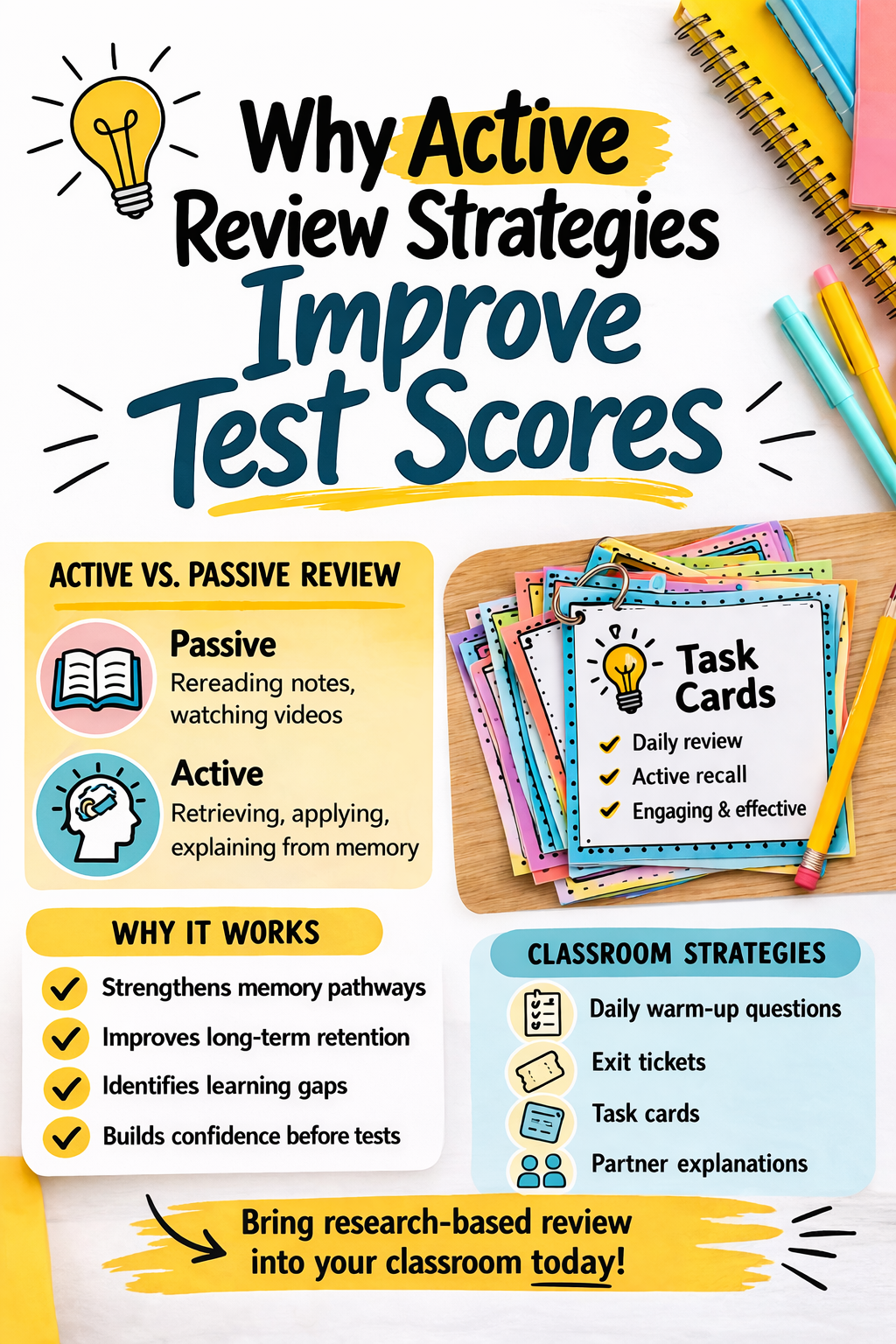
Students often spend hours studying, but time alone doesn’t guarantee results. The real difference lies in how they study—specifically, whether learning is active or passive.
Shifting from passive review to active engagement is one of the most powerful ways teachers can improve student outcomes.
🧠 Active vs. Passive Review
Passive review includes activities like rereading notes, highlighting text, or watching instructional videos. While these methods may feel productive, they often create an illusion of learning—students recognize information but struggle to recall it independently.
Active review, on the other hand, requires students to retrieve and apply information without immediately seeing the answer.
Examples include:
- Answering questions without notes
- Explaining concepts out loud
- Solving problems from memory
- Teaching a peer
This process—known as retrieval practice—forces the brain to work harder, which strengthens memory and understanding.
🔍 What the Research Says
Research in cognitive science consistently shows that active recall is far more effective than passive review:
- Henry L. Roediger III and Jeffrey D. Karpicke (2006) found that students who practiced retrieval remembered significantly more information long-term than those who simply reread material.
- John Dunlosky et al. (2013) identified practice testing and distributed practice as two of the highest-impact learning strategies out of ten commonly used study techniques.
- Robert A. Bjork describes retrieval as a “desirable difficulty,” meaning it feels harder in the moment but leads to stronger, more durable learning.
📈 Why Active Review Works
Active review strengthens learning in several key ways:
Strengthens Memory Pathways
Each time students retrieve information, neural connections are reinforced, making recall faster and more reliable.
Improves Long-Term Retention
Information practiced through retrieval is stored more deeply than information that is simply reread.
Identifies Learning Gaps
When students attempt to recall and struggle, it reveals exactly what they don’t yet understand—allowing for targeted reteaching.
Builds Confidence Before Testing
Practicing recall under low-stakes conditions reduces anxiety and improves performance on high-stakes tests.
💡 Classroom Strategies That Use Active Review
You don’t need to overhaul your entire lesson plan—small shifts can make a big impact:
Daily Warm-Ups
Start class with 2–3 questions from previous lessons to reinforce prior learning.
Exit Tickets
Have students write or explain one key concept from the day without looking at notes.
Encourage movement and engagement while practicing retrieval in short bursts. Click the link for my freebie task cards.
Partner Explanations
Students take turns teaching a concept to a peer—one of the most effective forms of active learning.
Low-Stakes Quizzing
Frequent, no-pressure quizzes help normalize retrieval and improve retention over time.
⚖️ Active Learning + Time Matters
Active strategies are even more powerful when combined with spaced practice—reviewing material over time instead of cramming.
Research shows that spacing + retrieval leads to significantly higher retention than either strategy alone (Cepeda et al., 2006).
📌 Bring It Into Your Classroom
Active review doesn’t have to be complicated or time-consuming. With the right tools, you can easily incorporate research-based strategies into your daily routine.
✨ Use my interactive review activities to make retrieval practice engaging, effective, and simple to implement.
📚 Sources
- Roediger, H. L., & Karpicke, J. D. (2006). Test-enhanced learning: Taking memory tests improves long-term retention. Psychological Science.
- Dunlosky, J., Rawson, K. A., Marsh, E. J., Nathan, M. J., & Willingham, D. T. (2013). Improving students’ learning with effective learning techniques. Psychological Science in the Public Interest.
- Bjork, R. A. (1994). Memory and metamemory considerations in the training of human beings.
- Cepeda, N. J., et al. (2006). Distributed practice in verbal recall tasks: A review and quantitative synthesis. Psychological Bulletin.
Comments ()