

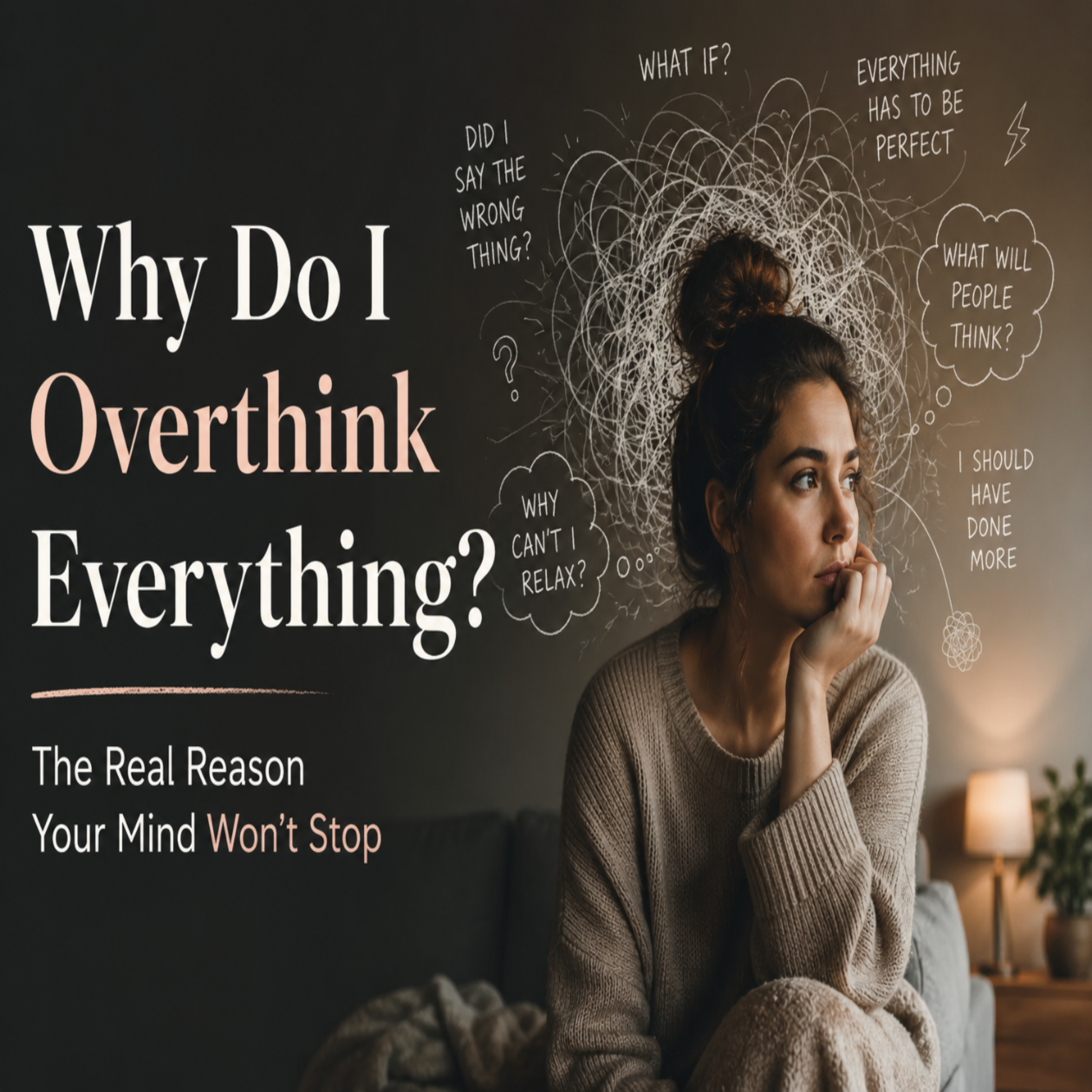
Why Do I Overthink Everything?
You replay a conversation that ended hours ago and start wondering whether you said the wrong thing. You make a decision, only to question it twenty minutes later. You imagine situations that haven't happened yet and prepare yourself for outcomes that may never happen. Eventually, after exhausting yourself with possibilities, you ask the question that brought you here: Why do I overthink everything?
One reason is that your mind is searching for something life rarely gives you: certainty. You want to know that you made the right decision, what someone really meant, whether tomorrow will work out the way you hope, and whether the choice you're about to make will turn out to be the correct one. Thinking feels like a way of gaining control over those unknowns, but eventually thinking stops producing useful information. You're no longer solving the problem. You're repeating it. That's where thinking can become overthinking.
What Overthinking Actually Looks Like
Overthinking isn't the same as thinking deeply. Deep thinking can be incredibly useful. You consider the information available to you, examine your options, reach a conclusion and move forward. Overthinking begins when that process refuses to end. You revisit the same question, imagine another possibility and find another reason to doubt the conclusion you reached five minutes earlier.
The problem isn't necessarily how much you think. The better question is whether your thinking is actually taking you anywhere. There is a significant difference between thinking that leads to a decision and thinking that simply produces more thinking. When you recognize yourself entering that loop, ask:
Is this thought helping me make a decision, or am I waiting for a level of certainty that doesn't exist?
Why Do I Overthink Everything?
There isn't one universal reason people overthink, because everyone's circumstances are different. However, there is a common pattern worth recognizing. When something matters to you, you naturally want to get it right. The more important the decision feels, the more pressure you may place on yourself to predict what will happen.
That's when the questions begin. What if I make the wrong choice? What if they misunderstood me? What if I embarrass myself? What if this doesn't work? What if I regret this six months from now? Thinking gives you the feeling that you're doing something about the uncertainty, so you continue analyzing.
The problem is that many of life's questions cannot be completely answered beforehand. Eventually, more thinking doesn't create more certainty. It simply gives your mind more possibilities to examine.
Your Mind Is Searching for Certainty
Imagine you're considering accepting a new job. You compare the salary, research the company, consider the location, think about career progression and perhaps speak to people you trust. All of that is useful thinking. Eventually, however, you've gathered most of the information reasonably available to you. Now comes the uncomfortable part: you have to choose.
You can't know exactly what your new manager will be like. You can't know whether you'll enjoy the position six months from now. You can't know whether another opportunity would have appeared if you'd waited another month. There is uncertainty, and an overthinking loop can begin when you refuse to move until that uncertainty disappears.
So you research again. You ask another person. You rewrite your list of advantages and disadvantages. You imagine another scenario. Yet the missing information may not be hiding somewhere waiting to be discovered. Sometimes it simply doesn't exist yet. You'll only discover what happens after you act.
That's one of the most uncomfortable truths about overthinking:
sometimes you're not missing an answer. You're struggling to accept uncertainty.
Thinking vs Overthinking
A useful way to recognize overthinking is to ask whether your thoughts are producing something actionable. Healthy thinking tends to move from a problem to information, from information to options, and eventually from options to a decision and action. Overthinking follows a different path. You identify the problem, gather information, consider your options, begin doubting them, gather more information, discover more possibilities and eventually arrive back at the original problem.
That loop can feel productive because your mind is extremely busy. But being mentally busy isn't the same as making progress. You can spend three hours analyzing something without being any closer to making a decision.
Sometimes the most useful question isn't,
"What else can I think about?" It's, "Do I already know enough to take the next reasonable step?"
Why You Replay Conversations in Your Head
You leave a conversation and suddenly remember something you said. A few minutes later, your mind starts analyzing it. Why did I say that? Did that sound strange? Maybe they thought I meant something else. I should have explained myself differently.
Before long, you're having the conversation again, except this time you're playing every role. You're deciding what the other person heard, what they thought about it and what they now think about you. The problem is that you don't actually have access to most of that information. You're filling the gaps with assumptions.
Because there is no definitive answer available, your mind can continue generating interpretations almost indefinitely. When you notice this happening, ask yourself whether there is something you genuinely need to do about the conversation. If you need to clarify something or apologize, that's an action. If there is nothing to do, replaying the conversation another twenty times probably won't provide the certainty you're searching for.
Why You Second-Guess Your Decisions
Overthinking can create the belief that another round of analysis will protect you from making a bad decision. Yet almost every meaningful choice contains disadvantages. Choose A and you wonder about B. Choose B and you start thinking A might have been safer. Even after you've decided, your mind can reopen the case.
Behind this pattern is an unrealistic expectation: a good decision should feel completely certain. It often doesn't. You can make a reasonable decision and still feel unsure. You can make the best choice available with the information you have today and later discover that circumstances changed.
You can even make a decision that doesn't work out without that automatically meaning you were foolish for making it. Good decision-making isn't the ability to predict the future. It's the ability to make reasonable choices despite incomplete information.
Why Overthinking Can Feel Worse at Night
During the day, your attention constantly has somewhere else to go. There is work, messages, people, responsibilities and noise. Then you get into bed and most of those distractions disappear. Suddenly your mind has space to revisit everything it postponed.
The awkward conversation returns. Tomorrow's meeting appears. The decision you haven't made demands attention. Something you did three years ago somehow decides that midnight is the perfect time to make another appearance.
Trying to force yourself to "stop thinking" can become another battle. Instead, notice what your mind is asking you to solve. Is there something you can realistically act on right now? If there is, identify the next reasonable action. If there isn't, recognize that another hour of thinking probably won't produce information that isn't currently available.
Not every question needs to be solved tonight.
How to Interrupt the Overthinking Loop
Breaking an overthinking loop doesn't necessarily require you to win an argument with every thought. Start by identifying exactly what you're trying to solve. Mental noise often feels enormous because ten different questions are happening simultaneously. Reduce them to one clear problem.
Then ask whether you currently have enough information to do something about it. If the answer is yes, identify the next reasonable action. Not the perfect action. Not the action guaranteed to produce the perfect outcome. Just the next reasonable one.
If you cannot act, ask yourself another question: What information am I expecting more thinking to produce? Sometimes there is a legitimate answer and you need more information. Other times, the answer is uncomfortable because you're not waiting for information at all. You're waiting to feel certain.
Recognizing that difference can change the entire conversation happening inside your head.
You Don't Need Certainty to Move Forward
Overthinking makes an attractive promise: think a little longer and you'll finally feel sure. The problem is that the feeling you're waiting for may never arrive. There will always be another possibility, another interpretation, another risk and another question you could ask.
At some point, progress requires accepting that you don't know everything. You make the phone call. You send the message. You choose. You apply. You say no. You say yes. You move forward.
Not because you're certain, but because you've thought enough.
The goal isn't to become someone who never thinks deeply. Your ability to think can be one of your greatest strengths. The goal is learning to recognize when your thinking has finished its job and when continuing to analyze has simply become another way of avoiding action.
When Overthinking Starts Affecting Everyday Life
Most people can become stuck in their thoughts occasionally, particularly when something important or uncertain is happening. However, persistent worry, rumination or distress can sometimes interfere with sleep, work, relationships and everyday functioning.
If what you're experiencing is persistent or significantly affecting your daily life, consider speaking with a qualified mental-health professional. You don't need to diagnose yourself or understand exactly what's happening before asking for professional support.
Sometimes the next useful action isn't another hour spent trying to understand everything yourself. It's having a conversation with someone qualified to help you make sense of what you're experiencing.
The Truth About Overthinking
Understanding overthinking isn't about learning how to empty your mind. It's about changing the relationship you have with your thoughts and recognizing that not every thought requires an answer, reaction or decision.
In The Truth About Overthinking, PeteB takes this conversation further, exploring why we become trapped inside our own thinking, how our search for certainty can keep us stuck, and why learning to move despite uncertainty can be more powerful than trying to eliminate every uncomfortable thought.
If you've ever felt exhausted by your own mind, this book was written for that conversation.
Read The Truth About Overthinking by PeteB on Unfiltered Reality.
Your mind can always find another question.
You don't have to answer all of them before you live.
https://payhip.com/b/1rK3H
Comments ()