
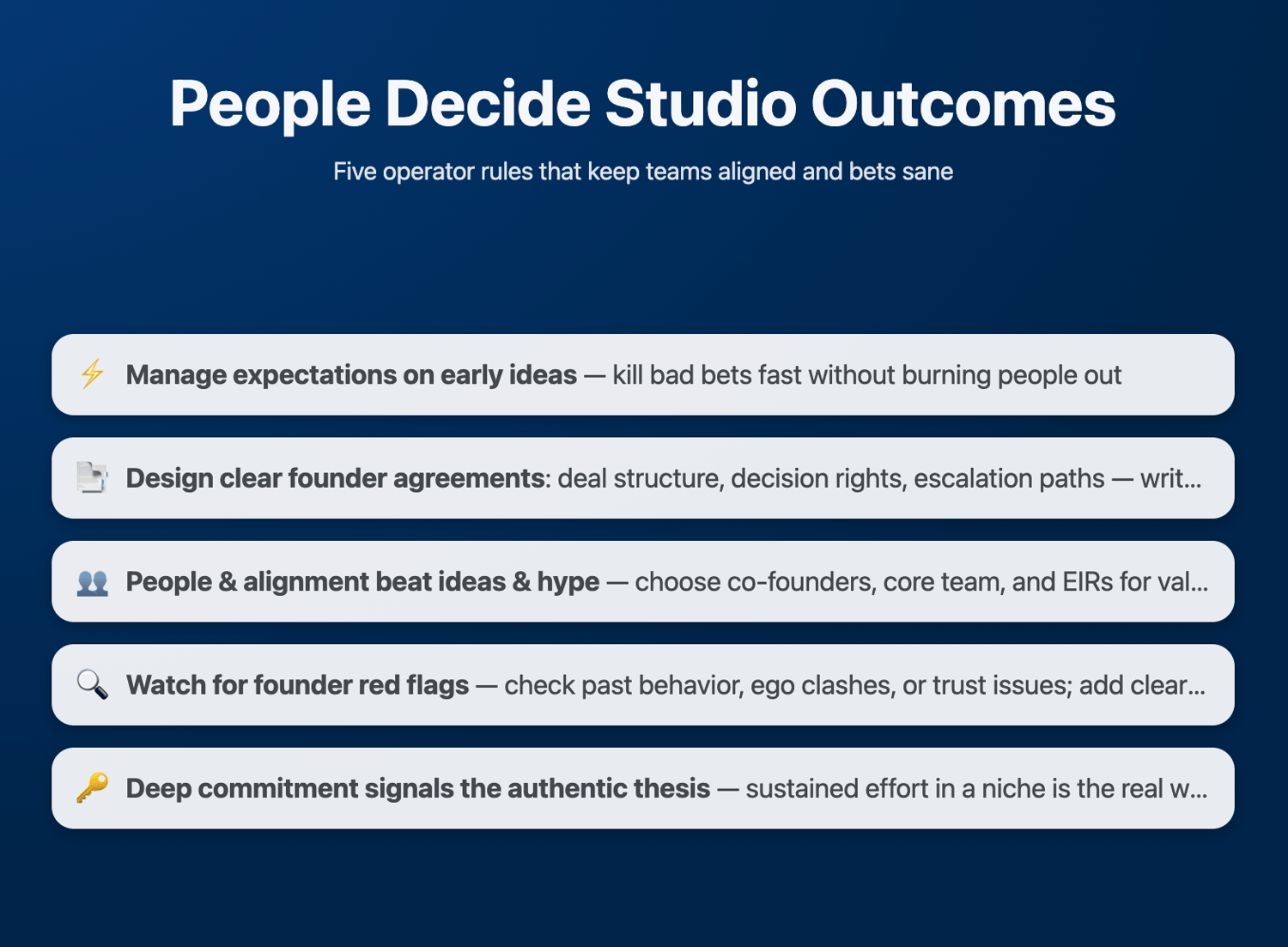
Three field stories that prove why human dynamics matter more than market size or tech stacks
If you're building or leading a venture studio, you already know that market timing, technology choices, and business models all matter. You've probably spent months refining your thesis, building your tech stack, and analyzing competitive landscapes.
But there's another layer that's equally critical and often overlooked: the human dynamics that make everything else work. The chemistry between co-founders. The alignment between studio leaders and entrepreneurs. The trust you build with corporate partners. Get these relationships right, and your solid strategy becomes unstoppable. Get them wrong, and even perfect execution hits invisible walls.
The best studio outcomes come down to founder chemistry, team alignment, and relationship capital. The worst outcomes? Same factors, just in reverse.
Here are three stories from the field that show why people are the defining factor in venture studio success.
Story 1: The EIR Who Failed His Way to Success (2015)
We were eight weeks into building an office supply marketplace when the numbers started looking ugly. The market was fragmented across dozens of local suppliers. Customer acquisition costs were discouraging. Every metric pointed to the same conclusion: this wasn't going to work.
So we killed it. Two months of work, gone.
Our young Entrepreneur-in-Residence took it hard. He'd invested emotionally in the idea, built relationships with potential customers, and genuinely believed in the vision. When we made the call to shut it down, he walked away frustrated and a little bitter.
I thought we'd lost him for good.
Three weeks later, he knocked on our door with a new idea. E-ticketing for events. Same energy, same passion, but this time focused on a market with real demand and cleaner unit economics.
We said yes. We co-built the venture inside the studio over the next 18 months. The startup went from zero to Series A in 24 months.
What this taught me about studio operations:
First, treat your studio as a repeat vehicle, not a one-shot deal. The best entrepreneurs fail fast and bounce back faster. If you set up your culture to support quick pivots without emotional destruction, you turn failures into learning cycles.
Second, manage expectations around early-stage ideas. Make it clear that ideas are cheap and disposable. What matters is the founder's ability to execute and adapt. When you make it easy to kill bad bets, you remove the emotional attachment that keeps people stuck on dying projects.
Third, preserve relationships through the failure. How you handle the shutdown determines whether the entrepreneur comes back with something better or goes to your competitor. We stayed supportive, gave honest feedback, and made it clear the door was open for better ideas.
Story 2: When Perfect Projects Implode (2021-2022)
Peak metaverse hype. Everyone was building in crypto and NFTs. A blockchain marketing agency asked me to help them pivot into a venture studio model.
The strategy was elegant: build one strong project, use the launch and token sale to create a community of 30-50k engaged users, then funnel that audience toward every future project. A built-in distribution engine for the studio.
An external founder brought us the first project. On paper, it was perfect. The team had domain expertise. The market was hot. The technology was solid. We had clear milestones and reasonable timelines. Six months later, we launched. The ICO went smoothly. Early user feedback was strong. Traction looked promising.
Then the chemistry between the studio lead and the startup founder started breaking down. Disagreements over already agreed terms between the studio and the startup. Reopened debate on budget allocation. Tension around who got credit for early wins. Normal startup friction, or so we thought.
Within weeks, it escalated into a full relationship breakdown. The founder of the startup wanted to suddenly separate from the studio - but there was no apparent reason. Other than not wanting to honour the deal. He basically wanted to exploit the studio in the most destructive way possible.
Despite attempts to mediate and recover the situation, this ended up in a bad breakup. The startup, having lost the execution capabilities provided by the studio, slowly degraded into a zombie project. The studio could recover some of their loss, but the situation left the studio leadership with some painful scars.
What this taught me about founder diligence and agreements:
First, lock decision rights and escalation paths into your studio-startup agreement before you start building. When tensions arise – and they will – you need clear processes for resolving conflicts. Without explicit frameworks, every disagreement becomes a power struggle.
Second, add founder psychology to your diligence process. Technical skills and market knowledge aren't enough. You need to evaluate how founders handle stress, criticism, and shared decision-making. Red flags around ego, paranoia, or control issues will only get worse under pressure.
Third, tie vesting schedules and communication cadences to specific milestones. Don't assume good intentions will carry you through rough patches. Make expectations explicit. Define what good partnership behavior looks like, and build consequences for when it breaks down.
Fourth, test the relationship under pressure before you commit long-term. Run a small project together first. See how they handle feedback, missed deadlines, and resource constraints. You'll learn more about their character in six weeks of stress than six months of pitch meetings.
Story 3: When Trust Becomes Your Competitive Advantage (2024)
A US NGO leader reached out about adding a venture studio element to his organization. He'd been running entrepreneurship programs for minority founders for decades. Good track record, strong reputation in his community, but no project with high profit potential.
We ran a "Zero to Minimum Viable Studio" process together. Within the first few weeks, the real opportunity became clear. His secret weapon was his corporate network.
Over decades of running programs, he'd built relationships with procurement teams at local companies. These companies had supplier diversity mandates. They needed to work with minority-owned businesses, but finding qualified vendors was always a challenge.
That's when it clicked. Instead of a traditional venture studio, we could build a corporate venture studio model. Use his relationships to identify real procurement needs, then build startups specifically to fill those gaps. Guaranteed customers from day one.
The model is still being refined, but the foundation is rock solid.
What this taught me about studio assets and positioning:
First, deep trust in a specific niche can be your core competitive advantage. Markets reward relationships and credibility over pure execution speed. If you've spent decades building trust with a particular community or industry, that's an asset most studios can't replicate.
Second, start with one corporate pilot and prove the model works before scaling. Corporate partnerships move slowly, but they provide stability that venture funding can't match. One successful pilot becomes your case study for expanding the program.
Third, focus on solving real corporate problems rather than trying to create new needs. Corporate venture studios work best when they address existing pain points with measurable ROI. Innovation for innovation's sake doesn't resonate with enterprise buyers.
The Pattern: People and Agreements Trump Everything Else
These three stories share a common theme: people and alignment issues decide studio outcomes more than market size, technology choices, or business models.
Your biggest risks aren't competitive. They're internal. Misaligned co-founders, unclear decision rights, and poor founder psychology screening can destroy years of work in weeks.
Here's how to protect yourself:
For studio-founder relationships: Write down decision rights before you need them. Define what happens when you disagree on strategy, resource allocation, or timeline changes. Test the relationship under small stress before committing to big projects.
For team building: Hire for alignment first, skills second. A slightly less experienced person who shares your values will outperform a superstar who fights your culture. Values alignment becomes more important as pressure increases.
For founder selection: Add psychology screens to your diligence process. How do they handle criticism? Do they share credit for wins? How do they react when plans change? You're not just betting on their idea – you're betting on their character under pressure.
For corporate partnerships: Start with your existing relationships. Trust built over years gives you advantages that money can't buy. Corporate venture studios work best when you already have credibility with the buyers.
The Bottom Line
Ideas are cheap. Markets shift. Technology evolves. But people are the true decisive factors in venture studios.
If you're building a venture studio, invest as much time in getting the human dynamics right as you do in market research and product development. Your biggest competitive advantage sits in your team chemistry and founder relationships.
Get that foundation right, and everything else becomes manageable. Get it wrong, and even perfect execution won't save you.
Want to go deeper? If you want the full playbook on how to build AI-driven venture studios, read Venture Speed – get your copy at venturespeed.ai. And if you're ready to talk, book a 45-min studio review call to find the risks and gaps before they find you.