
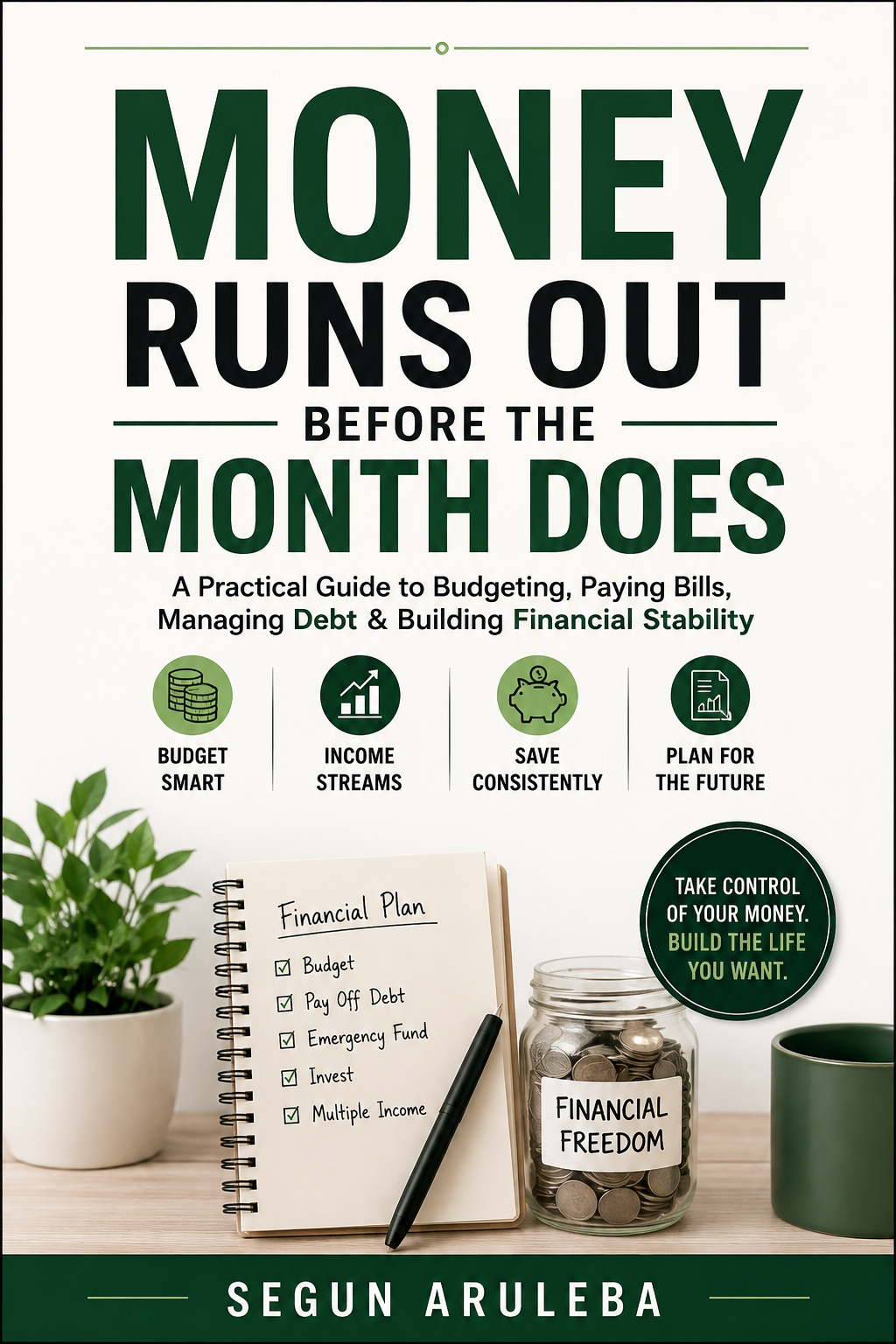
A Practical Guide to Budgeting, Paying Bills, Managing Debt & Building Financial Stability
Does your money seem to disappear faster than expected?
You receive your salary, business income, freelance payment, trading proceeds, or other income and feel relieved for a moment.
Then the bills start.
Rent,Food,Transportation,Electricity,School expenses,Debt repayments,Subscriptions,Family responsibilities,Unexpected expenses.
Before you know it, you're checking your account balance and asking yourself:
“Where did all my money go?”
And then another question appears:
“How am I going to make it to my next income?”
Money Running Out Before the Month Does was created for people who are tired of repeating this cycle.
This is not a book about becoming rich overnight.
It is not a collection of unrealistic financial promises.
It is not built around complicated investment terminology that leaves you more confused than when you started.
It is a practical guide focused on something much more immediate:
Helping you understand your money, organize your priorities, manage financial pressure, and build habits that can support greater financial stability over time.
THE PROBLEM THIS BOOK ADDRESSES
Many people work hard for their money but still struggle to manage it.
The problem isn't always a lack of income.
Sometimes the problem is what happens between receiving the money and spending it.
Without a clear plan, money can disappear through dozens of small decisions.
A few convenience purchases.
An unnecessary subscription.
A meal purchased because there was no time to cook.
An impulse online purchase.
A debt repayment that wasn't planned for.
An unexpected bill.
A family obligation.
A forgotten annual expense.
Individually, these expenses may not appear significant.
Together, they can create serious pressure.
Then the cycle begins again.
You receive money.
You pay urgent bills.
You spend on immediate needs.
You deal with unexpected expenses.
You borrow or postpone something.
You reach the end of the month with little or nothing left.
Then you wait for the next payment.
Money Running Out Before the Month Does is designed to help readers interrupt that cycle by developing a clearer financial system.
WHAT YOU WILL LEARN
The book takes readers through the practical areas that have the greatest impact on everyday financial stability.
You will learn how to look at your current financial situation honestly instead of avoiding it.
You will learn how to create a realistic budget based on your actual income and expenses.
You will learn how to prioritize bills when your available money cannot cover everything at once.
You will learn how to identify unnecessary spending and financial leaks.
You will learn how to organize debt and understand different repayment approaches.
You will learn why communicating early with creditors can be better than ignoring financial difficulties.
You will learn how to think through unexpected bills and financial emergencies.
You will learn how to begin building an emergency fund.
You will explore practical ways to improve your earning capacity.
And you will learn how to turn these ideas into repeatable financial habits.
THE FOUR-LEVEL BILL PRIORITY SYSTEM
One of the practical frameworks introduced in the book is the Four-Level Bill Priority System.
When money is tight, it can feel as though every bill is equally urgent.
But every expense does not necessarily have the same financial consequence.
The system helps readers organize expenses according to priority.
Level 1 focuses on essential living expenses.
These may include housing, basic food, essential utilities, necessary transportation, and necessary healthcare.
Level 2 focuses on contractual and financial obligations.
These may include loan payments, credit obligations, insurance, and other formal commitments, depending on the reader's circumstances and agreements.
Level 3 focuses on important but more flexible household and lifestyle expenses.
Level 4 focuses on discretionary spending.
The purpose is not to tell readers that some obligations don't matter.
The purpose is to provide a framework for making better decisions when available resources are limited.
Instead of paying whichever bill creates the most immediate emotional pressure, readers can step back, assess their situation, and make decisions based on priorities.
BUDGETING WITHOUT THE COMPLICATION
A budget should not be a punishment.
It should be a plan.
Many people abandon budgeting because they create systems that are too complicated to maintain.
A practical budget needs to reflect real life.
It should account for regular bills, variable expenses, debt obligations, savings, unexpected costs, and reasonable personal spending.
Money Running Out Before the Month Does encourages readers to look at their finances as a complete system.
The goal is not simply to record expenses.
The goal is to understand them.
Where is your money going?
Which expenses are essential?
Which expenses are flexible?
Which expenses occur every month?
Which expenses happen only occasionally?
Which payments are creating financial pressure?
Which spending habits could be changed?
These questions help turn budgeting from a theoretical exercise into a practical decision-making tool.
STOPPING FINANCIAL LEAKS
Sometimes financial pressure doesn't come from one enormous expense.
It comes from many small expenses repeated over time.
Consider a daily convenience purchase.
One purchase might not feel important.
But repeated every day, week after week, it can become a meaningful part of your monthly spending.
The same applies to unused subscriptions, frequent food delivery, impulse shopping, unnecessary upgrades, excessive convenience spending, and other recurring purchases.
The book helps readers identify these patterns without encouraging extreme restriction.
The objective isn't to eliminate every enjoyable purchase.
It is to spend intentionally.
You should be able to enjoy your money.
But you should also know what your spending is doing to your financial goals.
MANAGING DEBT WITH A PLAN
Debt can make monthly cash flow significantly more difficult.
When multiple payments compete for limited income, financial pressure increases.
The solution isn't simply to tell someone to “pay off their debt.”
A useful plan requires understanding what is owed.
Readers are encouraged to create a debt inventory containing information such as balances, minimum payments, interest rates where applicable, and due dates.
Once the information is visible, readers can begin evaluating repayment strategies.
The book introduces approaches such as the debt snowball and debt avalanche methods.
The debt snowball focuses on paying smaller balances first to create psychological momentum.
The debt avalanche focuses on prioritizing higher-interest debt to potentially reduce interest costs.
Neither approach needs to be treated as a universal answer.
The important lesson is to choose a structured approach that fits your circumstances and that you can realistically maintain.
HANDLING UNEXPECTED BILLS
Life does not always respect your budget.
A vehicle may require repairs.
An appliance may stop working.
A business expense may appear unexpectedly.
A family responsibility may arise.
An important bill may arrive at the wrong time.
When this happens, panic can lead to rushed financial decisions.
The book encourages readers to pause and assess the situation.
What is actually urgent?
What can wait?
What resources are available?
What expenses can temporarily be reduced?
What payment options exist?
Who needs to be contacted?
What consequences could come from each available choice?
These questions help create a decision-making process for difficult moments.
BUILDING AN EMERGENCY FUND
An emergency fund can provide a financial buffer when unexpected expenses occur.
But many people hear “emergency fund” and immediately assume they need a large amount of money before they can begin.
That mindset can become a barrier.
The book encourages readers to start with realistic milestones.
The first goal may simply be creating a small financial buffer.
Once that becomes achievable, the reader can gradually increase the target.
The objective is to develop the habit of setting money aside for genuine unexpected needs rather than relying entirely on borrowing when something goes wrong.
INCREASING INCOME RESPONSIBLY
Cutting expenses has limits.
There is only so much that can be removed from a budget before further reductions begin affecting essential needs or quality of life.
That is why the book also addresses income.
Readers are encouraged to consider their skills, experience, career opportunities, professional development, freelance opportunities, consulting, teaching, digital products, small businesses, and other legitimate income opportunities that fit their circumstances.
The message is not:
“Work endlessly.”
Instead, it is:
“Look for sustainable ways to increase your earning capacity while managing the money you already have.”
For professionals, this might mean developing a valuable skill or preparing for a better-paying role.
For entrepreneurs, it might mean improving pricing, customer acquisition, or business processes.
For freelancers, it might mean developing a stronger offer or finding better clients.
For artisans, it might mean improving visibility, service quality, or product distribution.
The specific strategy will depend on the individual.
BUILDING FINANCIAL HABITS
A financial plan only becomes useful when it can be maintained.
That is why the book focuses on habits.
Readers are encouraged to develop routines such as:
Reviewing spending regularly.
Checking upcoming bills.
Updating the budget.
Tracking debt progress.
Reviewing savings.
Planning for upcoming expenses.
Evaluating income opportunities.
Setting financial goals.
The goal is to make financial management a normal part of life rather than something you only think about when there is a crisis.
WHO IS THIS BOOK FOR?
Money Running Out Before the Month Does is designed for a broad audience of people who want to improve how they manage their money.
It may be useful for:
Monthly salary earners,Young professionals,Public servants,BankersTeachers,Traders,Freelancers,Artisans,Small-business owners,Entrepreneurs,Busy parents,Independent professionals.
People managing multiple financial obligations.
People who regularly reach the end of the month with little money remaining.
People who want to develop better financial habits.
If you earn money but struggle to make that money last, the principles in this book may help you create a clearer system.
FOR MONTHLY SALARY EARNERS
Receiving a salary once or twice a month can create a dangerous illusion of abundance.
On payday, the account balance looks healthy.
Then rent, food, transportation, utilities, debt payments, family obligations, and other expenses begin reducing it.
A structured plan can help you allocate your income before it disappears.
FOR SMALL-BUSINESS OWNERS AND ENTREPRENEURS
Business income can be irregular.
Some months are strong.
Other months are slow.
This makes financial planning especially important.
The principles in this book can help business owners think more carefully about separating personal and business expenses, planning for irregular income, preparing for predictable costs, and avoiding unnecessary financial pressure.
FOR FREELANCERS AND INDEPENDENT WORKERS
When income varies, traditional monthly budgeting can become difficult.
The book encourages readers to think about income volatility, essential expenses, savings buffers, and planning ahead during stronger income periods.
FOR TRADERS AND OTHER VARIABLE-INCOME EARNERS
Variable income requires discipline.
A strong income month does not necessarily mean that all of the money should immediately be spent.
Planning for weaker periods can help create greater financial resilience.
FOR PROFESSIONALS AND EXECUTIVES
Higher income does not automatically eliminate financial problems.
Lifestyle inflation, large commitments, debt, family obligations, and poor cash-flow management can affect people at many income levels.
The book therefore focuses on principles that remain relevant as income changes.
WHAT MAKES THIS GUIDE DIFFERENT?
The approach is practical.
The book does not assume that everyone has the same income.
It does not assume that everyone has the same financial responsibilities.
It does not assume that cutting every enjoyable expense is the answer.
Instead, it focuses on financial awareness, prioritization, planning, and consistency.
Readers are encouraged to understand their own numbers and make decisions based on their circumstances.
The guide also uses practical exercises, examples, checklists, reflection questions, and planning tools to turn concepts into actions.
IT IS DESIGNED TO BE USED, NOT JUST READ
You can read a financial book from beginning to end and forget most of it.
This guide is designed differently.
Readers are encouraged to stop and work through exercises.
Write down your expenses.
List your debts.
Review your bills.
Identify spending leaks.
Create your budget.
Set savings targets.
Review your progress.
Build a financial action plan.
The worksheets and exercises are intended to help turn financial knowledge into practical behavior.
THE BIGGER TRANSFORMATION
The ultimate goal isn't simply to help you create a spreadsheet.
It is to help you develop a better relationship with your money.
Instead of asking:
“Why am I always broke?”
You can begin asking:
“What does my income need to accomplish this month?”
Instead of:
“How will I pay all these bills?”
You can ask:
“Which obligations should I prioritize first?”
Instead of:
“Where did my money disappear?”
You can ask:
“Did my spending follow the plan I created?”
Instead of:
“I need to borrow money again.”
You can ask:
“What can I change now to reduce the likelihood of being in this position again?”
Those questions represent a shift from financial reaction to financial intention.
IMPORTANT NOTE
This book is an educational resource, not personalized financial, legal, tax, investment, or debt-management advice.
Financial circumstances differ from person to person, and laws, regulations, lender policies, interest rates, taxes, and available financial products vary by location and over time.
Readers should consider their individual circumstances and seek appropriate professional advice when necessary, particularly for significant financial, legal, tax, investment, or debt decisions.
YOUR NEXT STEP
If you are tired of reaching the end of the month and wondering where your money went, the answer isn't necessarily to panic.
Start by understanding.
Understand what you earn.
Understand what you owe.
Understand where your money goes.
Understand which bills matter most.
Understand which expenses can be changed.
Understand what you can do today to prepare for tomorrow.
Then build a system.
Money Runs Out Before the Month Does gives you a practical starting point for doing exactly that.
You don't need to change everything overnight.
You need to begin.
Start with your numbers.
Create your plan.
Take one action.
Then repeat.
Over time, those small decisions can become habits.
And those habits can become the foundation for greater financial stability.
Money Running Out Before the Month Does
A Practical Guide to Budgeting, Paying Bills, Managing Debt & Building Financial Stability
Written by Segun Aruleba
Take the first step toward managing your money with greater clarity, intention, and confidence.
Get your copy today and begin building a financial system you can actually use.