
"Truth does not become weaker because it is opposed."
— Attributed to Giordano Bruno
Few figures in history have become as legendary as Giordano Bruno. To some, he was a visionary philosopher centuries ahead of his time. To others, he was a dangerous heretic whose ideas threatened the established order. Between myth and reality lies the story of a man whose life was far more fascinating than most people realize.
More Than an Astronomer
One of the greatest misconceptions is that Bruno was executed simply because he believed the Earth revolved around the Sun.
The truth is more complex.
Unlike Galileo, Bruno was not an astronomer. He did not prove scientific theories through observation or mathematics. He was a philosopher who believed that reason, imagination, and contemplation could reveal truths beyond ordinary perception.
For Bruno, the universe was not merely large—it was infinite.
He proposed that every star in the night sky might be another sun, surrounded by worlds of its own. In an age when most people believed the universe ended just beyond the visible stars, this idea was astonishing.
The Forgotten Master of Memory
One of Bruno's least-known talents was his extraordinary work on the art of memory.
He developed intricate systems that allowed students to memorize enormous amounts of information using symbolic images arranged within imaginary palaces of the mind.
European nobles invited him to teach these techniques, and many considered him one of the greatest memory experts of the Renaissance.
Some historians believe these systems inspired later developments in psychology, education, and cognitive science.
Was Bruno Really a Magician?
Bruno frequently wrote about magic, but not in the sense modern movies portray.
For him, magic meant understanding the hidden relationships that connect all things in nature.
He believed that symbols, imagination, music, mathematics, astrology, and human thought could influence the soul because everything in the universe was interconnected.
He called this natural magic—the search for the invisible harmony underlying creation.
Although he also studied Hermetic writings and ancient Egyptian philosophy, Bruno insisted that true magic required wisdom rather than superstition.
A Dangerous Thinker
Bruno questioned nearly everything.
He rejected intellectual conformity.
He criticized blind obedience.
He argued that no institution should possess absolute authority over truth.
These ideas made him admired by some and feared by many.
Throughout Europe he wandered from city to city, lecturing, debating scholars, and often leaving behind controversy.
The Long Trial
In 1592 Bruno was arrested in Venice after being denounced by a nobleman who had once welcomed him into his home.
He was transferred to Rome, where he spent nearly eight years imprisoned while the Roman Inquisition investigated his writings and beliefs.
The accusations extended far beyond astronomy.
His views on theology, philosophy, the nature of Christ, the soul, and the universe conflicted with several core teachings of the Church.
The Final Sentence
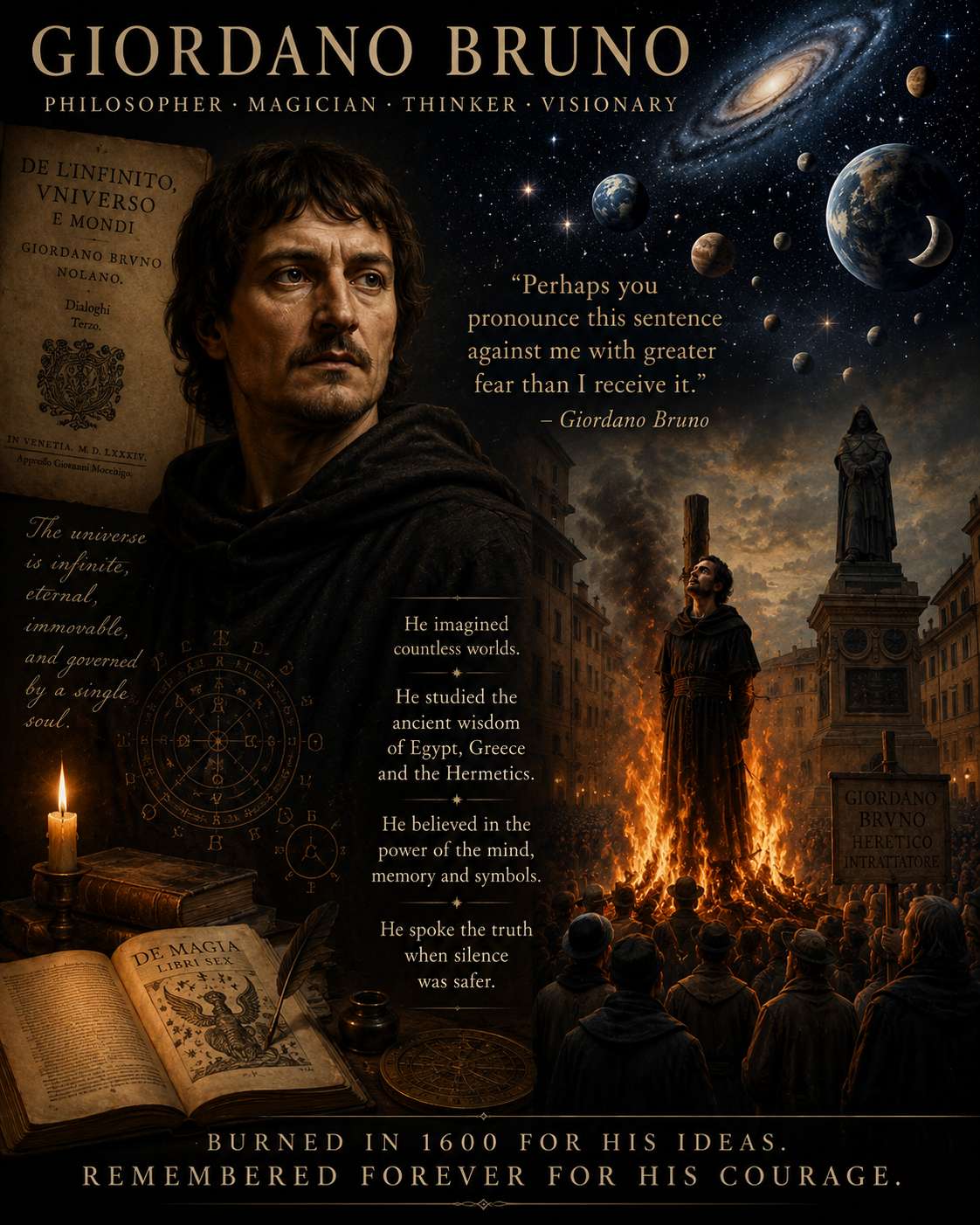
On 17 February 1600, Giordano Bruno was led to Campo de' Fiori in Rome.
Historical accounts suggest that before his execution, his tongue was restrained with a wooden or metal gag to prevent him from addressing the crowd.
He was burned alive.
According to a famous account, after hearing his sentence he declared:
"Perhaps you pronounce this sentence against me with greater fear than I receive it."
Whether every word was recorded exactly is debated by historians, but the statement has become one of history's most powerful symbols of intellectual courage.
The Legacy Bruno Never Saw
Centuries after his death, many of Bruno's philosophical ideas gained new attention.
Today we know that the universe contains billions of galaxies and countless stars with planetary systems.
Although Bruno reached his conclusions through philosophy rather than scientific observation, his vision of an immense cosmos seems remarkably bold for the sixteenth century.
His bronze statue now stands in Campo de' Fiori, the very square where he was executed, reminding visitors that the pursuit of ideas has often demanded extraordinary courage.
Final Reflection
Giordano Bruno was neither simply a scientist nor merely a magician.
He was a philosopher who refused to place limits on thought.
Whether one agrees with his ideas or not, his greatest lesson remains timeless:
The freedom to ask questions has always been one of humanity's greatest acts of courage.
Explore More Mysteries
Visit the Whisper Mysteries blog for free articles on ancient history, philosophy, archaeology, unexplained phenomena, and hidden knowledge.