
Gnosticism and the Secret Knowledge: The Hidden Teachings That Refused to Die
"Some books were burned. Others were buried. A few were hidden... waiting for the right moment to be found."
In the winter of 1945, a farmer digging near the Egyptian town of Nag Hammadi struck something hard beneath the desert soil.
It was not gold.
Nor was it a forgotten tomb.
It was a sealed clay jar.
For centuries, no one had touched it.
When it was finally opened, dozens of ancient manuscripts emerged—fragile papyrus codices wrapped in leather, preserved by the dry desert air. The texts had remained hidden for more than sixteen centuries.
Why had someone buried them?
The answer may lie in the fear that knowledge itself could become dangerous.
Knowledge Reserved for the Few
The word Gnosis comes from the Greek language and simply means knowledge.
Yet the Gnostics were not speaking about ordinary knowledge.
They referred to an inner awakening—a direct understanding of reality that could not be taught in the same way mathematics or history could.
According to many Gnostic writings, truth was something to be experienced rather than believed.
This idea placed them at odds with many religious authorities of their time.
If every individual could discover truth inwardly, who would control the interpretation of that truth?
Perhaps that question proved more threatening than the teachings themselves.
The Books That Nearly Vanished
Most people have heard of the Bible.
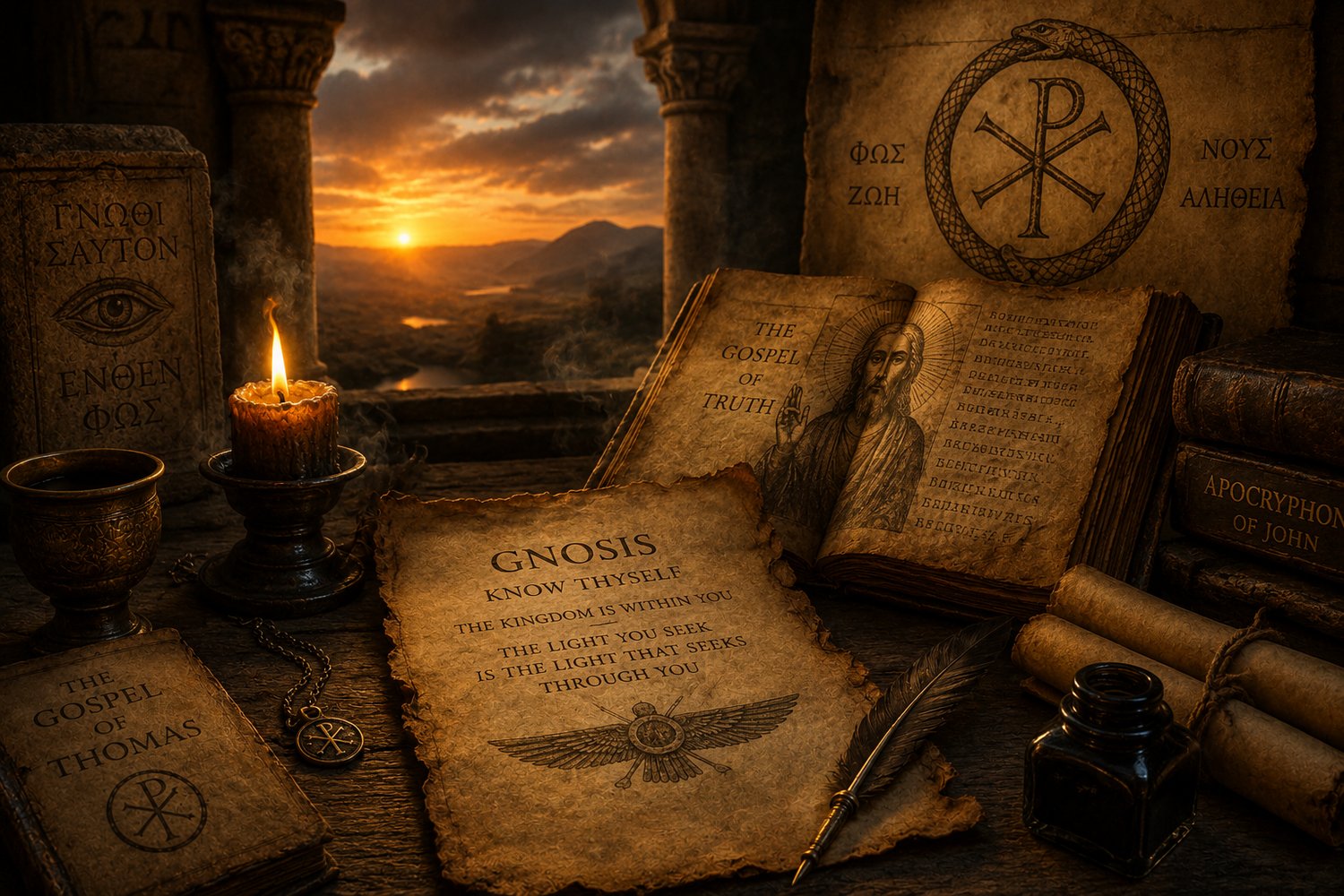
Few have heard of The Gospel of Thomas, The Gospel of Truth, The Apocryphon of John, or The Gospel of Philip.
These texts survived almost by accident.
Many scholars believe they were hidden shortly after church authorities condemned numerous writings they considered heretical during the fourth century.
Rather than destroying them, someone chose another path.
They buried them.
Their decision allowed those manuscripts to outlive empires.
The God Who Wasn't the Highest God
One of the most surprising ideas found in several Gnostic traditions is the distinction between the ultimate, unknowable Source and a lesser creator figure often called the Demiurge.
In these texts, the Demiurge is not necessarily portrayed as the supreme divine reality but as the architect of the material world.
Different Gnostic schools described this figure in different ways—sometimes as ignorant, sometimes as arrogant, and sometimes simply as incomplete.
This interpretation differs significantly from mainstream Jewish and Christian theology and remains one of the most debated aspects of Gnostic literature.
Sophia's Forgotten Story
Among the most fascinating figures in Gnostic mythology is Sophia, whose name means Wisdom.
In several texts, Sophia's actions lead to the emergence of the imperfect creator and the material universe.
Rather than being a simple tale of good versus evil, these writings present a cosmic drama involving knowledge, separation, and the longing to return to a higher reality.
Whether read as mythology, allegory, or philosophy, the story continues to intrigue readers nearly two thousand years later.
Symbols Hidden in Plain Sight
Unlike many ancient traditions, Gnosticism often spoke through symbols rather than direct instruction.
The serpent, usually feared in other traditions, sometimes appears as a bearer of awakening.
Light becomes more than illumination.
Darkness becomes more than the absence of light.
Even paradise is reinterpreted.
To many Gnostic writers, sacred stories concealed multiple layers of meaning, accessible only to those willing to look beyond the literal words.
The Strange Silence of History
Perhaps one of history's greatest mysteries is not that Gnostic communities existed.
It is how thoroughly they disappeared.
Entire schools vanished.
Libraries were destroyed.
Teachers faded into obscurity.
For centuries, most knowledge about Gnosticism came from the writings of its opponents.
Only with the discovery at Nag Hammadi did the Gnostics begin to speak again in their own voices.
It was as though history had suddenly gained access to the other side of an ancient conversation.
The Knowledge That Cannot Be Stolen
One sentence appears repeatedly throughout different Gnostic traditions, although expressed in many forms:
"The kingdom is within you."
To some, these are merely poetic words.
To others, they represent the central mystery of Gnosis—that the greatest discovery is not hidden inside temples, mountains, or forgotten libraries, but within human consciousness itself.
Perhaps that is why so many ancient seekers pursued silence instead of certainty.
And perhaps that is why, after nearly two thousand years, the hidden books of the desert continue to ask questions that no civilization has fully answered.
Continue Deeper into the Hidden World
If this book awakened your curiosity about ancient beliefs, forbidden traditions, ritual, symbolism, or the invisible world that has fascinated humanity for centuries, the journey does not have to end here.
Recommended next from our collection:
The Ancient Wisdom of Witches
Explore the forgotten traditions, symbols, natural wisdom, folklore, and spiritual practices that shaped the image of the witch long before modern popular culture transformed it.