

"History tells us that civilization began when humans learned to farm. But what if history is wrong?"
Beneath the sun-scorched hills of southeastern Turkey lies a place that has rewritten everything we thought we knew about our past. It is older than Stonehenge. Older than the Egyptian pyramids. Older than the first cities.
Its name is Göbekli Tepe.
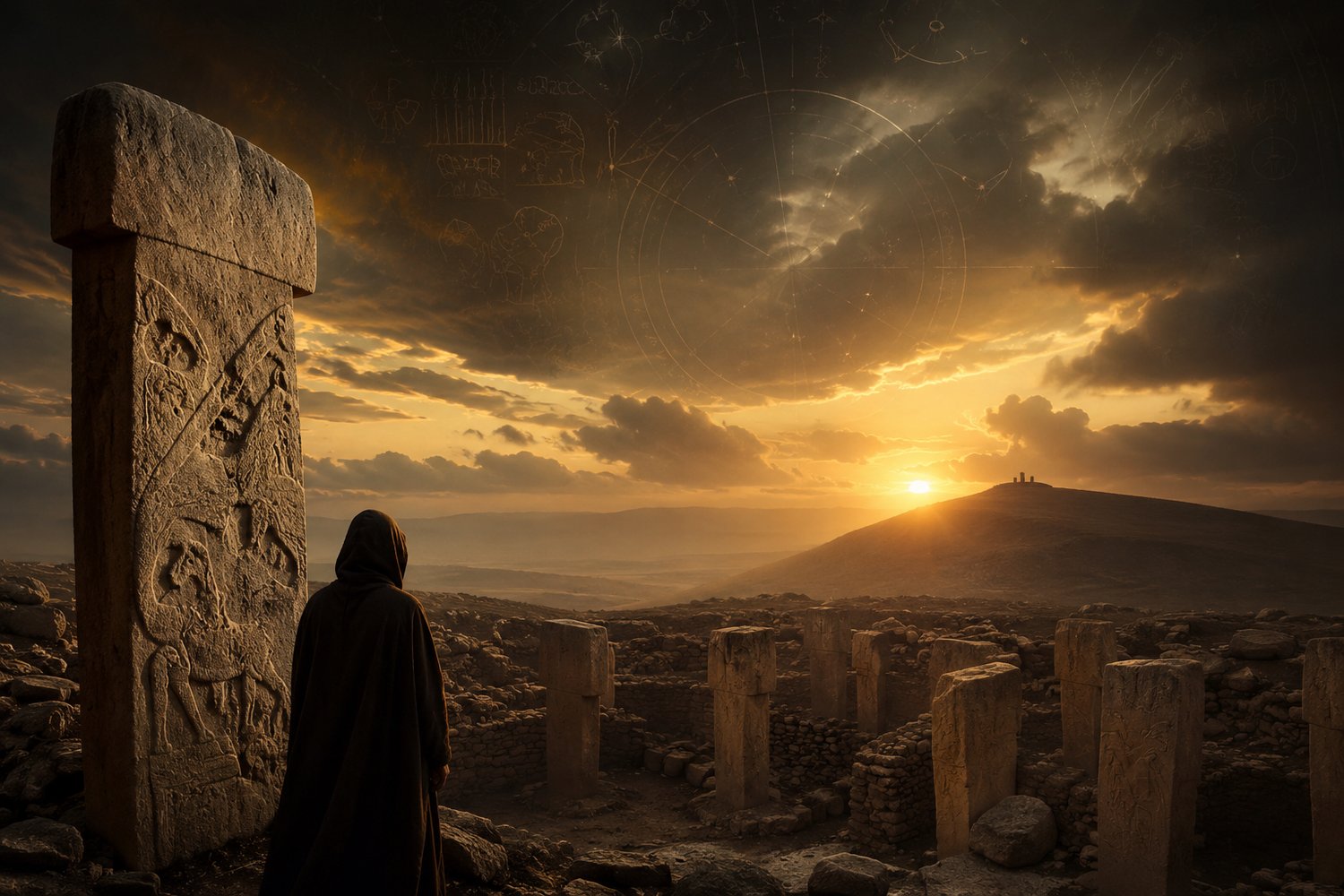
For thousands of years, it slept beneath the earth, hidden as though someone had deliberately buried it to protect a secret. Then, in the 1990s, archaeologists uncovered something extraordinary: massive circular temples carved from limestone, decorated with mysterious animals and abstract symbols, built nearly 12,000 years ago.
According to conventional history, the people of that era were simple hunter-gatherers.
So who built this monumental sanctuary?
And more importantly... why?
A Monument Before Civilization
Everything about Göbekli Tepe defies expectations.
The enormous T-shaped pillars, some weighing more than sixteen tons, were carefully quarried, transported, and arranged with astonishing precision. The builders possessed engineering knowledge that should not have existed at the end of the Ice Age.
No evidence of permanent villages.
No metal tools.
No written language.
No wheel.
Yet they created one of the most impressive sacred sites ever discovered.
It is almost as if a forgotten chapter of human history has been torn from the book.
The Silent Language of Stone
The stone pillars are covered with foxes, snakes, vultures, wild boars, lions, insects, and creatures whose meanings remain unknown.
Were they decorations?
Religious symbols?
Astronomical maps?
Or messages left for people living thousands of years in the future?
Many researchers believe the carvings formed a symbolic language—a language we have not yet learned to read.
Imagine standing there at dawn twelve millennia ago.
The rising sun illuminates the carvings.
Priests—or perhaps astronomers—perform rituals beneath the open sky.
No one knows what words were spoken.
No one knows which gods, if any, were invoked.
Only the stones remain.
The Civilization That Vanished
One question refuses to disappear.
If hunter-gatherers built Göbekli Tepe, why do we find no earlier stages of development leading to such extraordinary architecture?
Could there have been another culture before the civilizations we know today?
A civilization erased by time.
Perhaps by climate change.
Perhaps by catastrophe.
Or perhaps simply forgotten.
Legends from around the world speak of ancient peoples who possessed remarkable knowledge before a great flood changed the world.
The story appears in Mesopotamian traditions.
It appears in Greek mythology.
It appears in many ancient cultures separated by oceans and centuries.
Coincidence?
Or fragments of a forgotten memory?
Why Was It Buried?
Perhaps the greatest mystery is not how Göbekli Tepe was built.
It is why it was buried.
The site was not destroyed.
It was intentionally covered with thousands of tons of earth and stone.
Who buries a sacred temple?
Why preserve it instead of abandoning it?
Some archaeologists believe it marked the end of an era.
Others wonder whether the builders wanted future generations to discover it only when humanity was ready.
If so...
Their message waited nearly twelve thousand years.
What If We Are Missing the Bigger Picture?
Göbekli Tepe forces us to ask uncomfortable questions.
How many civilizations have risen and disappeared without leaving more than a handful of stones?
How much knowledge has been lost forever?
Could our timeline of history be incomplete?
Every new discovery at Göbekli Tepe raises more questions than answers.
Perhaps that is its true purpose.
Not to tell us what happened...
But to remind us how little we truly know.
Final Reflection
The greatest mysteries are not always hidden beneath oceans or inside forgotten tombs.
Sometimes they stand quietly on a lonely hill, waiting for curious minds willing to question accepted history.
Göbekli Tepe is more than an archaeological site.
It is a challenge.
A whisper from humanity's forgotten past.
And perhaps the first page of a story that has yet to be told.