

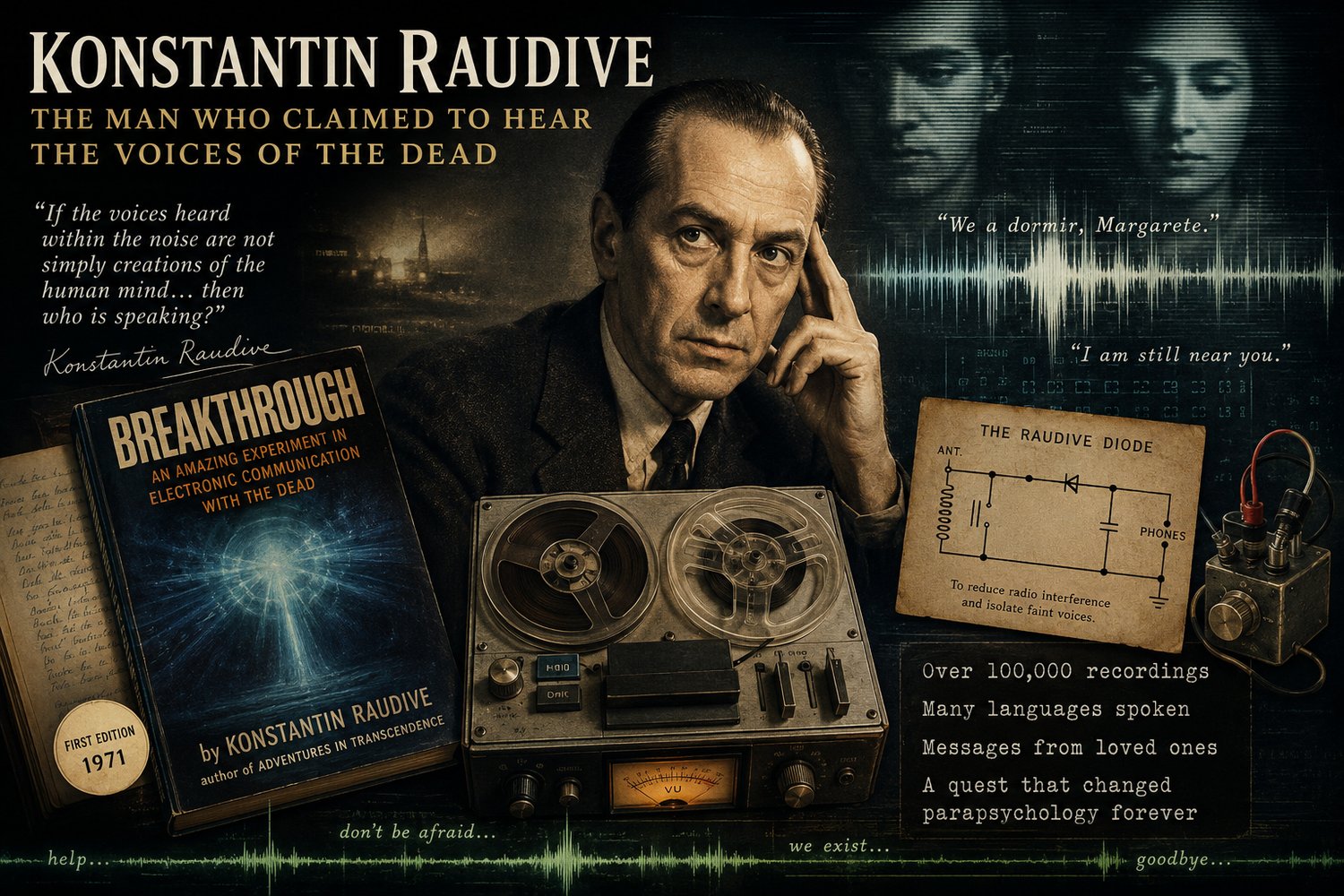
Throughout the history of unexplained phenomena, only a handful of researchers have left a lasting mark on the study of life after death. One of the most intriguing among them was Konstantin Raudive (1909–1974), a Latvian psychologist, writer, and researcher best known for his work on Electronic Voice Phenomena (EVP)—mysterious voices allegedly captured on audio recordings.
Although he is widely recognized for his 1971 book Breakthrough, there are many fascinating aspects of his life and research that remain largely unknown.
He Was More Than a Paranormal Researcher
Before becoming associated with EVP, Raudive was already a respected intellectual. He studied philosophy, psychology, and literature across several European countries and was influenced by the ideas of Carl Jung. Throughout his academic career, one question remained at the center of his interests:
Does human consciousness survive physical death?
Unlike many paranormal enthusiasts, Raudive approached this question with the mindset of a scholar rather than a sensationalist.
Exile Changed His Life
After the Soviet occupation of Latvia during World War II, Raudive and his wife, the well-known Latvian writer Zenta Mauriņa, fled their homeland and eventually settled in Sweden.
The experience of exile profoundly shaped his worldview. Having witnessed war, displacement, and human suffering, he became increasingly interested in the possibility that death might not be the end of consciousness.
The Meeting That Changed Everything
In 1964, Raudive read a book by Swedish artist Friedrich Jürgenson, who claimed he had accidentally recorded mysterious voices while making nature recordings.
Most people would have dismissed the story.
Raudive did exactly the opposite.
He contacted Jürgenson, and together they began conducting experiments. Their early attempts produced inconsistent results, but Raudive remained convinced that the phenomenon deserved serious investigation.
More Than 100,000 Recordings
One of the least known facts about Raudive is the sheer scale of his research.
He claimed to have made over 100,000 audio recordings, working with engineers, technicians, physicians, and psychologists in an effort to eliminate ordinary explanations.
For him, the phenomenon was not based on a handful of unusual tapes but on years of systematic observation.
The Voices Spoke in Strange Ways
Raudive noticed something unusual.
Many of the recorded voices appeared to speak extremely quickly, often blending several languages into a single sentence. A message might contain German, Latvian, French, and English words all at once.
He referred to this as a polyglot language, believing it to be one of the unique characteristics of EVP.
The Raudive Diode
Few people know that Raudive experimented with a simple electronic device that later became known as the Raudive Diode.
Based on an old crystal-radio concept, the circuit was intended to reduce radio interference and provide a cleaner environment for recording unexplained voices.
Although its effectiveness has never been scientifically confirmed, the device became well known among EVP researchers.
The Message That Convinced Him
According to Raudive, one of the first recordings that deeply affected him contained the phrase:
«"Ve a dormir, Margarete."»
He believed the message referred to someone close to his family who had recently passed away.
Whether genuine or not, this recording strengthened his conviction that the phenomenon deserved lifelong study.
Recognition During His Lifetime
Raudive's work attracted attention beyond paranormal circles.
In 1969, he and Professor Alex Schneider received recognition from the Swiss Association for Parapsychology for their investigations into Electronic Voice Phenomena.
His research was discussed throughout Europe and later introduced to English-speaking audiences through the publication of Breakthrough.
The Mystery After His Death
One of the most curious stories surrounding Raudive emerged after his death in 1974.
Several EVP researchers later claimed to have recorded a voice identifying itself as Konstantin Raudive or suggesting that he continued to exist beyond death.
These reports remain anecdotal and have never been independently verified, but they have become part of EVP folklore.
What Does Science Say?
The scientific community does not consider Raudive's recordings to be evidence of communication with the dead.
Researchers generally explain EVP through factors such as:
- Auditory pareidolia—the human brain's tendency to recognize words within random noise.
- Radio interference.
- Electronic artifacts.
- Psychological suggestion and expectation.
To date, no controlled scientific experiments have demonstrated that EVP recordings originate from deceased individuals.
A Legacy of Questions
Whether one accepts or rejects his conclusions, Konstantin Raudive changed the history of paranormal research.
He transformed a little-known curiosity into an international topic of discussion and inspired countless books, documentaries, experiments, and debates about consciousness, death, and the possibility of realities beyond ordinary perception.
Perhaps his greatest legacy is not the answers he believed he found, but the question he dared to ask:
If the voices heard within the noise are not simply creations of the human mind... then who is speaking?