

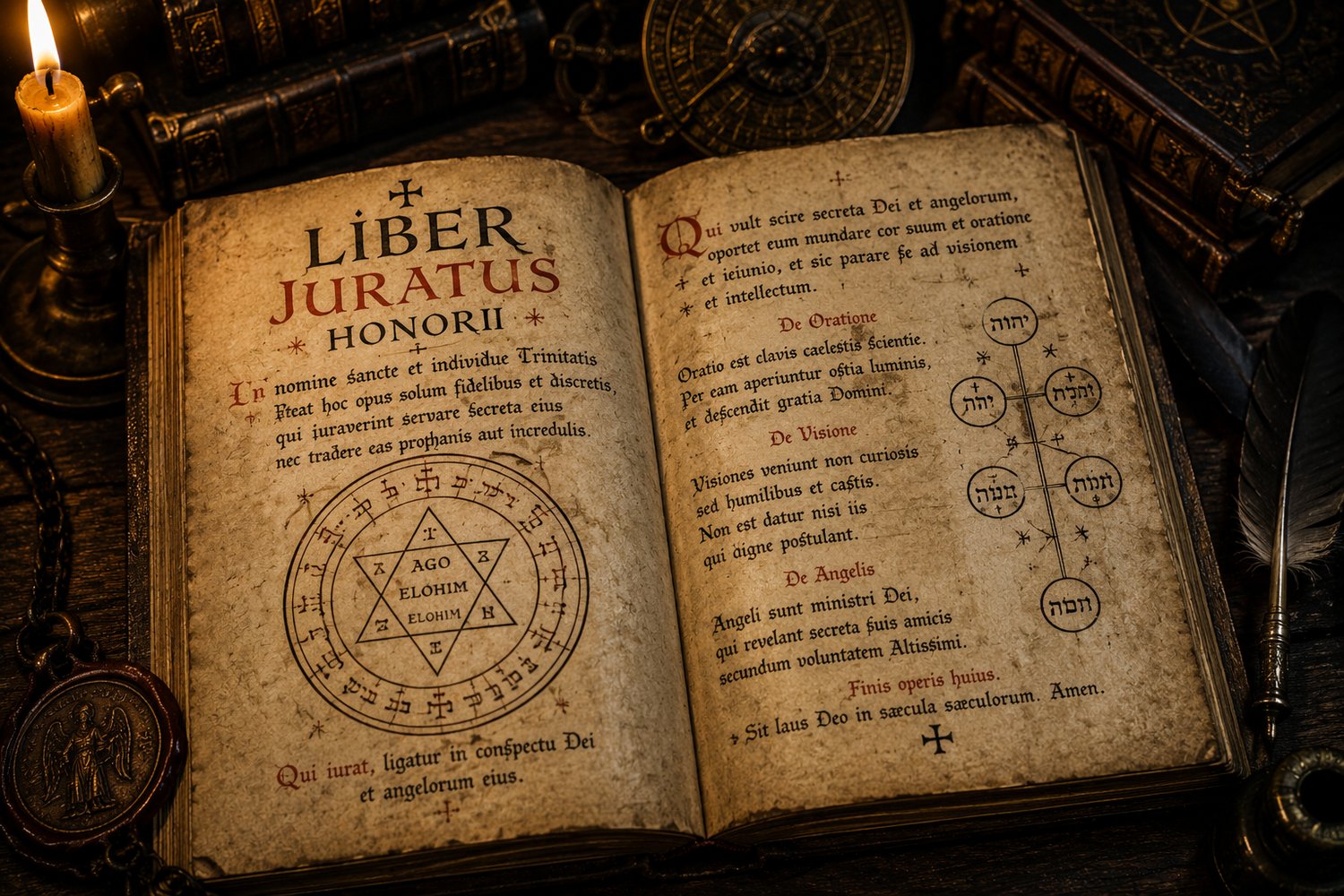
The Forbidden Book That Was Never Meant for Everyone
Among the many medieval grimoires that have survived the centuries, few are surrounded by as much mystery as the Liber Juratus, also known as The Sworn Book of Honorius.
Unlike many famous grimoires, its greatest secret is not hidden in unusual symbols or elaborate diagrams.
It is hidden in its intended audience.
The title itself offers the first clue. The word Juratus means "sworn." According to the introduction preserved in medieval manuscripts, the book was intended only for individuals who had taken a solemn oath to protect its contents. Whether this account reflects historical events or serves as a literary device is uncertain, but it reveals how exceptional and restricted the text was meant to appear.
This immediately sets the Liber Juratus apart from many other medieval works.
Rather than presenting knowledge as something anyone could possess, it portrays wisdom as something that required discipline, discretion, and moral responsibility.
Another fascinating aspect is that the manuscript focuses less on material gain than many later grimoires. Modern readers often expect medieval occult books to revolve around treasure, power, or supernatural control. The Liber Juratus is different.
Much of its content reflects a search for divine wisdom, contemplation, and a deeper understanding of creation. Historians generally view it as a product of medieval religious and intellectual traditions, where prayer, symbolism, and philosophy were often intertwined.
One detail that is rarely mentioned is the extraordinary effort required to produce a manuscript like this.
Every copy was written entirely by hand. Before the invention of the printing press, creating a single manuscript demanded months—sometimes years—of careful work by trained scribes. As a result, no two surviving copies are exactly alike. Differences in wording, additions, omissions, and annotations reveal that the text evolved as it was copied across generations.
In many ways, each manuscript became a historical document in its own right.
This is one reason why scholars continue to study the Liber Juratus today. They are not only interested in what the book says but also in how it changed over time, what those changes reveal about medieval Europe, and how ideas traveled across different regions and cultures.
Perhaps the greatest lesson of the Liber Juratus is not that it contains hidden secrets.
Its real value lies in showing us how knowledge was regarded nearly eight centuries ago—not as entertainment or instant information, but as something precious, demanding patience, study, and personal responsibility.
That may be why this remarkable manuscript continues to fascinate historians, collectors, and curious readers today.
Sometimes, the greatest mystery is not the book itself.
It is the world that believed such a book was worth protecting with an oath.
Visit the Whisper Mysteries blog for free articles on ancient history, philosophy, archaeology, unexplained phenomena, and hidden knowledge.