
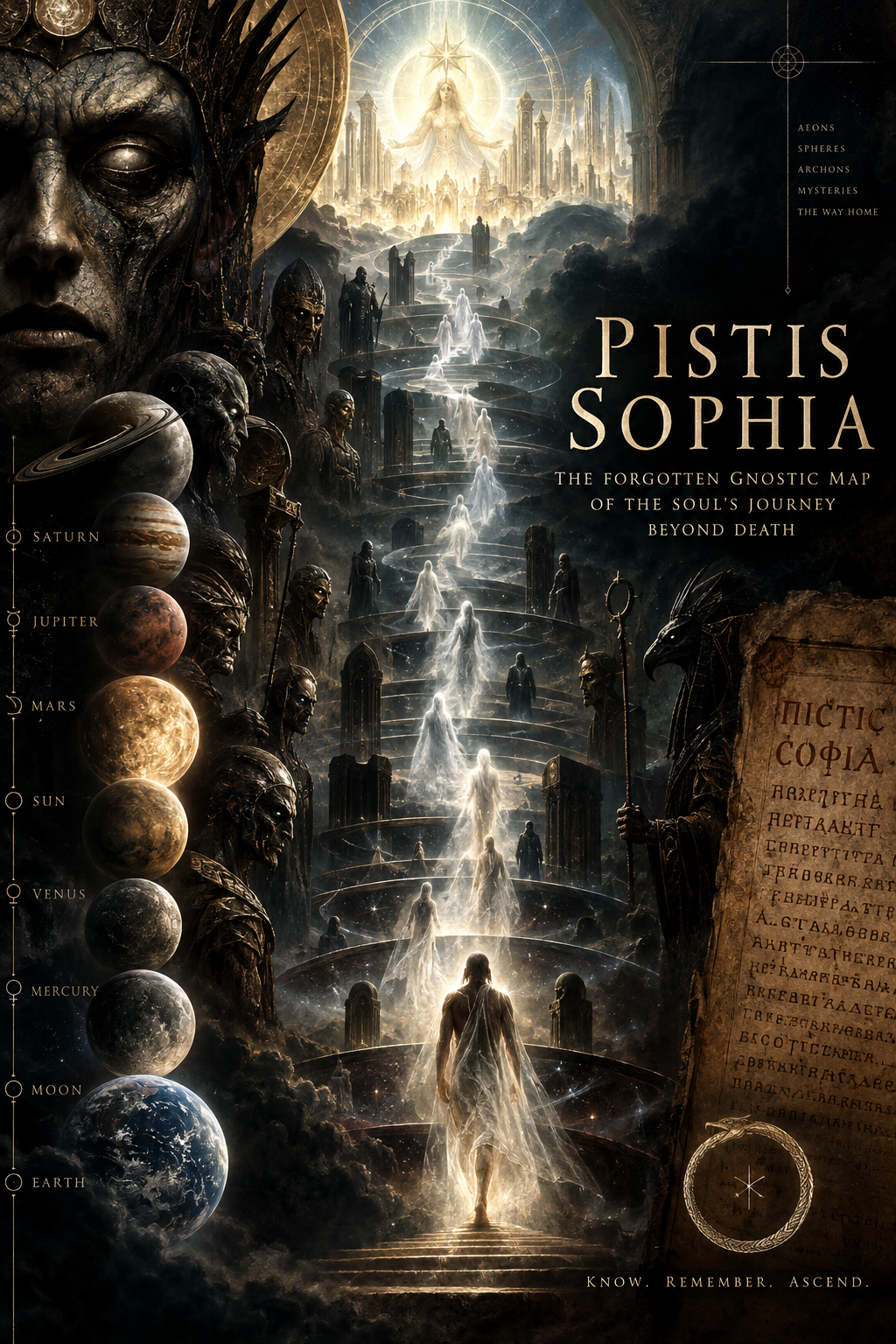
Long before modern theories spoke of soul traps, false lights and invisible barriers surrounding humanity, an obscure Coptic manuscript described a universe filled with powers, rulers, gates, mysteries and regions through which the soul struggled to rise toward a reality beyond the visible world.
Among the surviving writings associated with ancient Gnostic Christianity, few are as strange, elaborate and difficult to penetrate as the Pistis Sophia, a massive Coptic work whose pages seem to open not merely onto an alternative Christianity, but onto an entire hidden geography of existence.
Its universe is not simple.
Heaven is not one place waiting immediately beyond death, nor is the cosmos divided neatly between Earth, Heaven and Hell. Instead, existence unfolds through aeons, spheres, invisible regions, rulers, powers, receivers, guardians, mysteries and progressively higher realms of light, while souls may ascend, fall, become delayed or become entangled according to their spiritual condition and the knowledge they possess.
For modern readers familiar with theories about Archons, reincarnation traps and the possibility of a false cosmic system surrounding humanity, Pistis Sophia can therefore feel disturbingly familiar.
Yet what the ancient manuscript actually says is stranger — and considerably more complex — than most modern internet versions suggest.
A Manuscript That Almost Disappeared
Unlike the famous Nag Hammadi library discovered in Egypt in 1945, Pistis Sophia survives principally in a completely different manuscript known as the Askew Codex.
The codex eventually entered the British Museum after being acquired by the physician and collector Anthony Askew during the eighteenth century. Today it is preserved by the British Library under the shelfmark Add MS 5114. The catalogue describes a Coptic manuscript consisting of 178 folios, or 356 pages, copied by two scribes, with several leaves missing. The surviving manuscript itself has been broadly dated to the period between the fourth and seventh centuries, although the underlying work is generally considered earlier.
The words Pistis Sophia are usually translated approximately as Faith-Wisdom, although the title by which we know the work may not have been its original title. G. R. S. Mead, whose influential English translation appeared in the late nineteenth century and was revised in 1921, suggested that a title such as Books of the Savior might more accurately describe the manuscript as a whole.
This distinction matters because Pistis Sophia is not simply a book about a female divine figure named Sophia.
It is an enormous cosmological teaching.
And at its center stands a resurrected Jesus revealing mysteries that ordinary humanity supposedly never received.
Jesus Remains on Earth — for Eleven Years
The narrative begins with a remarkable premise.
Instead of ascending almost immediately after the Resurrection, as a reader familiar only with the canonical Gospels might expect, Jesus remains with his disciples and teaches them for eleven years, gradually revealing increasingly profound mysteries concerning the invisible universe.
The disciples include familiar figures such as Mary Magdalene, Peter, John and others, but Mary Magdalene occupies an especially prominent position, repeatedly asking questions and interpreting spiritual teachings.
The result feels less like the narrative of the canonical Gospels and more like an initiation.
Jesus is no longer merely explaining morality, parables or the coming kingdom.
He is explaining the architecture behind reality.
The manuscript describes realms above realms, orders of powers and forces that operate beyond ordinary human perception, giving the impression that the visible cosmos represents only the lowest portion of an immense metaphysical structure.
That concept lies at the heart of Gnostic thought: what we perceive may not be the whole of existence, while salvation depends partly upon discovering what lies beyond appearances.
Sophia Falls From the Higher Realm
The central drama concerns Sophia.
Sophia belongs to a higher spiritual order but sees a light above her and desires to ascend toward it. Her longing draws her away from her proper region, and she becomes trapped in chaos, surrounded and attacked by hostile powers.
One of the principal forces opposing her is called the Self-Willed, often rendered from the Greek Authades, who produces a lion-faced power that torments Sophia and attempts to seize her light.
Here the text becomes intensely symbolic.
Sophia cries upward toward the Light, repents repeatedly and asks to be rescued, while her enemies seek to strip her of her remaining power.
Her long sequence of repentances forms one of the most memorable portions of the entire work.
Read literally, it is a cosmic story about a spiritual being falling among hostile powers.
Read symbolically, it becomes something profoundly human: consciousness sees something higher, reaches toward it, becomes lost, encounters forces stronger than itself and slowly remembers the direction from which the light originally came.
This is why Sophia remained such a powerful Gnostic symbol.
Her tragedy is not simply that she fell.
Her tragedy is that she became separated from the realm to which she belonged.
The Universe of the Archons
The world of Pistis Sophia contains numerous Archons, or rulers, operating within cosmic regions and spheres.
At one point the text describes Jesus entering the region of the Archons of the sphere while concealing his true identity by taking the likeness of Gabriel, so that the rulers did not recognize him. The passage is extraordinary because it presents the invisible heavens not as empty space but as territories populated by beings possessing limited knowledge and authority.
This is exactly the kind of material that has inspired modern comparisons with checkpoints, cosmic administrators and hidden controllers.
Yet the ancient text does not describe these rulers as aliens operating technological machinery, nor does it identify their territories with radiation belts or physical structures surrounding Earth.
Their realm is theological and metaphysical.
Nevertheless, the underlying idea remains provocative: between humanity and the highest divine reality exist powers that are neither human nor supreme.
They belong to an intermediate cosmos.
Some exercise authority.
Some obstruct.
Some punish.
Others receive or transport souls.
And beyond all of them lie greater mysteries.
What Happens to the Soul After Death?
This is where Pistis Sophia becomes particularly relevant to modern discussions about the soul trap.
The manuscript contains extensive teachings concerning the fate of souls, their actions during earthly life and the powers that encounter them after death. Souls do not simply disappear into an undefined spiritual realm; they can be taken through regions governed by cosmic authorities and subjected to consequences connected with their earthly conduct.
The text speaks about receivers, powers associated with the transport and administration of souls, along with rulers and regions through which post-mortem existence unfolds.
Its cosmology therefore gives death an almost bureaucratic dimension.
There are territories.
There are authorities.
There are laws.
There are consequences.
There are ways upward and ways downward.
To a modern reader this can sound surprisingly close to the idea of spiritual checkpoints, although interpreting these structures as literal technological detention facilities goes beyond what the manuscript itself tells us.
The essential Gnostic concern was not electromagnetic imprisonment.
It was spiritual ignorance.
Knowledge Was Not Merely Information
One of the greatest misunderstandings surrounding Gnosticism is the assumption that Gnosis meant possessing a collection of secret passwords.
Names, mysteries, seals and sacred formulas certainly became important within several late antique esoteric traditions, and Pistis Sophia contains an extraordinarily elaborate language of mysteries and divine powers.
But Gnosis meant something deeper than memorizing occult vocabulary.
It meant recognition.
A person had to understand the nature of the cosmos, the nature of the powers operating within it and, above all, the origin of the spiritual element within oneself.
If the material world convinces consciousness that material existence is its only possible reality, then consciousness remains tied to that reality.
Knowledge breaks the illusion.
For this reason, the Gnostic problem resembles awakening from a dream far more than discovering a magical escape code.
The soul is liberated not simply because it knows the name of a guardian but because it knows who it is in relation to that guardian.
The Mysterious Mysteries
The word mystery appears constantly throughout Pistis Sophia.
Yet the mysteries described are not merely hidden historical information.
They are transformative forms of sacred knowledge associated with spiritual power, purification and ascent.
Jesus explains increasingly elevated mysteries to the disciples, and the text repeatedly suggests that possession of the correct spiritual knowledge changes what can happen to the soul beyond physical existence.
This creates one of the most provocative questions raised by the manuscript.
If two souls leave the physical world in different states of consciousness, do they experience the same reality?
For Pistis Sophia, apparently not.
Spiritual understanding matters.
What one has become matters.
Knowledge matters.
The internal condition of the soul matters.
The geography of the afterlife therefore cannot be separated from the consciousness moving through it.
Was This an Ancient Version of the Soul-Trap Theory?
This is where modern interpretation must be handled carefully.
There are undeniable similarities.
Modern soul-trap theories propose that humanity exists inside a controlled system, that non-human entities exercise authority over certain regions, that the soul encounters them after death and that knowledge or awareness can help consciousness avoid becoming trapped again.
Pistis Sophia contains cosmic rulers, invisible regions, the movement of souls after death and mysteries connected with liberation.
The similarities are real.
But the differences are equally important.
The manuscript does not say that the Van Allen belts imprison souls.
It does not describe Saturn transmitting a control frequency.
It does not describe the Moon as an artificial relay station.
It does not use the modern concept of Loosh.
And it does not tell its readers simply to turn away from a white tunnel after death.
Those ideas were attached much later to ancient Gnostic themes.
What survives in Pistis Sophia is not a technological prison theory but something subtler and perhaps more disturbing: a universe in which consciousness can become trapped because it does not understand the realm through which it is moving.
The Light Is Not Always Simple
Modern soul-trap theories often warn that the light encountered during a near-death experience may be deceptive.
Pistis Sophia should not be used as proof of this claim, because it does not teach the modern doctrine of the “false white-light tunnel.”
Nevertheless, its cosmology refuses to equate every luminous manifestation automatically with the highest God.
There are multiple regions of light, degrees of spiritual power and beings of vastly different rank throughout the invisible cosmos.
Higher does not always mean highest.
Powerful does not necessarily mean supreme.
Luminous does not necessarily mean ultimate.
This hierarchy is one of the most important ideas for understanding late Gnostic cosmology.
The Pleroma or supreme divine reality lies beyond layers of lesser existence, meaning that the spiritual traveler must learn to distinguish between levels of reality rather than simply accepting the first supernatural realm encountered.
That idea alone is enough to explain why Pistis Sophia continues to fascinate modern esoteric readers.
Mary Magdalene: The Disciple Who Understands
Another extraordinary feature of Pistis Sophia is the importance given to Mary Magdalene.
She repeatedly steps forward to question Jesus, interpret passages and explain spiritual meanings, often demonstrating an understanding that surpasses that of the other disciples.
Her prominence is impossible to ignore.
Rather than remaining a peripheral figure, Mary becomes one of the principal voices through which the mysteries are explored.
This offers a very different image of early Christian spiritual authority from the one many modern readers expect.
Within the world of Pistis Sophia, spiritual insight is not presented as exclusively male, institutional or hierarchical.
Understanding belongs to whoever can perceive the mystery.
And Mary perceives repeatedly.
The Strange Lesson Hidden Behind Sophia’s Fall
Sophia's story can be interpreted cosmologically, theologically or psychologically, but its deepest theme may concern misdirected desire.
She sees a light and wants to reach it.
Yet she initially misunderstands what she sees.
She descends into chaos.
She becomes surrounded by powers that exploit her weakened condition.
Only through recognition, repentance and renewed orientation toward the true Light does she begin to rise again.
This makes the story strikingly relevant even outside religious belief.
Human beings constantly pursue lights.
Money can appear as light.
Power can appear as light.
Ideology can appear as light.
Fame, status, obsession and certainty can all appear as lights promising elevation.
Sophia's tragedy warns that the presence of something luminous does not guarantee that we understand its source.
The greatest deception may therefore not require darkness.
It may require a light we have mistaken for the Light.
What If the Real Prison Is Ignorance?
Modern theories frequently imagine the Archons as external beings actively feeding upon humanity.
Ancient Gnostic texts offer something more philosophically unsettling.
The rulers possess power partly because humanity remains unaware of its deeper origin.
The prison therefore does not consist entirely of walls built from outside.
Part of it exists within perception itself.
If you believe the lowest level of reality is the entire universe, you will never search above it.
If you believe every authority is legitimate simply because it possesses power, you will never question its origin.
If you cannot remember what you are, anyone can tell you what you are.
Seen this way, Gnosis becomes an act of rebellion against unconscious existence.
Not rebellion for its own sake, but the refusal to confuse appearance with ultimate reality.
Pistis Sophia and the Modern Matrix
This may explain why the manuscript feels so contemporary despite its enormous age.
Today we live inside realities partially constructed by algorithms, screens, political narratives, advertising systems, social expectations and invisible technological infrastructures that influence what we see long before we consciously decide what to believe.
The ancient Gnostics did not know about algorithms.
They did not know about virtual reality.
They knew nothing of satellites, artificial intelligence or electromagnetic radiation belts.
Yet they were obsessed with an eerily modern question:
What if the reality presented to us is not the highest reality available to consciousness?
That question survived when almost everything else surrounding those ancient communities disappeared.
Perhaps this is why Yaldabaoth, Sophia and the Archons continually return in modern culture.
Their mythology gives names and faces to one of humanity's oldest suspicions — that something separates perception from truth.
The Mystery Remains
There is no scientific evidence proving that Pistis Sophia contains a literal map of the territory awaiting consciousness after biological death.
Nor can the manuscript prove that Archons physically surround Earth or control reincarnation.
It belongs to ancient religious literature, and its cosmology should be understood within that historical context.
But that does not make it insignificant.
A Coptic manuscript surviving from late antiquity preserves an immense vision in which the visible world is only one layer of existence, spiritual beings populate regions beyond ordinary perception, souls continue their journey after death, knowledge changes their destiny and liberation requires recognition of a reality higher than the powers governing the lower cosmos.
For anyone investigating the origins of modern Matrix theories, this is far more interesting than forcing twentieth-century technology into ancient manuscripts.
The true mystery is already there.
It has been waiting inside the pages for centuries.
And perhaps the most unsettling line we can draw from the entire Gnostic tradition is not that invisible beings are preventing us from escaping Earth.
It is the possibility that a consciousness that does not know where it came from may not recognize the way home.
Sources
British Library, Pistis Sophia (The Askew Codex), Add MS 5114.
G. R. S. Mead, Pistis Sophia: A Gnostic Gospel, revised edition, 1921.
The Gnostic Society Library, complete Pistis Sophia archive and index.