

The sea has always guarded its secrets.
Some remain hidden beneath layers of sand. Others disappear into forgotten shipwrecks. But every so often, the ocean decides to surrender one of its mysteries—and when it does, history is forced to rewrite itself.
Such was the case in the spring of 1900.
A group of sponge divers seeking shelter from a storm near the small Greek island of Antikythera descended into the deep, expecting nothing more than another routine dive. Instead, through the dim blue water, they found a Roman shipwreck frozen in time.
Scattered across the seabed were marble statues, bronze sculptures, jewelry, amphorae, coins... treasures that had rested undisturbed for nearly two thousand years.
But among these magnificent artifacts lay something no one noticed at first.
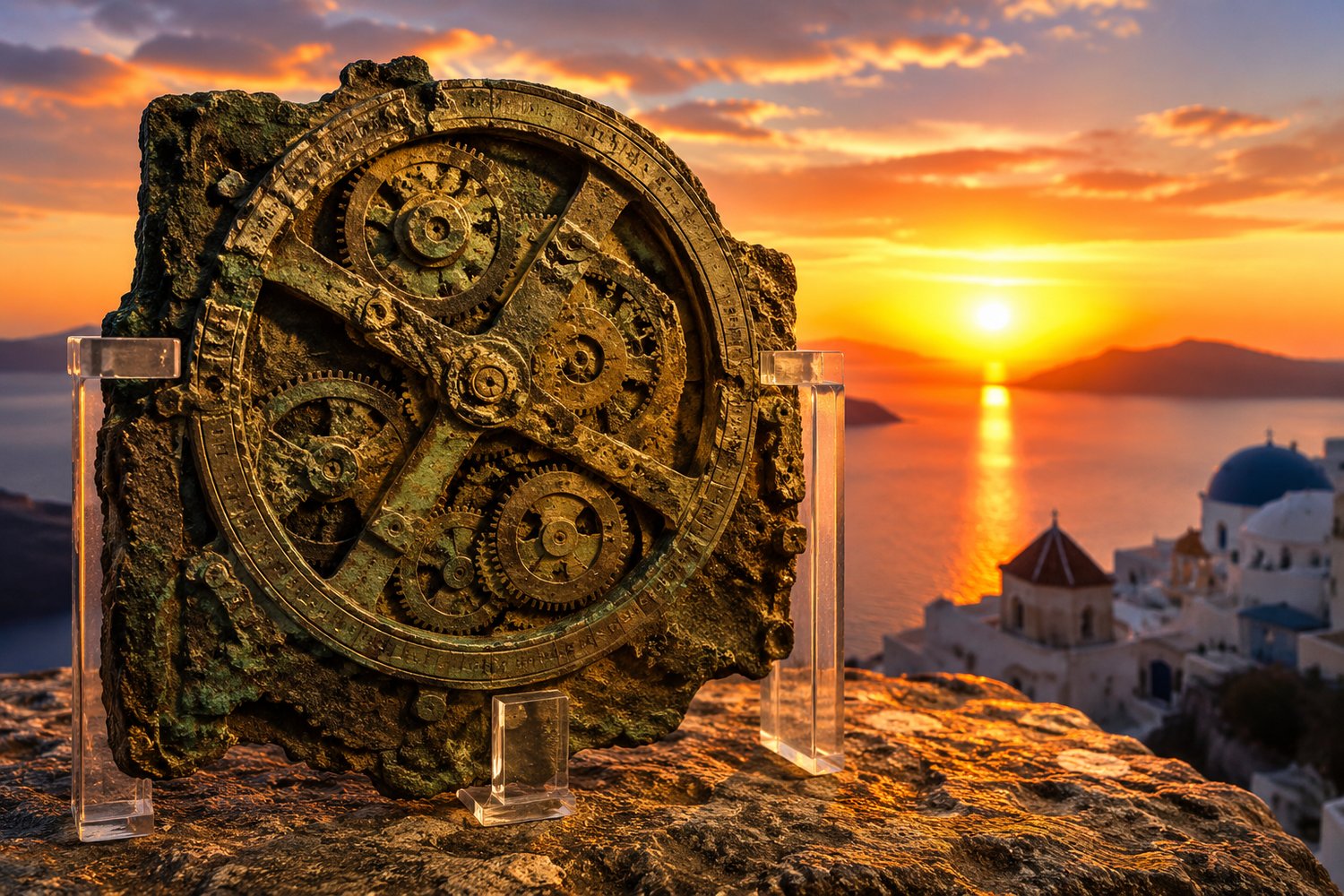
A lump of green, heavily corroded bronze.
Broken.
Cracked.
Apparently worthless.
Had it remained on the sea floor, history might never have known what it truly was.
Months later, while cleaning the recovered objects at the National Archaeological Museum in Athens, archaeologist Valerios Stais noticed tiny bronze gears emerging from the corroded mass.
Gears.
Inside an object believed to have been built over two thousand years ago.
No one could explain it.
Mechanical gears of such precision were thought to belong to medieval clocks—machines invented more than a thousand years later.
Yet here they were.
Hidden inside an artifact from ancient Greece.
At first, many scholars believed it was a mistake.
Some suggested the gears had accidentally fallen into the wreck centuries later.
Others argued the object was simply too advanced to be authentic.
But as more fragments were examined, the impossible became undeniable.
The mechanism contained dozens of interlocking gears, carefully calculated gear ratios, engraved scales, tiny inscriptions, and rotating pointers capable of predicting astronomical cycles with astonishing precision.
It was not a decorative object.
It was a machine.
An analog computer.
Centuries before the first mechanical clocks.
Centuries before Europe entered the Renaissance.
Perhaps the greatest surprise is that the Antikythera Mechanism was never meant to amaze future generations.
It was built to be used.
Its bronze gears silently followed the rhythms of the heavens.
The movements of the Sun.
The phases of the Moon.
The positions of planets known to the ancient Greeks.
Even eclipses could be predicted years in advance.
Whoever designed it possessed extraordinary mathematical knowledge.
But perhaps even more remarkable is that the inscriptions reveal the machine was intended to teach.
It explained celestial cycles.
It guided its user.
It transformed the sky into something that could almost fit inside a small wooden box.
Hidden within its intricate gear system were mathematical relationships that continue to astonish engineers today.
Some gear ratios accurately reproduce the irregular motion of the Moon, compensating for variations that are almost impossible to observe with the naked eye.
This level of sophistication should not have existed in the first century BC.
Yet it did.
Even more intriguing is what the mechanism does not tell us.
It bears no signature.
No inventor claimed it.
No workshop proudly engraved its name.
The identity of its creator vanished long ago.
Some historians suspect it was connected to the brilliant scientific tradition of Rhodes, where astronomers and mathematicians flourished.
Others see echoes of the work of Hipparchus, whose observations transformed ancient astronomy.
Still others wonder whether its origins reach back to the lost ideas of Archimedes himself.
No one knows.
What makes the mystery even deeper is that no other machine of similar complexity has ever been discovered from the same period.
Not one.
It appears in history almost without warning...
And then disappears.
It is as if an entire technological tradition flourished briefly before fading into silence.
Could there have been other mechanisms?
Were they melted down for their valuable bronze?
Destroyed in wars?
Hidden in shipwrecks that still rest beneath the Mediterranean?
Or do they remain buried beneath forgotten cities waiting to be uncovered?
The more researchers study the Antikythera Mechanism, the stranger the story becomes.
Modern X-ray imaging has revealed more than two thousand Greek characters engraved inside the fragments—an instruction manual concealed for centuries beneath corrosion.
Each new scan uncovers words that no human eye had seen since antiquity.
It is almost as though the machine has been speaking in whispers for two thousand years...
And only now are we beginning to hear its voice.
Some researchers have even noticed that the craftsmanship suggests experienced instrument makers rather than isolated genius.
If that observation is correct, the Antikythera Mechanism may not have been unique at all.
It may simply be the only survivor of a forgotten technology.
If that is true, history has preserved not the beginning of the story...
But its final surviving page.