

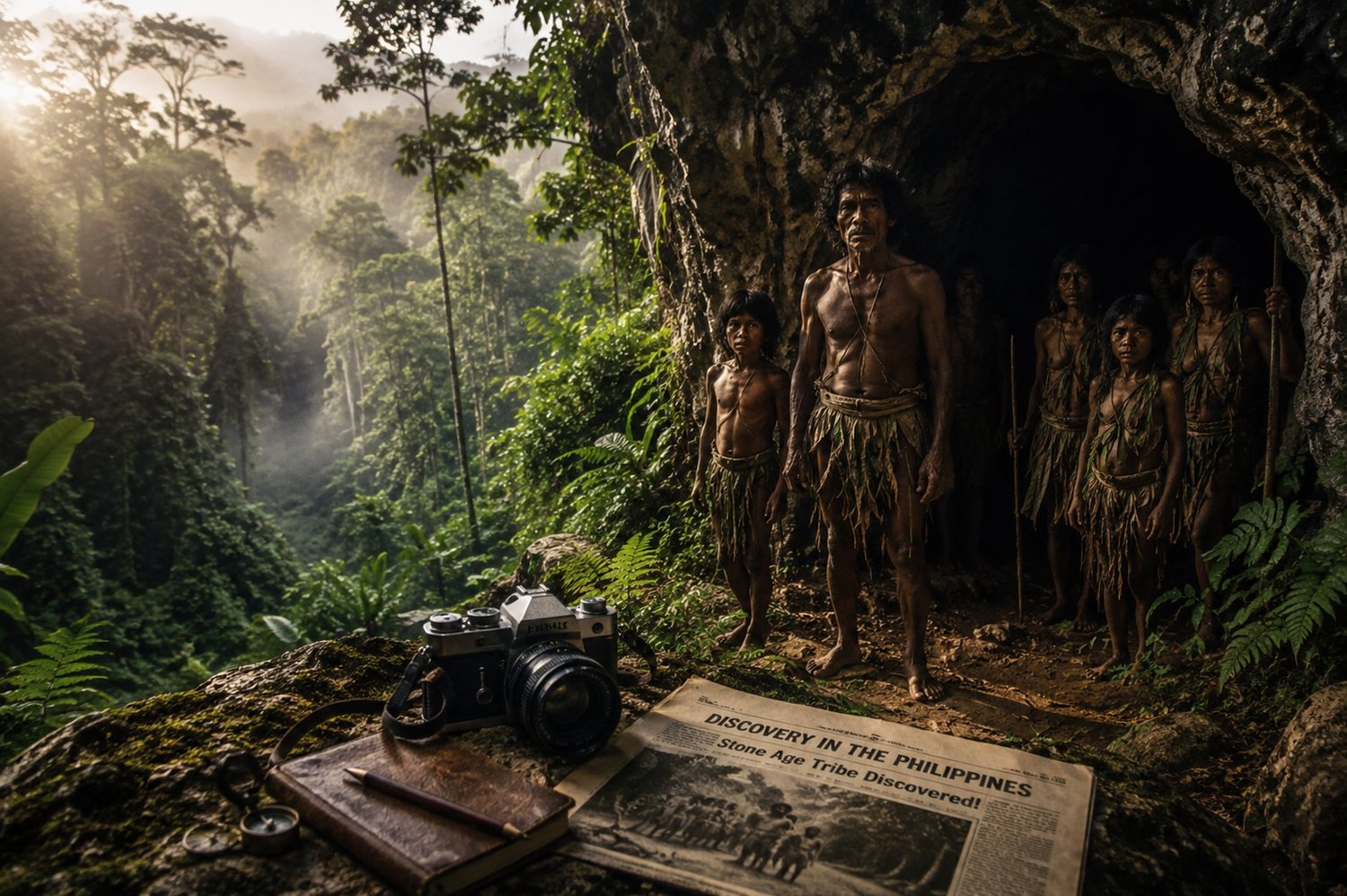
Were the Tasaday truly the last people living in the Stone Age, or were they at the center of one of the greatest anthropological controversies of the 20th century? More than fifty years later, the answer remains far more complicated than the headlines ever suggested.
A Discovery That Captivated the World
In 1971, news spread across the globe of an astonishing discovery deep within the rainforests of Mindanao in the Philippines. A small group of just twenty-six people, known as the Tasaday, had reportedly been found living in complete isolation.
According to early reports, they had no knowledge of farming, metal tools, or warfare. They were said to live in caves, wear clothing made from leaves, and rely on stone tools much like prehistoric humans.
It sounded like a window into humanity's distant past.
Newspapers celebrated the discovery. Documentaries were filmed. National Geographic featured the tribe, and millions of people believed they were witnessing living survivors of the Stone Age.
The Tasaday quickly became one of the most famous isolated peoples on Earth.
The Hidden Barrier
But there was something unusual.
Almost immediately after the discovery, access to the Tasaday was tightly controlled.
Only a handful of carefully selected journalists, scientists, and photographers were allowed to visit them. Independent researchers were largely kept away.
This secrecy fueled curiosity.
Why were so few people allowed to verify such an extraordinary claim?
At the time, few questioned the official story.
When the World Returned
Everything changed in 1986.
After the fall of Philippine President Ferdinand Marcos, restrictions disappeared, and journalists finally returned to the region.
What they found stunned the world.
Many of the people once photographed wearing leaf garments were now living in ordinary bamboo houses. They wore shirts, jeans, and had long-standing contact with neighboring communities.
Some locals even claimed that the Tasaday had been encouraged to pose as a completely isolated tribe whenever visitors arrived.
Almost overnight, headlines shifted from "The Last Stone Age Tribe" to "The Greatest Anthropological Hoax."
Was It All a Hoax?
The truth, however, proved far more complicated.
Later linguistic and anthropological research suggested that the Tasaday were indeed a real indigenous group with their own unique dialect and cultural traditions.
What appears to have been exaggerated was not their existence—but their isolation.
Rather than being untouched survivors from the Stone Age, they were likely a small forest-dwelling community whose lifestyle had been dramatically romanticized for political, financial, and media purposes.
Reality was less sensational than the legend—but no less fascinating.
Why the Story Still Matters
The Tasaday controversy is about much more than one remote tribe.
It reminds us how easily extraordinary stories can spread when they confirm what people want to believe.
The world wanted to discover a living Stone Age.
The media wanted an unforgettable story.
Politics found an opportunity.
Science, meanwhile, struggled to separate evidence from mythology.
The Real Mystery
Perhaps the greatest mystery isn't whether the Tasaday lived like prehistoric humans.
The real mystery is how quickly an entire world accepted an extraordinary narrative with so little independent verification.
Their story forces us to ask uncomfortable questions:
How often do we confuse mystery with truth?
How much of history is shaped by those who tell the story?
And how many modern myths are being created today before our very eyes?
The Tasaday remain one of history's most fascinating reminders that reality is often far stranger—and far more complex—than fiction.
Sometimes the greatest mystery isn't hidden in a remote jungle... but in the stories humanity chooses to believe.