
If your shop, café, salon or office lease has a CPI rent review in February or March, the number that sets your new rent comes out on 27 January 2027. That's when the ABS publishes the December 2026 quarter CPI.
With inflation running higher this year (the CPI rose 4.3% in the 12 months to September 2026), the increases are bigger than tenants are used to. So it's worth checking the landlord's figure rather than just paying it. Here's how.
General information only, not legal or financial advice. Figures checked against the ABS and state Small Business Commissioners on 22 November 2026.
Step 1: read your rent review clause word for word
A CPI clause usually names four things. Write each one down:
- The index. Usually "All groups CPI" for a city, such as Sydney or Perth, or the "weighted average of eight capital cities".
- The two quarters. Often "the quarter ending immediately before the review date" compared with the same quarter a year earlier (or before the last review).
- Any cap or floor. For example "CPI, but not more than 5%" or "not less than 3%".
- Any extras. "CPI plus 1%", "CPI or 4%, whichever is higher", or a clause saying the rent can never go down.
Most disputes start here, not in the maths. A landlord using the national figure when your lease says Sydney, or the wrong quarter, can change the answer.
Step 2: get the right ABS numbers
The ABS switched to a monthly CPI as its headline inflation measure in November 2025. The quarterly series hasn't gone away. The ABS still publishes it, for indexation and contracts. Each quarter is now the average of its three months.
Quarterly figures are in Tables 17 and 18 of the monthly CPI release, updated in the March, June, September and December releases. Table 17 has the All groups index for each capital city and for Australia.
The headline graph on the ABS website is the national monthly figure. If your lease names a city and a quarter, that's not the number to use.
Step 3: watch out for the old index numbers
This is the trap of 2026. The ABS re-referenced the CPI so that September 2025 = 100.00. Before that, the base was 2011-12 = 100.0.
So Sydney's December 2024 index was 139.7 on the old series and 97.03 on the new one. Compare an old number with a new one and you get a nonsense "fall" of about 28%. Mistakes like this can turn up in a rent notice.
The fix:
- Take both index numbers from the same, current table. The ABS has re-referenced the history, so any two quarters compare correctly.
- If your lease or an old notice quotes an old-series number, convert it. The ABS conversion factor for All groups CPI is 0.6945 for Sydney and for the eight-capitals average (other cities differ slightly). 139.7 × 0.6945 = 97.02. That's a rounding difference from the published 97.03, which is why using the current table is better.
Re-referencing doesn't change the percentage movements, apart from rounding.
Step 4: do the maths
New rent = current rent × (review quarter index ÷ base quarter index).
Then apply any margin, cap or floor the clause has. Some leases use the published annual percentage, rounded to one decimal place, rather than the index ratio. Check which yours says.
Here's the example from my spreadsheet, a Sydney café whose rent review falls on 1 February each year:
- Rent before the February 2026 review: $66,166.52 a year plus GST.
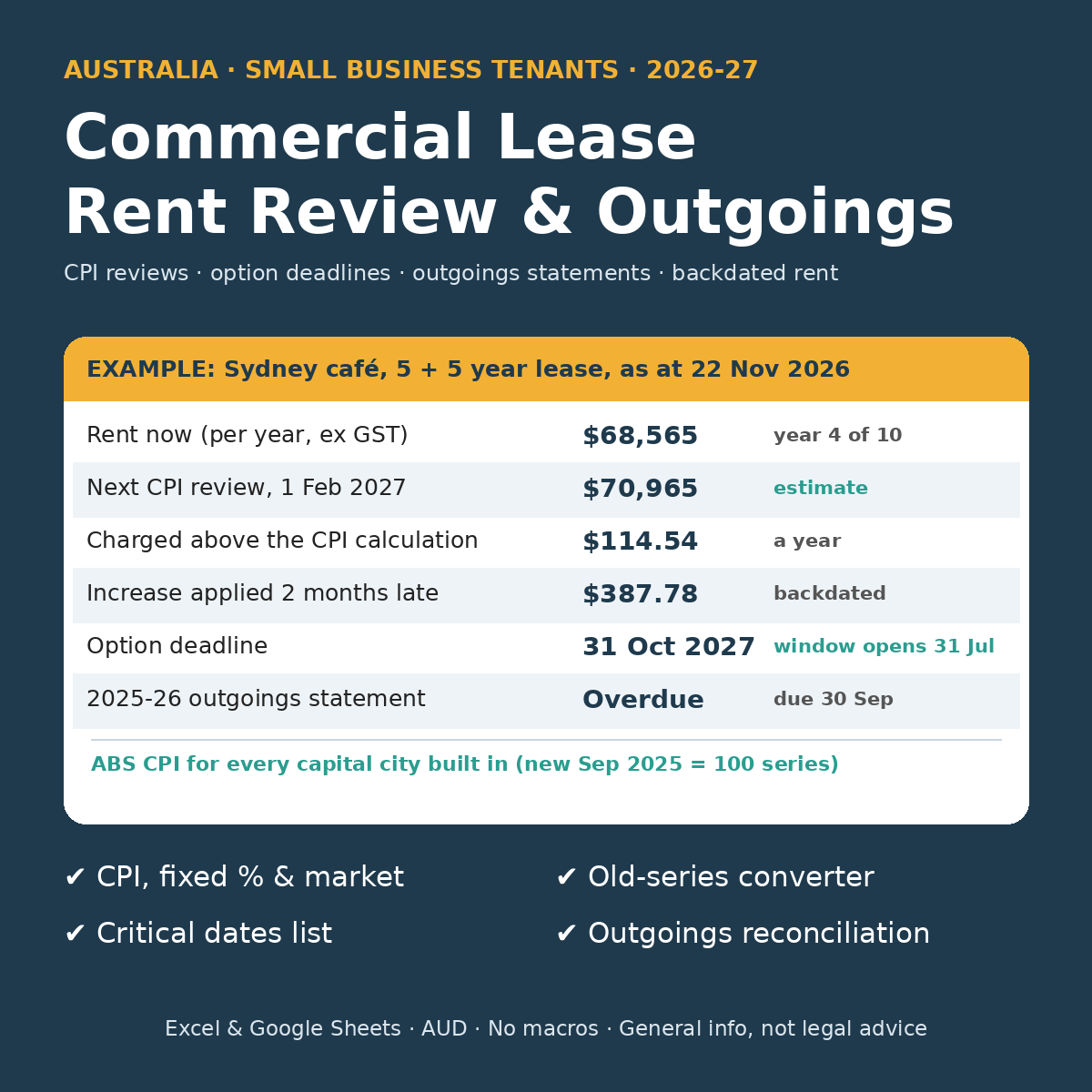
- Sydney CPI, December 2024 quarter: 97.03. December 2025 quarter: 100.38. That's a 3.45% increase, so the new rent should be $68,450.95.
- The landlord's notice used the eight-capitals average instead (96.81 to 100.32, or 3.63%), giving $68,565.49. That's $114.54 a year too much, every year from now on, because each later review builds on it.
- The increase was only charged from 1 April, so about $388 of backdated rent was still owed for February and March. In Queensland, the Small Business Commissioner says a tenant is still likely to owe a late increase backdated to the review date. Expect the same under most leases.
Step 5: know your state's retail lease rules
If your premises are covered by a retail leases Act, some clauses may not work the way they read:
- In NSW, the Retail Leases Act 1994 (s 18) makes a clause void if it gives the rent whichever of two methods is higher ("CPI or 4%, whichever is greater"), or stops the rent falling where the review could cause a fall. Rent reviews generally can't happen more than once a year, except fixed increases.
- In Queensland, the Small Business Commissioner says ratchet clauses and dual-method rent reviews are prohibited in retail shop leases.
- Other states and territories have their own rules, and non-retail leases mostly follow the lease wording. Check with your state's Small Business Commissioner (many offer free advice and low-cost mediation) or a leasing lawyer.
While you're in the lease: two more dates
Your option window. If you have an option to renew, you usually have to exercise it in writing inside a set window, often between 6 and 3 months before the term ends. Miss it and you'll probably lose the option. In the example, the window runs from 31 July to 31 October 2027.
Outgoings statements. If you pay a share of outgoings, NSW retail landlords must give an estimate before each accounting year and an audited statement within three months after it (30 September for a June year). If you don't get one, ask in writing. If it still hasn't come 10 business days later, the NSW Small Business Commissioner says you can withhold outgoings until it does, then pay within 28 days. In the example, the 2025-26 statement is overdue, and building insurance came in 12.5% above the estimate the year before. That's worth asking about.
A spreadsheet that does the checking
I built a spreadsheet for this: the Commercial Lease Rent Review & Outgoings Tracker. It has the ABS quarterly CPI for every capital city built in, on the new series back to 2008, with the old-series conversion factors. It works out each year's review (CPI, CPI plus a margin, fixed %, fixed amount or market, with caps, floors and no-fall clauses) and compares it with what you're charged. It also calculates backdated rent and any security top-up. It lists your option window, lease expiry and outgoings deadlines, and reconciles outgoings estimates against audited actuals. It flags the NSW and Queensland retail rules above. Excel and Google Sheets, no macros, with a worked example.
This article is general information, not legal or financial advice. Check your own lease wording, and see the ABS CPI release and your state's Small Business Commissioner for the full rules, or ask a leasing lawyer.