
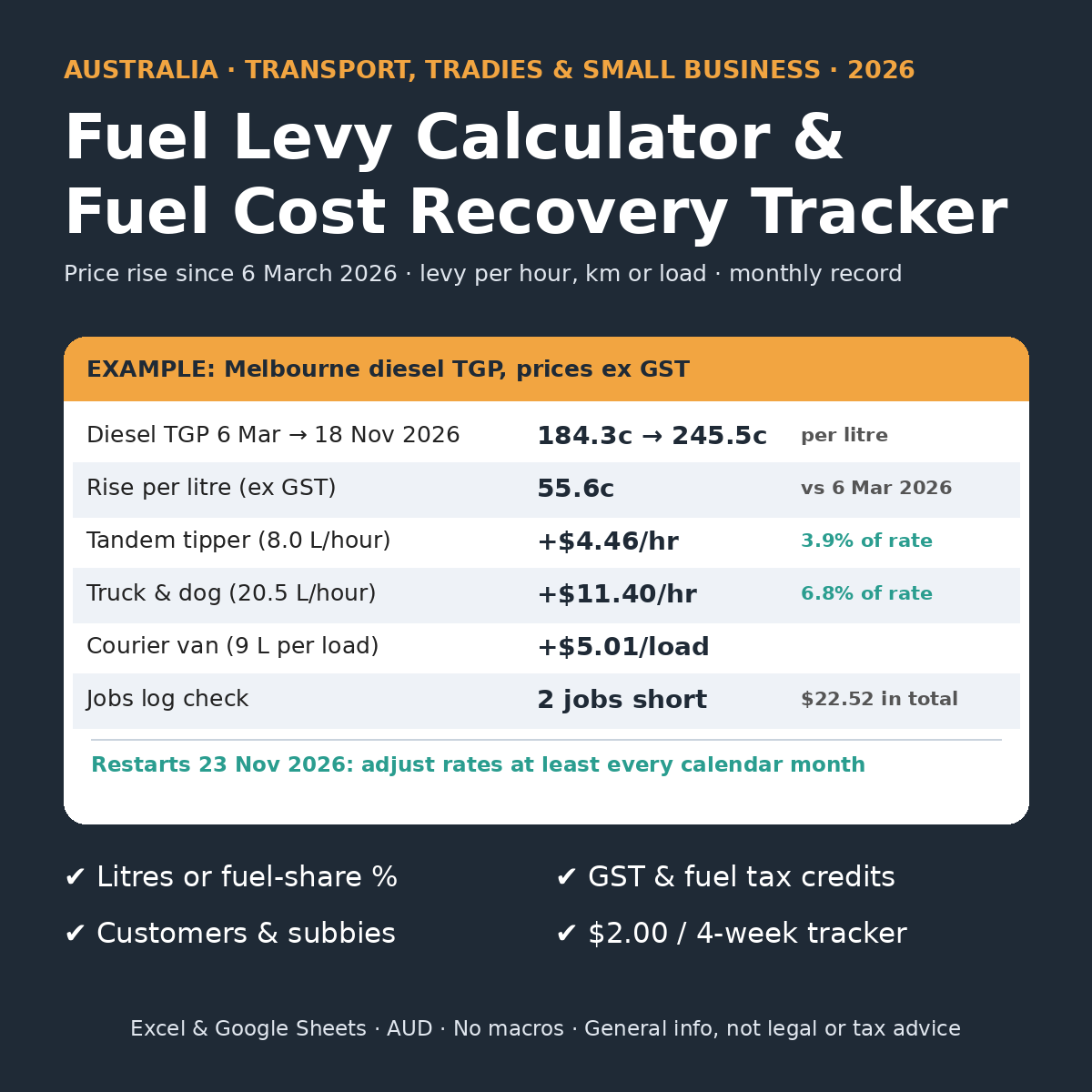
Diesel is still far above its pre-conflict price: 245.5 cents a litre at the Melbourne terminal gate on 18 November, against 184.3 cents on 6 March. From Monday 23 November 2026, the Fair Work Commission's fuel cost recovery order applies again across road transport supply chains. Here's how to work out a levy that covers the real increase, and keep a record that shows it.
General information only, not legal, tax or financial advice. Rules checked against the Fair Work Commission, the Fair Work Ombudsman, the ATO and the ACCC on 22 November 2026.
What changed on 23 November
The order first applied from 21 April to 5 June 2026, then stopped when diesel fell below $2 a litre. On 9 November the Commission varied it and restarted it. The key points:
- Who pays more: businesses in a road transport contractual chain must adjust the rates they pay so that owner-drivers, small fleets, couriers and other providers recover the increased cost of fuel. That's the cost per litre now minus the cost per litre on or before 6 March 2026.
- How often: at least once every calendar month (it used to be fortnightly).
- How: a change to the rate, a fuel levy, a direct reimbursement, or an existing rise-and-fall clause, as long as it's adjusted at least monthly.
- Agreed fuel levies: these count only if the payer has given the provider a copy of the order, the levy is adjusted at least monthly, and the payer has taken reasonable steps to make sure it's enough.
- When it ends: after the AIP's weekly national average diesel terminal gate price is below $2.00 a litre for 4 weeks in a row. Restarting it after that needs a new decision. The Commission reviews the order in February 2027, then every three months.
- No back pay for the gap from June to November.
Customers at the top of the chain, such as manufacturers, large retailers and construction companies, must also take reasonable steps to check that the businesses below them pass the increase on.
The simple formula: litres x price rise
The order doesn't set a formula, but the Victorian Government's guidance uses the most direct one:
levy = litres used x (price per litre now − price per litre on 6 March 2026)
Per hour, that's litres per hour x the rise. Per kilometre, it's litres per 100 km ÷ 100 x the rise.
Two decisions come first:
- Pick one price series and stick with it. The AIP's terminal gate price for your city is published every weekday. Your own fuel receipts work too. Don't mix them.
- Decide on GST. If you're GST-registered, you claim the GST on fuel back, so work out the rise ex GST and add GST to the levy on your invoice.
Worked example: a Melbourne tipper and a truck and dog
Take Melbourne diesel at 184.3c a litre on 6 March and 245.5c on 18 November. That's a rise of 61.2c including GST, or 55.6c a litre ex GST.
- Tandem tipper: the Victorian guidance assumes 30.8 L/100 km at 26 km/h, or about 8.0 litres an hour. That's about $4.46 an hour. On a base rate of $114.43 an hour, that's a 3.9% levy.
- Truck and tri-axle dog: 53.9 L/100 km at 38 km/h, or about 20.5 litres an hour. That's about $11.40 an hour, 6.8% of a $166.67 base rate.
- Courier van: at 9 litres a load, about $5.01 a load.
Reset the levy each month. If diesel falls to the March price or below, the levy is $0: the order only covers increases.
The fuel-share % method, and why you should check it
Many freight contracts use a percentage levy instead:
levy % = (price now ÷ base price − 1) x fuel's share of your costs
It's quick, but it's only as good as the fuel share you plug in. In our example the price is up 33.2%:
- If the tandem tipper uses a "rule of thumb" fuel share of 30%, the levy is 10% of $114.43, or $11.40 an hour. That's more than double the $4.46 the litres actually cost. At the March price, fuel was only about 11.7% of that hourly rate.
- If the truck and dog uses 20%, the levy is 6.6%, or about $11.07 an hour, which is $0.33 an hour short of the litres it burns.
Too high is a risk: in April the ACCC sent notices asking businesses to back up large fuel surcharges, and said a surcharge blamed on fuel must be substantiated. Too low and you absorb the rest. Run both methods and compare.
Fuel tax credits: should you net them off?
The order just says "cost per litre", so agree the basis with the other party. Netting credits off only changes the rise when ATO rates change: the heavy vehicle on-road rate was 20.2c for fuel bought 2 February to 31 March 2026 and is 21.3c from 3 August 2026, which takes about 1.1c off the rise. Light vehicles on public roads get no credit.
6 checks before you send the next invoice
- Is the work covered? The order covers road transport work in a contractual chain, but not livestock or cash in transit. Tradie call-outs may sit outside it, though an agreed contract levy is still fine.
- Is your baseline written down? Record the price on or before 6 March 2026 and where it came from.
- Has every month been adjusted? Note the date you set each month's rates. A missed month is the easiest thing to spot.
- Did the payer give you a copy of the order? Without it, an agreed levy doesn't count under the levy clause.
- Does the levy cover the litres you actually burn? Check job by job, especially on long or heavy runs.
- Do you also pay subbies? Pass the increase down. In Victoria and WA, owner-driver laws may also require a hirer that collects a fuel levy to pass a fair share on.
Run your own numbers
I made a Fuel Levy Calculator & Fuel Cost Recovery Tracker for Australian owner-drivers, small fleets, tradies and the businesses that pay them. Enter your baseline price, each month's price and your vehicles' fuel use, and it shows:
- the levy per hour, per km and per load for up to 12 vehicles, by both methods
- a month-by-month record of each adjustment, with a flag for any month you missed
- a jobs log showing what you charged or paid against the increased fuel cost, by customer and contractor
- a tracker for the 4-weeks-under-$2.00 rule
Excel and Google Sheets, no macros.
This article is general information only and isn't legal, tax or financial advice. It doesn't take your circumstances into account. The order can be varied or revoked, and the FWC reviews it in February 2027. Check the current order at fwc.gov.au, and talk to your adviser or industry association about your situation.