
Christmas 2026 lands awkwardly for small employers. Christmas Day is a Friday, Boxing Day is a Saturday, and most states add an extra public holiday on Monday 28 December. Then come New Year's Day (Friday 1 January) and Australia Day (Tuesday 26 January). That's up to five public holidays in five weeks.
Since 1 October 2026 you can't surcharge card payments, so the public holiday surcharge is one of the few left. Here's how to work out what each day costs, whether opening beats closing, and what surcharge would cover the wages.
General information only, not legal, payroll or tax advice. Rates and dates checked against the Fair Work Ombudsman, the award texts, the ATO and the ACCC on 22 November 2026.
Which days are public holidays?
From the Fair Work Ombudsman's 2026 and 2027 lists:
- Friday 25 December: Christmas Day, everywhere.
- Saturday 26 December: Boxing Day (Proclamation Day in SA) everywhere except Tasmania.
- Monday 28 December: an additional public holiday in every state and territory except Tasmania, where Monday 28 December is Boxing Day.
- Christmas Eve evening: a part-day public holiday from 7 pm in SA and the NT, and from 6 pm in Queensland. SA and the NT also have New Year's Eve from 7 pm.
- Friday 1 January and Tuesday 26 January 2027, everywhere.
Rights follow where the employee is based for work. Regional holidays come on top.
What you pay if you open
The award sets the rate. For the awards most small businesses use:
- Restaurant, Hospitality, General Retail and Fast Food awards: 225% of the base hourly rate for full-time and part-time staff, and 250% for casuals. The casual figure already includes the 25% loading, so don't add it again.
- Clerks and Building and Construction awards: 250% for permanent staff, 275% for casuals.
- Hair and Beauty: 250%.
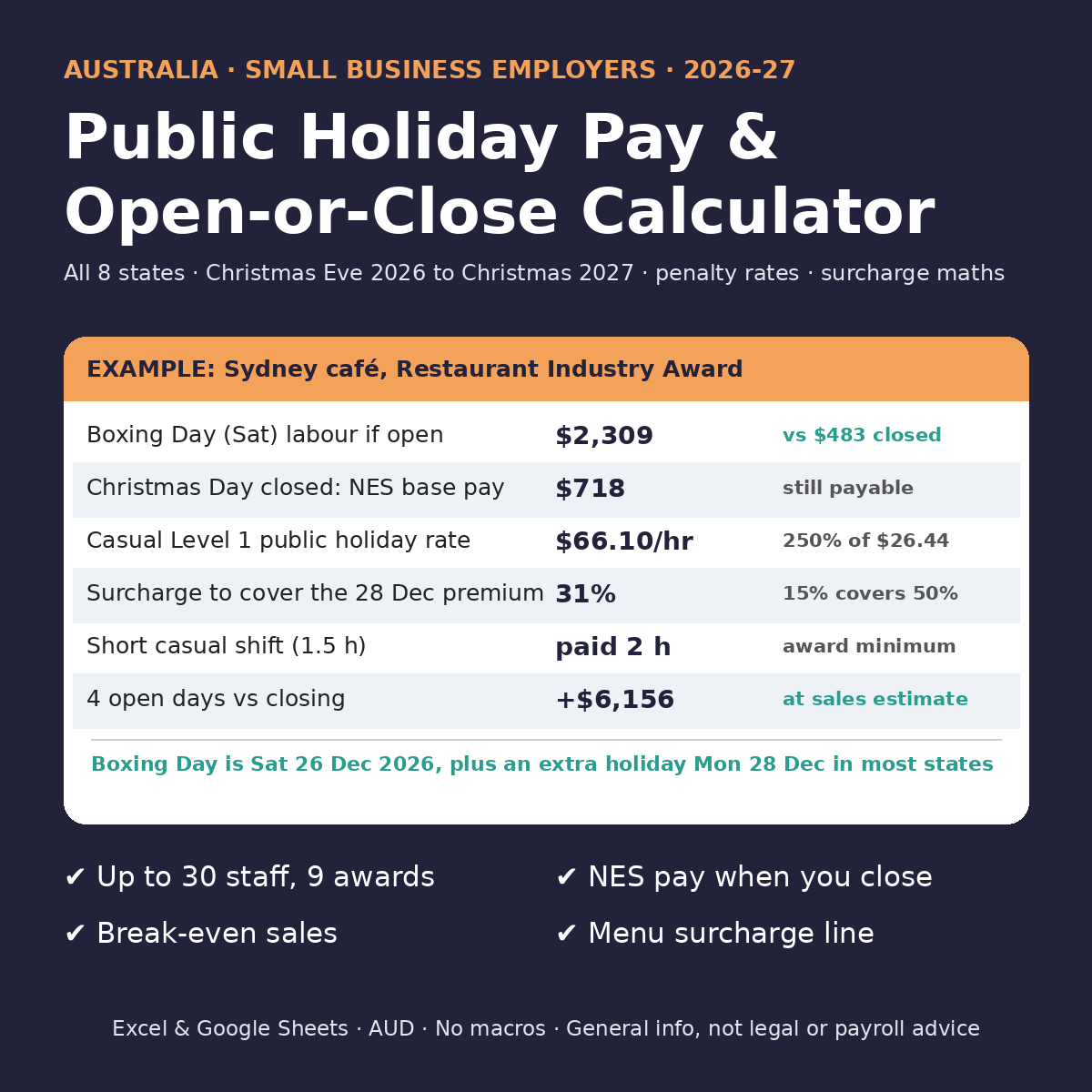
Some awards also set a minimum paid shift on a public holiday. Under the Restaurant and Hospitality awards it's 4 hours for permanent staff and 2 hours for casuals, even if they work less. A 1.5-hour casual shift is paid as 2 hours.
At 2026-27 rates, a Level 1 casual café worker on $26.44 an hour costs $66.10 an hour on a public holiday, plus super.
Closing isn't free
Under the National Employment Standards, a full-time or part-time employee who normally works on the day of the week a public holiday falls gets their base pay for the ordinary hours they would have worked, even if you close. Casuals don't. And you can't change the roster just to avoid it.
In our worked example (a Sydney café with two full-time and two part-time staff and four casuals), closing on Christmas Day still costs about $718 in base pay, super and on-costs. That's the floor to compare opening against, not zero.
Should you open? Compare the extra cost with the extra profit
For each day:
- Labour cost if you open: public holiday pay for everyone working, base pay for permanent staff who normally work that weekday but aren't rostered, plus super (12% of qualifying earnings, which includes public holiday pay for ordinary hours) and other on-costs such as workers comp.
- Labour cost if you close: just the base pay for permanent staff who normally work that weekday, plus super and on-costs.
- Profit from opening: expected sales ex GST x your gross margin, plus any surcharge income, minus card fees, the extra labour cost and any other costs of opening.
The example café expects $5,500 in takings on Boxing Day. Opening costs about $2,309 in labour against $483 if it closes, and opening still comes out about $2,175 ahead. On Monday 28 December, at $4,200 of takings, it's about $1,386 ahead. Its break-even that day is about $2,333 of takings. Below that, closing costs less.
What surcharge actually covers the wages?
surcharge that covers the premium = public holiday premium ÷ (sales ex GST x (1 − card fee %))
The premium is what the day costs above the same hours on a normal weekday, including super and on-costs. Use sales ex GST because the GST on the surcharge isn't yours to keep.
For the example café on Monday 28 December:
- the premium is about $1,132
- sales are $4,200 including GST, or $3,818 ex GST
- so the surcharge that covers it is about 30%.
A 15% surcharge brings in about $573 ex GST, which covers only about half the premium. On Boxing Day, with higher sales, about 25% would cover it.
That's why 10% or 15% often falls short. There's no legal cap: charge more, or treat the surcharge as a contribution and price the rest into your menu.
The rules for showing a surcharge
Under regulation 80A of the Competition and Consumer Regulations, a restaurant, café, bistro or takeaway shop can show a day surcharge as a percentage instead of a full price, but only if:
- the menu says "A surcharge of [percentage] applies on [the day or days]"
- that line is at least as prominent as the most prominent price on the menu.
The ACCC confirms weekend and public holiday surcharges are still allowed after the card surcharge ban. Two traps:
- Charge it only on days that are public holidays in your state. Christmas Eve is a part-day public holiday only in some states, and only from 6 pm or 7 pm.
- Salons, shops and other businesses can't use the exemption. They have to show the full price for the day.
Six checks before the roster goes out
- Confirm the public holidays where each employee works, including part-days.
- Check each award's public holiday rate and minimum shift. Juniors, apprentices and agreements differ.
- Ask staff early. Employees can refuse a request to work a public holiday if the request isn't reasonable or their refusal is reasonable.
- Pay permanent staff their base pay when a public holiday falls on their usual workday and they're not rostered.
- Pay super on public holiday pay within 7 business days of payday under Payday Super. Public holidays aren't business days.
- If you surcharge, update the menu and set your point of sale to charge it only on the right days.
Doing it for the whole team
Doing this by hand for eight staff and five holidays gets messy, so I built a spreadsheet for it: the Public Holiday Pay & Open-or-Close Calculator. It has every state's public holidays to Christmas 2027, rates for nine common awards (plus custom rows), up to 30 staff, NES pay, award minimum shifts, super and on-costs. For each day it shows labour cost open and closed, profit from opening, break-even sales, the surcharge that covers the premium and the menu line. Excel and Google Sheets, no macros: https://payhip.com/b/np5rw
This article is general information, not legal, payroll, tax or financial advice. Award rates change each 1 July and awards can be varied: check your award and the Fair Work Ombudsman's Pay Calculator, or talk to your adviser or industry association.