
Gift vouchers are the easiest thing a small business sells at Christmas. The money comes in now, the work comes later, and plenty of buyers spend more than the voucher when they come in. But vouchers have their own rules for how long they must last, what you can charge, and when the GST counts. They get messy when the register lives in a notebook.
This year there's an extra twist. Vouchers sold at Christmas 2023 with the 3-year minimum expire around Christmas 2026, so many businesses are selling new vouchers and dealing with expiring ones at the same time.
General information only, not tax, accounting or legal advice. Rules checked against the ATO and the ACCC on 22 November 2026.
Rule 1: most vouchers must last at least 3 years
Gift cards and vouchers bought on or after 1 November 2019 must be redeemable for at least 3 years from the day they're supplied or bought. That's in the Australian Consumer Law (sections 99A to 99G). Writing a shorter date on the voucher doesn't help: the 3 years still apply.
The 3-year minimum doesn't apply to some vouchers, including:
- vouchers sold at a genuine discount (the ACCC's example is a $60 card for a massage valued at $100)
- promotional giveaways, such as vouchers handed out at a market or donated to a school raffle
- vouchers for something only available for a specified period, like a one-off event
- loyalty programs, employee rewards, reloadable cards and second-hand cards.
Rule 2: show the expiry date
The expiry date must be prominently displayed. You can show it as a period instead, but then the issue date has to be there too, for example "Valid for 3 years from the date of issue. Issued: December 2026". If the voucher never expires, say so.
Rule 3: no fees after it's sold
You can't charge post-supply fees: no activation, account-keeping, balance enquiry or inactivity fees. Fees for reissuing a lost or damaged voucher, and booking fees you'd charge anyway, are allowed.
Rule 4: GST timing depends on the type of voucher
This is the one that trips up GST-registered businesses. The ATO splits vouchers into two types.
Face value vouchers. These are vouchers for a dollar amount the holder can spend on a reasonable choice of things, such as "$100 to spend". There's no GST when you sell it. GST is counted when it's used, at 1/11 of the voucher value used. If someone uses $60 of a $100 voucher in January, $5.45 of GST goes on that BAS.
Two details:
- If you charge more than the face value (say $105 for a $100 voucher with a gift box), GST on the extra $5 is counted at sale.
- If you sell a face value voucher at a discount, GST on redemption is still worked out on the full voucher value used, not the discounted price (ATO ruling GSTR 2003/5, para 114). A $100 Black Friday voucher sold for $80 still carries $9.09 of GST when it's fully used.
Specific item or service vouchers. These can only be used for a particular thing, such as "a 60-minute massage" or "dinner for two". The ATO calls them non-face value vouchers. GST is counted when you sell it, at 1/11 of the price paid (if the item is taxable), and not again when it's used.
So the same Christmas rush can put voucher GST on two different BASs. Specific vouchers land on the Oct–Dec BAS, due 28 February 2027 for quarterly lodgers. Face value vouchers land on whichever quarter they're used in.
Rule 5: expired balances need a GST adjustment
When a face value voucher expires with money left on it and you write that balance back to income in your books, you make an increasing adjustment of 1/11 of the unused amount, reported at label 1A on your BAS (GST Act section 100-15).
The ATO's own example: a café sells a $100 voucher, the holder spends $67, and it expires with $33 left. When the café writes the $33 back to income, it adjusts $3 of GST.
The adjustment happens when you write it back, not on the expiry date. Specific-item vouchers don't need one, because their GST was counted at sale.
How unused voucher money is treated for income tax is a separate question. Ask your accountant.
A worked example
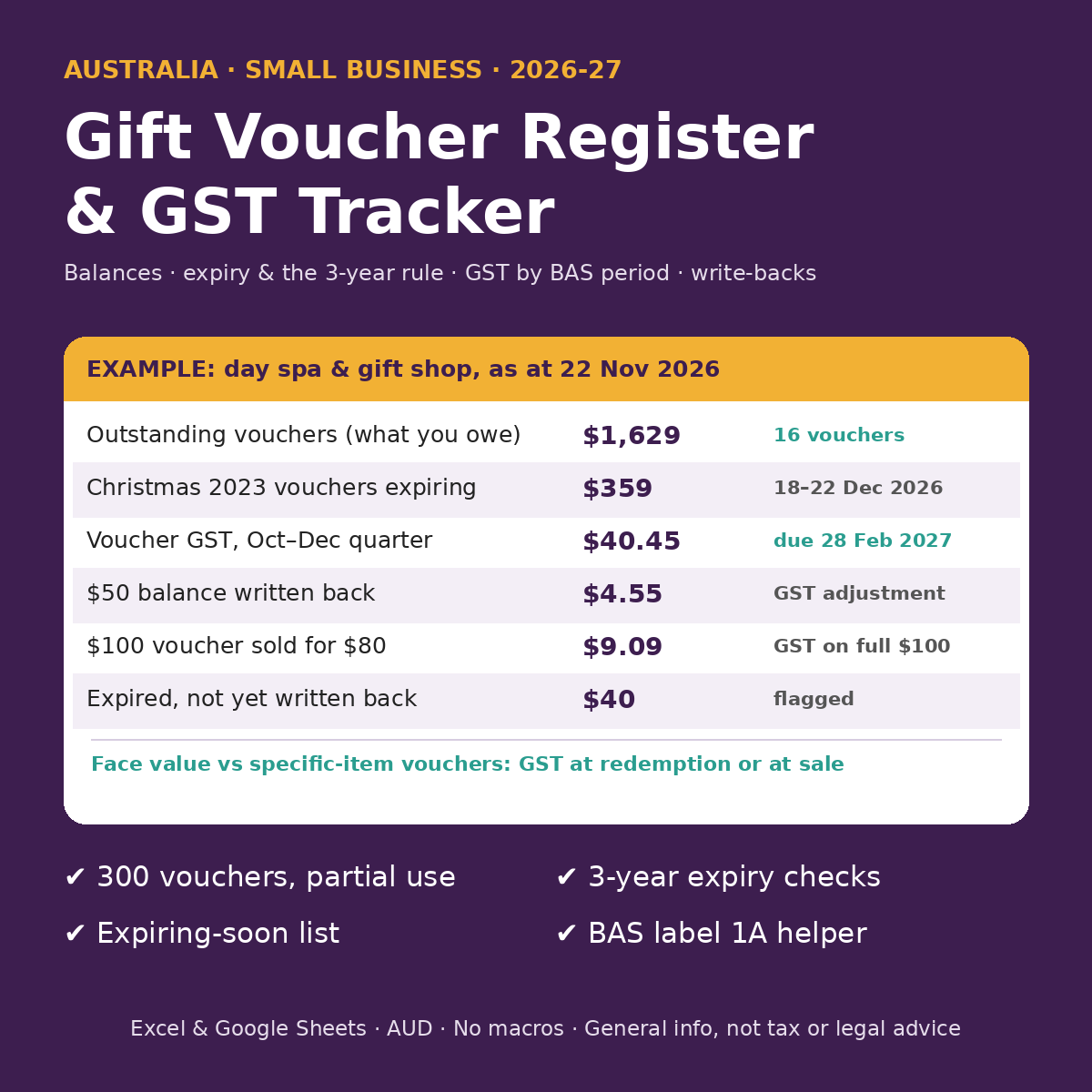
Here's the example from the spreadsheet: a day spa and gift shop with 25 vouchers in its register, as at 22 November 2026.
- It still owes $1,629 in vouchers across 16 vouchers. That's a liability in its books, not sales.
- Three vouchers sold at Christmas 2023 (two face value vouchers and a facial voucher) expire 18–22 December 2026, with $359 left on them. A reminder to the holders now could turn that into bookings.
- A $150 voucher from August 2023 expired with $50 unused. The spa wrote it back in August, so the Jul–Sep BAS includes a $4.55 increasing adjustment.
- A $100 voucher from November 2022 expired a year ago with $40 left and hasn't been written back. When it is, that's another $3.64 of GST.
- So far this quarter, its vouchers add $40.45 to GST on sales: $23.64 on a couples massage voucher sold in November (specific, so taxed at sale), 45 cents on the $5 gift box, and $16.36 on face value redemptions.
None of those numbers is hard. Keeping them right across hundreds of vouchers, partial redemptions and BAS quarters is what goes wrong.
Six habits that keep vouchers under control
- Number every voucher and record it before it leaves the counter: date, type, face value, price paid, buyer and recipient.
- Record every redemption, including partial ones, against the voucher number.
- Keep sold vouchers as a liability (for example an "Unredeemed gift vouchers" account), not as sales.
- Check expiring vouchers each month and decide whether to remind the holders.
- Write back expired balances deliberately, note the date, and include the 1/11 adjustment for face value vouchers.
- If you sell the business, hand over the register. A buyer who takes over the business as a going concern (or buys the company's shares) must honour existing gift cards.
A register that does the GST for you
I built a spreadsheet for this: the Gift Voucher Register & GST Tracker. It keeps up to 300 vouchers and 1,500 redemptions, with balances, statuses and the 3-year expiry check. It splits GST by voucher type, works out the write-back adjustment and shows voucher GST for label 1A by quarterly or monthly BAS period. It also lists the next vouchers to expire and every expired balance still in your books. Excel and Google Sheets, no macros, with a worked example.
This article is general information, not tax, accounting or legal advice. Check your own situation with your BAS agent or accountant, and see the ATO's "GST and vouchers" page and the ACCC's gift card guidance for the full rules.