

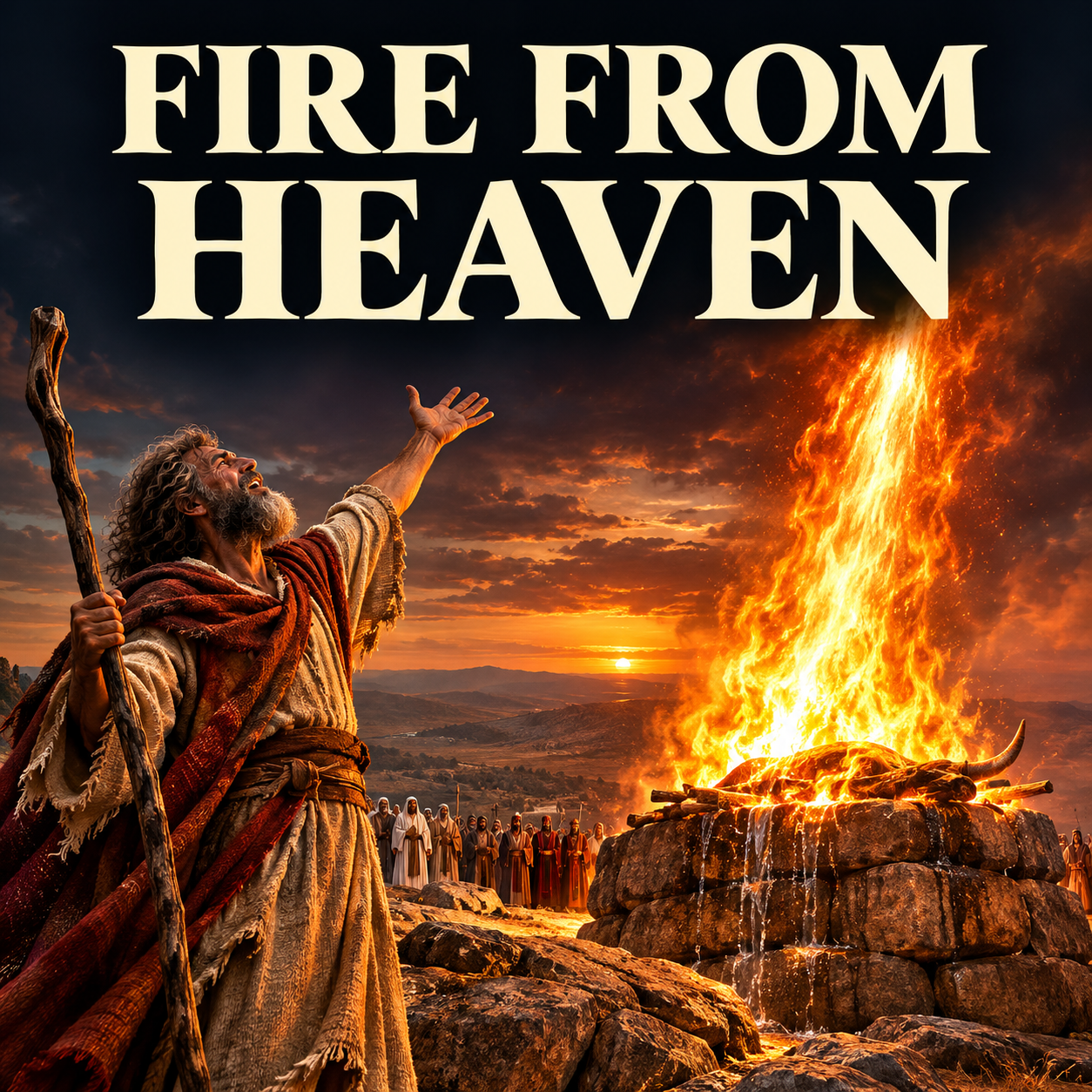
Four hundred and fifty prophets of Baal called out on Mount Carmel. No answer came. Then Elijah approached an altar soaked with water and prayed.
The story of Elijah and the prophets of Baal in 1 Kings 18 is one of the Bible’s most dramatic confrontations. Yet its central question goes deeper than who can call down fire: whom will Israel follow?
If you have watched our Mount Carmel story or want to study the passage for yourself, begin with the biblical account. The fire matters, but so do the drought before it, the purpose of Elijah’s prayer, and what happens afterward.
Where is the story of Elijah and the prophets of Baal?
The confrontation takes place on Mount Carmel in 1 Kings 18, during King Ahab’s reign. Read 1 Kings 17–19 for the wider story: drought and provision, the public confrontation, returning rain, and Elijah’s later fear and exhaustion.
In 1 Kings 18:17–18, Ahab blames Elijah for Israel’s trouble. Elijah points instead to the king’s abandonment of the Lord’s commands and his following of Baal. The conflict concerns Israel’s allegiance to God, not simply a rivalry between two impressive religious leaders.
Why did Elijah confront 450 prophets?
Elijah challenges the people to stop wavering between the Lord and Baal (1 Kings 18:21). The proposed test is direct: each side prepares a bull on wood without lighting it. The God who answers with fire will be acknowledged as God.
The narrative identifies 450 prophets of Baal in the contest. Verse 19 also mentions 400 prophets of Asherah among those Elijah asks Ahab to summon; the ensuing contest specifically describes Baal’s prophets. Keeping that distinction helps us read carefully rather than combining every number into the confrontation.
What happened on Mount Carmel?
Baal’s prophets call from morning onward, but receive no response. Their increasingly desperate actions cannot produce an answer (1 Kings 18:26–29).
Elijah then repairs the Lord’s broken altar using twelve stones, representing the tribes of Israel. He arranges the wood and the prepared offering and has four containers of water poured over them three times. Water runs around the altar and fills the trench (1 Kings 18:30–35).
At the time of the offering, Elijah prays that the people will know the Lord is God and that their hearts are being turned back. Fire consumes the offering, wood, stones, and dust and takes up the water. The people fall facedown and acknowledge the Lord (1 Kings 18:36–39).
The chapter also contains the execution of Baal’s prophets at the Kishon (verse 40). That difficult event belongs to this account’s setting of judgment; it is not permission for Christians to harm people who believe differently. Read the whole passage rather than treating it as a spectacle detached from its serious consequences.
Three lessons to reflect on
1. Faith involves allegiance
The people’s silence before the contest is revealing. Elijah’s question asks them to choose whom they will follow. For us, a useful reflection is whether our stated trust in God agrees with our ordinary decisions.
Ask: Where do approval, comfort, control, or success pull my loyalty away from God? Name one specific situation rather than writing only a general intention.
2. Prayer is more than a technique
Elijah’s prayer directs attention to God and the turning of people’s hearts. It is not a script for forcing a desired outcome. The contrast between frantic performance and Elijah’s appeal invites us to consider the purpose of our own prayers.
We can pray honestly and boldly without claiming that enough confidence guarantees a visible miracle. Read the prayer slowly in 1 Kings 18:36–37 and notice what Elijah asks the people to know.
If you want to build a steadier prayer rhythm, A Steady Life of Prayer Bible study workbook offers five practical studies.
3. Keep reading after the fire
Rain returns later in chapter 18. In chapter 19, the same Elijah becomes afraid and overwhelmed. God’s care includes food, rest, an encounter at Horeb, and a renewed commission.
A powerful moment does not remove every future struggle. When you feel weary, Elijah’s wider story gives you a reason to seek God’s care and receive practical help rather than pretend you are never afraid. Our Learning to Rest Bible study on rest and Sabbath explores this theme further.
A simple Mount Carmel Bible study
Read 1 Kings 18 in your preferred Bible translation. In a notebook, divide your page into three parts: what the passage says, what you need to understand, and how you will respond. New to journaling? Read how to start a Bible study journal.
- What is Elijah’s central challenge to the people?
- What does his prayer reveal about the purpose of the miracle?
- Which detail changes when you read chapters 17 and 19 too?
- What is one faithful action you can take this week?
A prayer to begin: Lord, help me read your Word carefully. Show me where my loyalties are divided, and teach me to follow you with honesty and trust. Amen.
Continue your study
For a guided reading path through 1 Kings 17–19, explore our Elijah on Mount Carmel printable Bible study workbook. It includes five Scripture studies, reflection questions, and space to work through your response.
Prefer a broader daily rhythm? The 30-Day Walk With Jesus Bible study and reflection journal offers a month of readings and reflection. These are digital PDFs for printing or annotation; no physical book is shipped.
Scripture reading: 1 Kings 17–19. This article offers Christian reflection; read each application alongside the biblical passage.
Helpful links