

Look, we all know the world’s changing. These days, every time you turn around, there’s some new AI tool promising to write your book for you while you put your feet up. It’s tempting, I get it. But the publishing world is watching us like a hawk right now, and if you want to keep your career on the tracks, you’ve got to play it smart.
It’s not just about playing with new gadgets; it’s about making sure you don't lose everything you’ve worked for. Here’s the "no-nonsense" guide to surviving the AI era without getting your fingers burnt.
1. Once an AI Book, Always an AI Book
On places like Amazon KDP, they’ve drawn a line in the sand. If a machine came up with the actual words, the cover art, or the translation, it’s "AI-Generated."
And here’s the kicker: you can’t "edit" your way out of that label. You could spend six months polishing that draft until it shines, but if an algorithm birthed it, you’ve got to tick that box. Now, don’t panic—if you’re just using it to check your spelling or bounce a few ideas around for a plot point, that’s "AI-Assisted," and you’re in the clear. But be honest about which one it is, or you’re asking for trouble.
2. Don’t Tell Porkies (The "Death Penalty")
If there’s one thing that’ll get you kicked out of the club, it’s lying about AI. The big platforms don't see it as a "little mistake"—they see it as a slap in the face. If they catch you being dishonest, they won’t just take down the book; they’ll shut your whole account.
Years of hard graft, your entire catalogue, gone in a puff of smoke. Plus, you’ll end up in a right mess with copyright. If you can’t prove you wrote it, you might not even own it. As the saying goes: “You’re the one responsible for what you upload, and if you’re caught lying, it’s curtains for your whole account, not just one book.”
3. Machines Haven’t Got a Soul
At the end of the day, a computer hasn't lived a life. It’s never had its heart broken, never had a bad day at the office, and it’s never sat in a pub listening to the world go by. Because of that, AI can produce some right rubbish—"nonsense text" that sounds okay at first but feels empty.
Readers aren’t daft. They can tell when a story’s got no heart. If you rely on a machine, you risk putting out something that feels fake, or worse, something that’s accidentally copied someone else’s work. A machine can’t replace us because it doesn’t know what it feels like to be us.
4. "Human-Made" is the New Top Shelf
Because the internet is getting flooded with generic, AI-produced gunk, being a real human writer is actually becoming a massive selling point. Use it! Tell your readers your book is "AI-Free" or "100% Research-Driven." It shows you’ve actually put the work in.
While you're at it, have a look at your older stuff. If you played around with AI for your blurbs back in the day and they sound a bit robotic, give 'em a refresh. Make sure your whole shop looks like a professional, human-run business.
5. Keep Your Receipts (The Paper Trail)
You need to treat your rough drafts like an insurance policy. If someone ever comes knocking and asks, "Did you actually write this?", you want to be able to point to a pile of evidence.
Keep everything:
- Your messy handwritten notes and research logs.
- Those early, terrible first outlines.
- Every version of the manuscript from start to finish.
And a word of advice: don't go copying and pasting big chunks of AI text into your main notes, even if you plan to rewrite them. It blurs the lines too much. Keep your work yours, and keep the proof to hand.
The Bottom Line
AI isn't going anywhere, and there's no point burying our heads in the sand. But you’ve got to be the boss of the tools, not the other way around. Technology can help with the boring bits, but the soul of the story has to come from you.
Ask yourself this: if you had to prove you wrote your book tomorrow, could you do it? Or is there a "ghost in the machine" that’s going to trip you up?
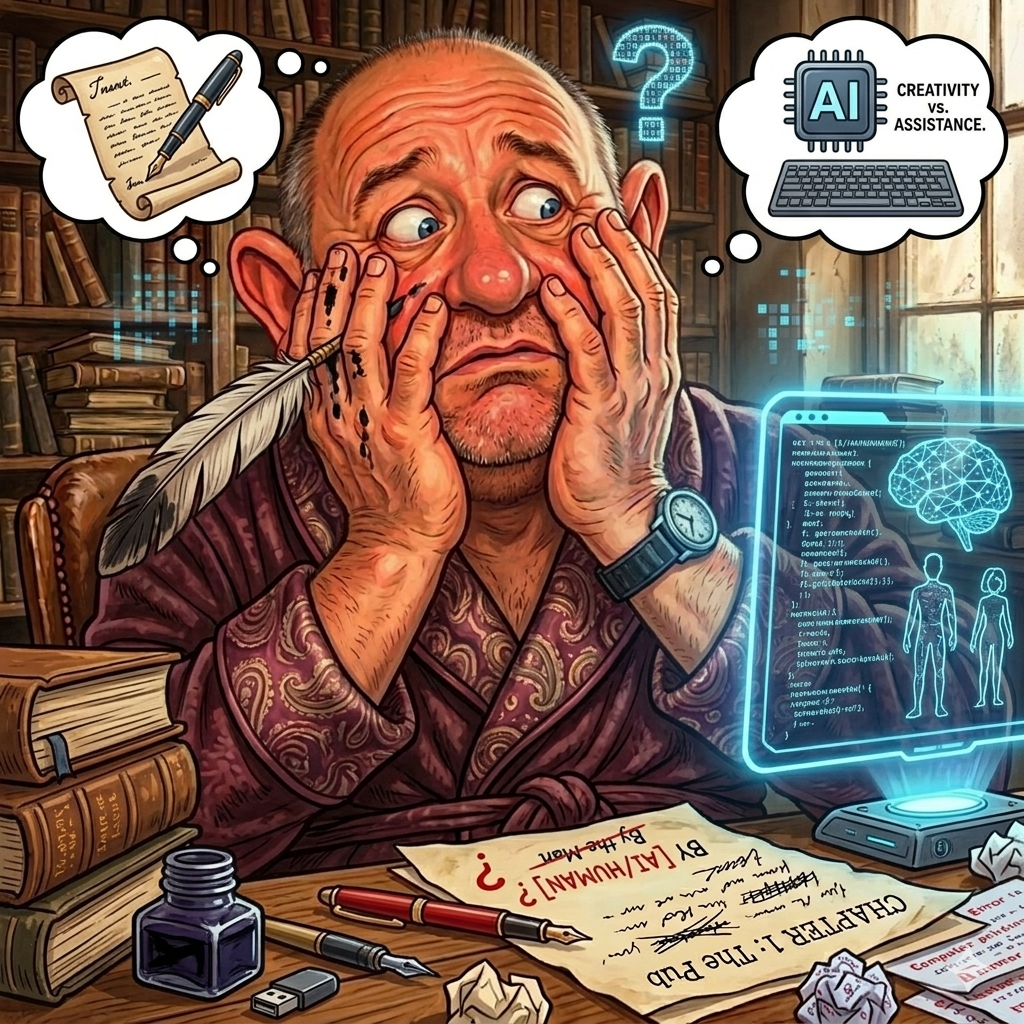
P.S. Full disclosure... I used AI to cartoonify me for the image.
Comments ()