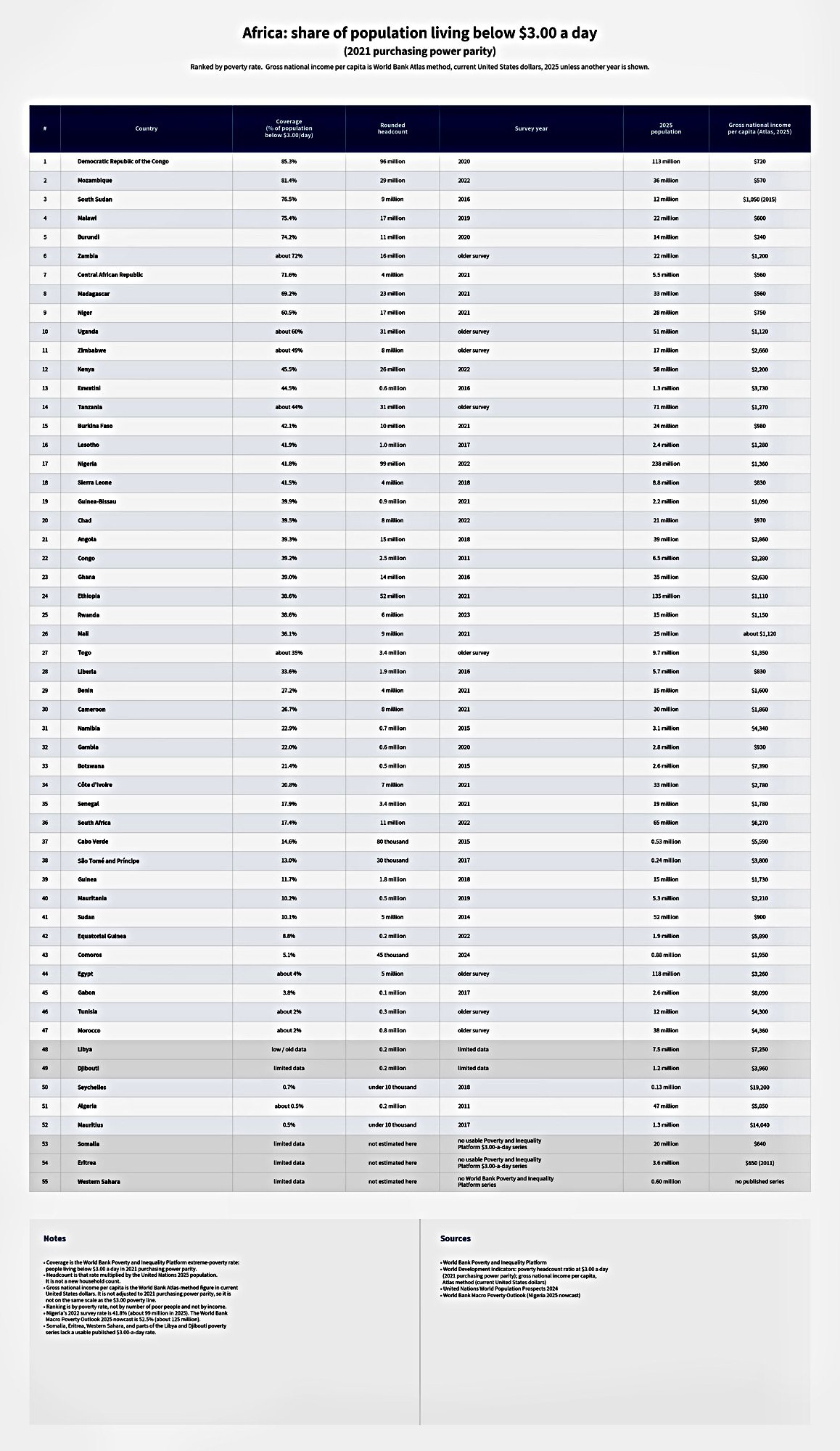

The discourse surrounding economic development in the Global South has long been preoccupied with aggregate macroeconomic expansion, often assessed and implemented through Gross National Income (GNI) per capita. However, the capability approach and modern development economics increasingly emphasise that aggregate wealth creation is a necessary but insufficient condition for human flourishing.
When applied to the African continent, this theoretical divergence manifests as a stark empirical reality of persistent decoupling of national income growth from the eradication of extreme destitution.
To rigorously interrogate this phenomenon, we must move beyond unidimensional growth metrics and adopt a bivariate analytical framework. The BidVerse Poverty-Income Cartesian Plane Index provides precisely this mechanism, mapping the structural dynamics of African economies by plotting the World Bank’s $3.00-a-day extreme poverty headcount ratio against GNI per capita. By spatialising these two critical observables, the index transcends traditional aggregate analysis, revealing the precise structural bottlenecks, including whether they be absolute resource scarcity or systemic distributional failures, that dictate whether macroeconomic capacity translates into foundational human security.
True global prosperity will only be achieved when the pursuit of aggregate wealth is entirely subordinated to the absolute elimination of severe human destitution.
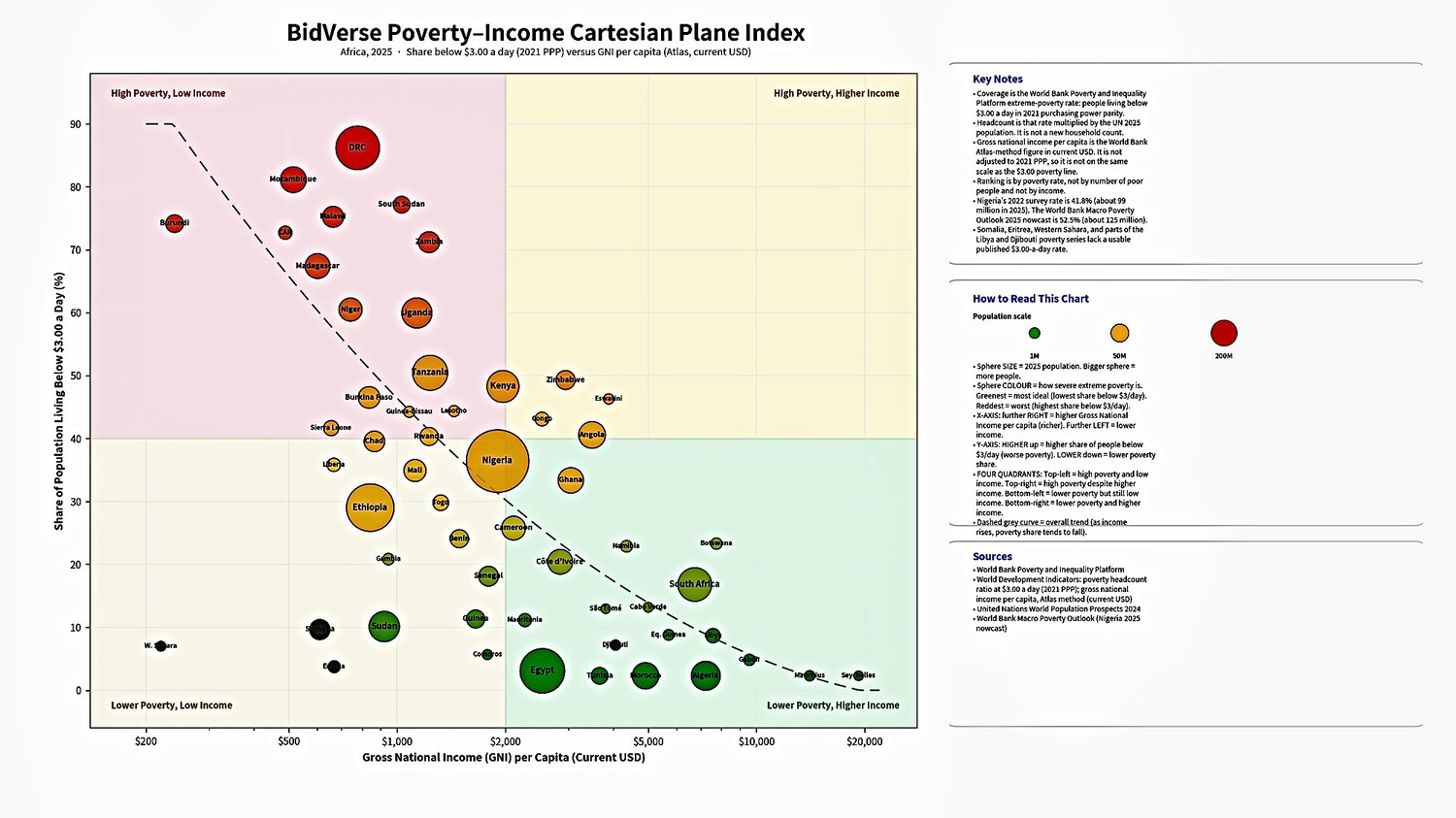
To understand the disconnect between national wealth and human welfare, we can map countries on a Poverty-Income Cartesian Plane. The vertical axis tracks the World Bank’s headcount ratio, being the share of the population living below the $3.00 daily poverty line, measured via Purchasing Power Parity (PPP) for ease of comparison. The horizontal axis measures Gross National Income (GNI) per capita, representing the average income earned per person in USD. Bubble sizes represent a country’s population, while colour gradients indicate poverty severity. The quadrants are divided at roughly 40% poverty and $2,000 GNI per capita.
High Poverty, Low Income - The Scarcity Trap
These economies in the top left quadrant combine a thin national-accounts pie with a massive concentration of households below the extreme-poverty line. Here, both constraints bind. Governments lack the domestic tax base to fund social safety nets without external assistance, and public investment is choked by a limited fiscal purse. Consequently, these nations remain heavily reliant on foreign aid. However, because the poorest are so deeply impoverished, broad-based economic growth can rapidly reduce headcount poverty. Until these nations generate more aggregate income, the majority will remain destitute.
Lower Poverty, Low Income - The Fragile Equilibrium
The countries in the lower left quadrant retain low per capita income, yet a smaller share of the population subsists below the US$3.00 daily poverty threshold. So these countries have the capacity to intervene, however, the position remains precarious. Poverty here is not primarily a problem of national income scarcity. But with many households clustered near the poverty line, a modest contraction in aggregate income or a marginal widening of income inequality can drive substantial numbers of people back into poverty. The policy imperative is to expand national output without excluding the most vulnerable, by stimulating jobs, instituting precise welfare delivery and and effective public services to ensure the most vulnerable are protected.
High Poverty, High Income - The Distribution Failure
These countries in the top right cell possess resources, as measured by GNI per capita, that are already past the threshold, and the capacity for government intervention exists. Yet they suffer from a chronic inefficiency of resource redistribution. Poverty here is therefore not primarily a scarcity-of-national-income problem; it is a "transmission and distribution" problem. High national income fails to reach households due to bad job prospects, weak safety nets, and inadequate social security that, even when present, fail to protect people from falling into extreme poverty. The best solutions are those that target the poor directly through better jobs, accurate welfare, and effective public services. Economic growth can raise national income without reducing poverty if the poorest people do not share in the new wealth.
Lower Poverty, High Income - The Final Frontier
This bottom right cell is the target quadrant for all countries, with higher mean resources and a smaller extreme-poverty share. Note that nations herein are not a homogenous group; each still has areas of concern, with the ultimate goal being to shift the country to the most bottom and most right position as possible of that cell. Countries already inside this quadrant still have a vertical objective of shrinking the residual poverty gap, thickening the headroom on state expenditure accounts to increase savings and investment, protecting the lower tail of consumption, and locking in insurance (such as well-resourced and managed Sovereign Wealth Funds) so that income volatility does not recreate extreme poverty. That is why the interior of the box is not the destination. The true destination is the far right edge, where countries possess high spending flexibility and vibrant private capital approaching an irreducible residual.
Across all four quadrants, a fundamental two-parameter structure applies. That is, poverty is dictated by average income, and that equity of its distribution. The broader question illustrated by this framework, particularly for African economies, is whether nations are successfully converting aggregate economic capacity into basic human security. The ultimate development question is not merely how much wealth is created, but what level of that created wealth actually progresses to eliminate the worst forms of human deprivation.
Naturally, mapping countries on a Cartesian plane has limitations. It cannot fully capture human dignity, health, education, freedom, or social exclusion. It is also constrained by imperfect data, arbitrary thresholds, and the inherent flaw of averages, which can mask inequality, power imbalances, and informal economic realities.
Yet, its value lies in providing a clear, disciplined method to compare national performance and expose where economic capacity and human welfare are dangerously disconnected. Used carefully alongside inequality measures, human development indicators, and governance assessments, it is a powerful diagnostic instrument. It should not be treated as a final judgment, but as a tool to reveal where policy attention, institutional reform, and resource mobilisation are most urgently needed.
True global prosperity demands that we look beyond the aggregate. If you are in Africa, or indeed anywhere in the developing world, ask yourself: where does your country sit on the Poverty-Income Cartesian Plane, and more importantly, what is being done to move it?
The empirical topography revealed by the BidVerse Poverty-Income Cartesian Plane Index carries profound implications for the future of macroeconomic policy and structural transformation in Africa. The non-linear relationship between GNI per capita and the extreme poverty headcount (evident in the asymptotic flattening of the trend curve at higher income deciles) suggests that the elasticity of poverty with respect to growth diminishes as economies mature, unless accompanied by deliberate institutional re-engineering.
For the high-income, high-poverty outliers, the data implies that market-mediated wealth transmission is fundamentally impaired by structural rigidities, necessitating a paradigm shift from growth-centric policies to distribution-centric institutional reforms, such as progressive fiscal architectures and universal social protection floors. Furthermore, the fragility observed in the lower-poverty, low-income quadrant underscores the vulnerability of compressed inequality at low mean incomes to exogenous macroeconomic shocks, highlighting the urgent need for counter-cyclical fiscal buffers and sovereign risk-pooling mechanisms.
Ultimately, the index demonstrates that the transition from aggregate wealth accumulation to the absolute elimination of severe destitution is not an automatic by-product of market expansion, but a complex function of state capacity, government deliberate intervention, institutional quality, and the measured calibration of economic policy to prioritise the lower tail of the consumption distribution.
(Adapted from a white paper by the author on the Poverty-Income Cartesian Plane Index and global development metrics.The methodology and concepts and the Index itself constitute the author's proprietary intellectual property. Any reproduction or adaptation requires prior written consent.)