


The value of total insurance premiums in a country, as a share of its GDP, is one of the clearest pictures of where its protection gap is widest. However, implications go far beyond risk cover.
They spill over to Sovereign Financing flexibility as well, since insurance markets in general perform a capital raising function, with a captive domestic quantum which can be invested internally, while furthermore serving as a primary channel for long-term contractual savings into the real economy.
For such an important source of liquidity, Africa's expenditure on insurance is far less than most people assume, therefore detrimental to the continent's growth from two ends - inadequate cover and minuscule savings.
Insurers act as institutional investors whose liabilities, often multi-decade in life and annuity business, create natural demand for duration-matched projects or assets. These include government bonds, infrastructure funding, real estate debt, and project finance. The very foundations for sturdy economic development.
In this capacity, the sector directly supports capital raising for physical infrastructure, commercial and residential property development, and fiscal financing, including through mandated minimum holdings in sovereign securities observed across several jurisdictions.
Insurance penetration (gross written premiums as a share of GDP) is the standard metric that quantifies the scale of a country’s insurance sector relative to its economy, serving as a direct proxy for the volume of long-term contractual savings that can be intermediated into capital markets. Where insurance penetration remains low, economies experience multiple deficits, chief among which are unaddressed protection gaps, and constrained domestic pool of "patient" capital.
Thus, the absence of this secure internal saving and funding mechanism raises the cost of long-term financing in a country as it relies more on external investor and public debt, both more costly on average and stringent in terms. Meanwhile, a low insurance penetration also increases reliance on shorter-maturity bank credit and limits the crowding-in of private investment.
The data below, drawn from the Deloitte 2024/25 Africa Insurance Outlook (Fitch Solutions) and reproduced in the African Insurance Organisation Annual Report 2025, illustrate the heterogeneity.
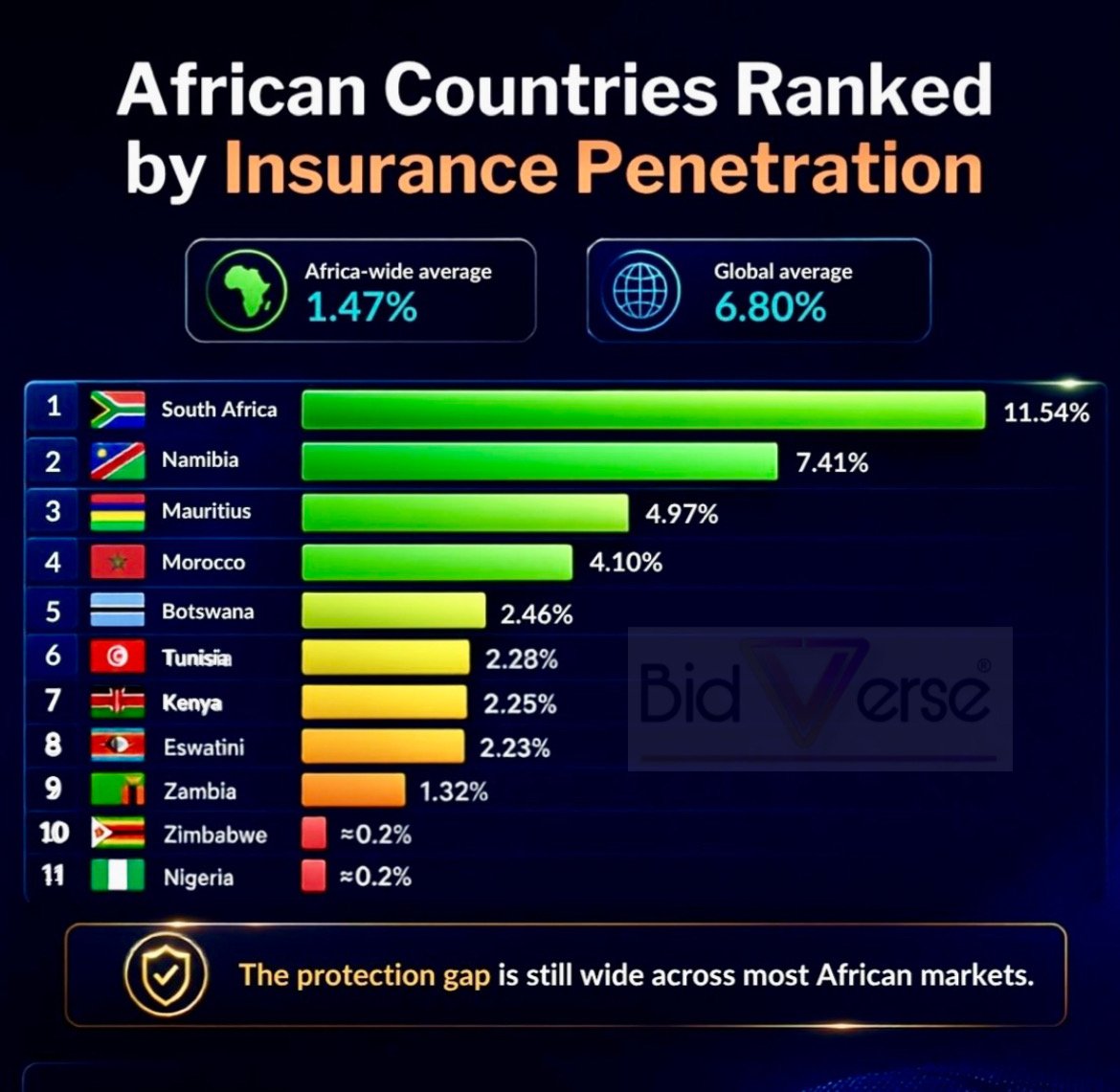
African countries ranked by Insurance Penetration
Africa-wide average: 1.47%
Global average: 6.80%
We immediately see from the data that South Africa is an outlier in Africa with over 11%, a position that reflects a mature insurance and pension complex whose combined assets under management run into hundreds of billions of USD. Not only is their economy well covered in terms of risk (about double the global insurance penetration), but their combined premiums purse constitutes an ever-present fountain that constantly quenches the domestic bond market as well as the Johannesburg Stock Exchange thirst.
Insurers and pension funds therefore supply consistent, price-sensitive demand for long-duration sovereign and parastatal paper, supporting lower term premia and enabling large-scale infrastructure and real-estate financing on domestic terms at a constant and affordable pace. Asset-liability management (ALM) practices, supported by deep secondary markets and regulatory frameworks, permit measured diversification beyond prescribed government securities into project bonds and property (think shopping malls for the case of South Africa).
After South Africa, the penetration drop is steep. Namibia is the only other market above the global average in Africa, with Mauritius the next closest. Then comes a long tail, where even major economies like Nigeria sit at a fraction of one percent, similar to Zimbabwe which is just emerging from a beleaguered two decades of economic malaise.
Namibia and Mauritius display comparable strengths. Namibia, for its part, benefits from close economic and regulatory linkages with South Africa. Meanwhile, Mauritius leverages its offshore financial-centre status to intermediate regional and international capital. Morocco on the other hand is fourth-placed. A ranking which aligns with North African financial-sector deepening and its support of cross-border issuance capacity.
In the middle tier (Botswana, Tunisia, Kenya, Eswatini), penetration levels indicate nascent but expanding institutional investor bases. Kenya, for example, has seen regulatory evolution around bancassurance, insure-tech, and green/sukuk instruments that allow insurers and pensions to allocate modestly to infrastructure. Be that as it may, absolute scale remains limited, necessitating blended-finance structures or development-finance institution (DFI) credit enhancement to attract meaningful domestic institutional participation.
At the lower end, the picture is materially different. Nigeria, Africa’s largest or second largest economy by several measures, records insurance penetration of approximately 0.2%. Combined with modest insurance assets under management relative to GDP, this produces a very shallow domestic institutional investor base. Additionally, portfolios are heavily concentrated in government securities for prudential and liquidity reasons, consistent with minimum-capital and prescribed-asset requirements in force.
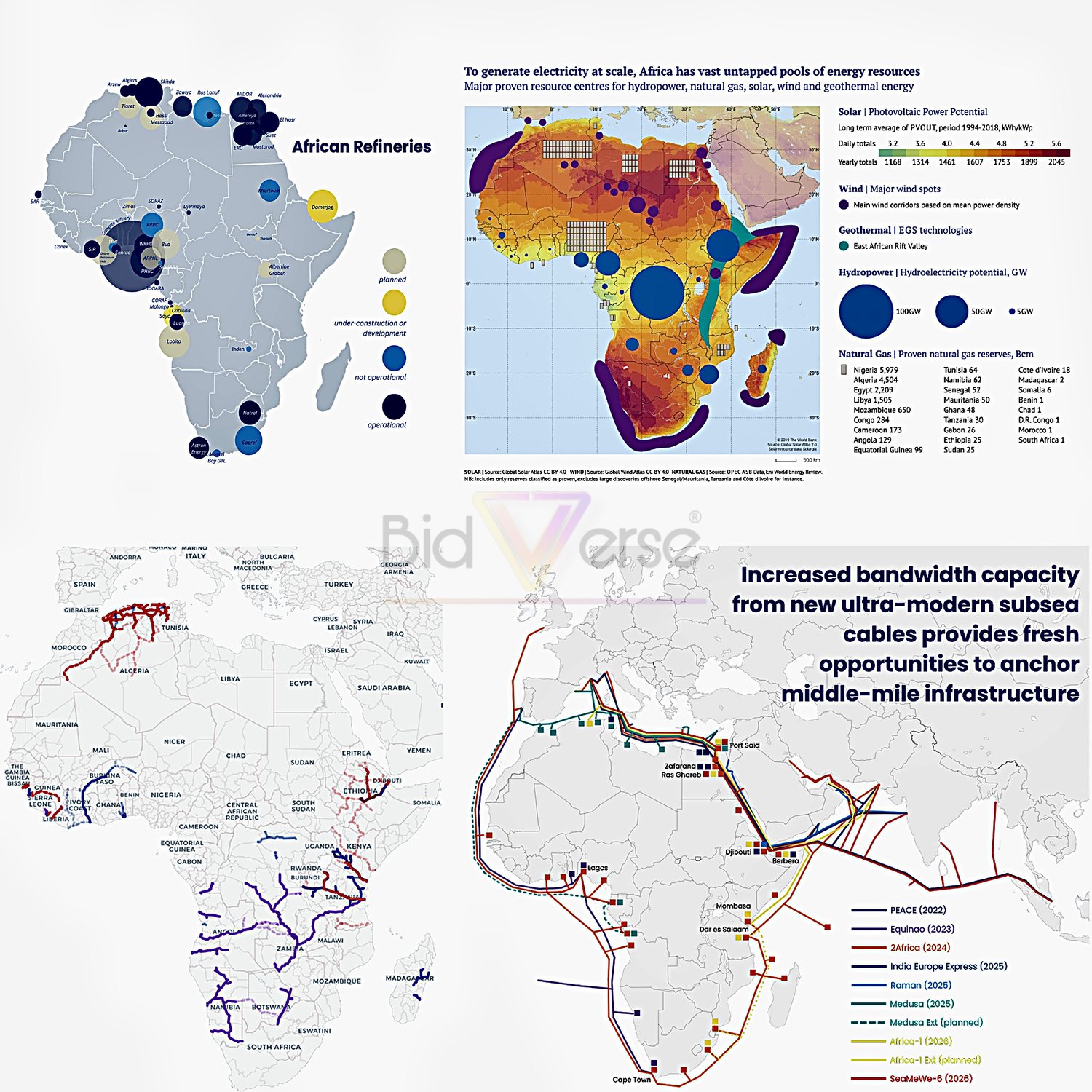
State of Africa infrastructure - 2025
For the majority of African countries, capital raising for infrastructure and large real-estate projects therefore relies disproportionately on domestic banking channels (short duration) or international markets (currency and refinancing risk). This is resulting in elevated sovereign and corporate spreads, maturity mismatches, and constrained gross fixed capital formation efficiency. Case in point are Zambia and Zimbabwe who exhibit analogous constraints, albeit on smaller absolute scales, as their economies are smaller than Nigeria.
From a theoretical perspective, insurance development augments capital accumulation through three channels.
First, it mobilises fragmented savings into professionally managed pools, performing maturity transformation that banks alone cannot sustainably deliver at scale. Second, credible risk transfer reduces uncertainty, supporting higher levels of private investment (consistent with modern growth models that incorporate financial intermediation). Third, it generates structural demand for long-horizon assets, deepening secondary markets and lowering the cost of capital for issuers.
Empirical patterns across African markets confirm a positive association between insurance penetration and financial-depth indicators; the leading jurisdictions like South Africa and Namibia exhibit deeper domestic debt markets and greater capacity to finance public and private projects internally. Prudential considerations reinforce the capital-raising lens, while solvency and liquidity rules appropriately emphasise safety and ALM.
One has to consider that mandated minimum holdings in government securities (evident in Kenyan and other national frameworks) safeguard policyholders while simultaneously providing governments with a reliable domestic investor base.
However, when the eligible asset universe remains narrow, owing in part to limited pipelines of credit-enhanced infrastructure bonds or standardised real-estate vehicles, concentration risk rises and productive capital formation is constrained. In such scenarios expanding the menu of investable assets (project bonds, infrastructure funds, REITs, green instruments) while preserving prudential standards is therefore a high-leverage policy lever.
For African governments and capital-markets authorities, expanding insurance penetration therefore constitutes a strategic domestic-resource-mobilisation instrument that every country on the continent should actively pursue.
Priorities to achieve higher Insurance penetration, and by extension, a captive domestic private investment purse, include regulatory modernisation that balances solvency with incentives for allocation to infrastructure and real estate; accelerated adoption of digital and bancassurance channels; and development of transparent, standardised long-term instruments aligned with insurers’ ALM and ESG mandates.
Regional harmonisation under the African Continental Free Trade Area (AfCFTA) can further enlarge the addressable market for cross-border institutional investment where African countries can attract fellow African insurance funds, while the local capital can also seek more quality regional investments and projects.
For capital-markets participants like exchanges, issuers, asset managers, and arrangers, the imperative is pipeline development. Bankable, de-risked projects and products tailored to the risk-return, regulatory, and duration profiles of African insurers will convert latent demand into actual capital deployment. In leading markets this process is already advanced; in African markets it remains the binding constraint.
This current Insurance penetration ranking is therefore best interpreted not as a static league table of weakness in risk cover alone, but also as a differentiated map of capital-mobilisation potential. Markets nearer the top already demonstrate how a robust insurance sector deepens domestic financing capacity and reduces external vulnerability while markets at the bottom possess the largest untapped upside.
Closing the insurance penetration gap is, in macroeconomic terms, synonymous with closing a material portion of the domestic long-term capital gap that continues to constrain infrastructure delivery, real-estate development, and sustainable fiscal financing across much of the continent.