

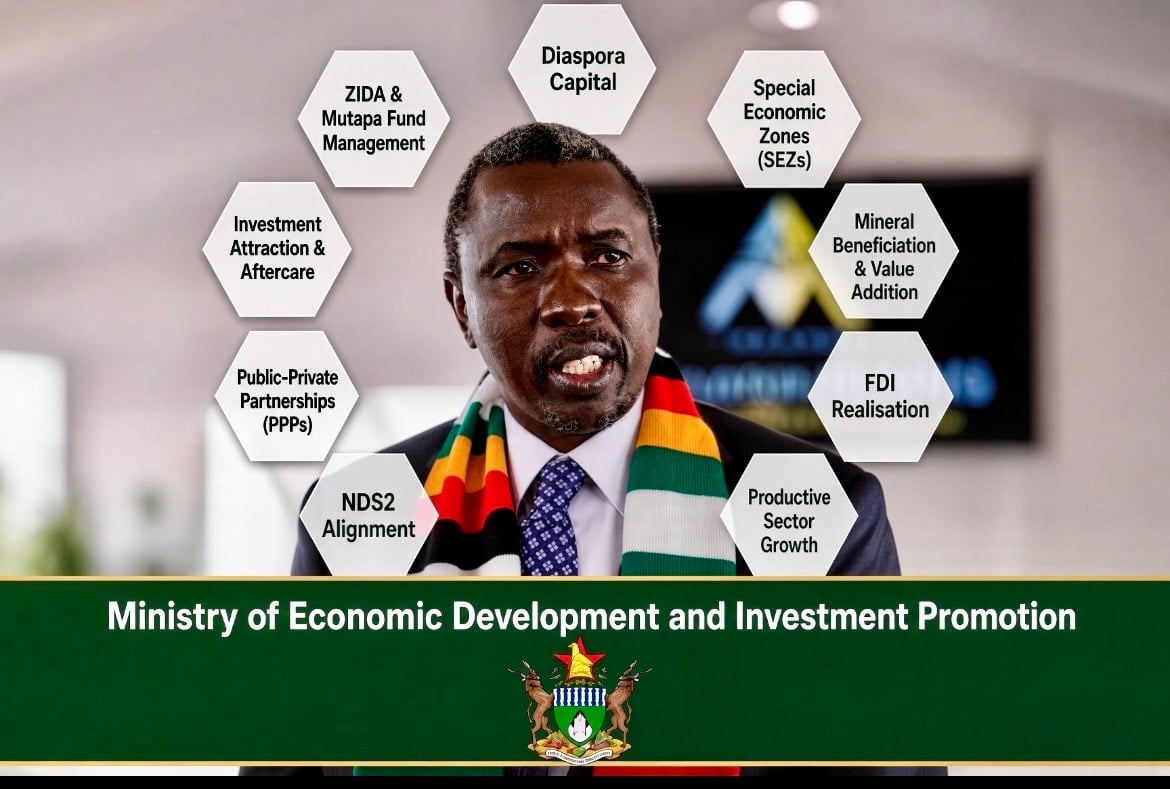
Zimbabwe has a new ministry. The Ministry of Economic Development and Investment Promotion (MinEDIP). Its responsible for capital formation, economic structural transformation, and productivity enhancement led by the private sector, alongside attracting and facilitating domestic, foreign, and diaspora investment.
The newly constituted ministry, which was established this week via the structural bifurcation of the former Ministry of Finance, Economic Development and Investment Promotion, holds a mandate oriented towards growth that is fundamentally focused upon structural transformation from public purse financed growth, towards more private capital let economy, with productivity enhancement driven largely by the private sector.
The delivery brief of this newly formed institution will encompass systematic attraction, facilitation and aftercare of Foreign Direct Investment (FDI), diaspora capital, but also domestic capital. Furthermore, the institutional remit will include the regulation of current and future Special Economic Zones and industrial parks, the origination and rigorous appraisal of PPPs for critical infrastructure, energy and logistics networks, alongside the targeted expansion of productive capacity within the agricultural sector, mineral value addition, manufacturing and tourism.
So, its core macroeconomic objectives inherently centre upon aligning investment pipelines and project execution with the structural pillars of the National Development Strategy 2 (NDS2), thereby converting nominal investment commitments into bankable assets, employment generation and export growth. Since land also is part of the national asset I assess that commercial strategy around land will be managed under this ministry - rightly or wrongly, national discourse on this will determine final position.
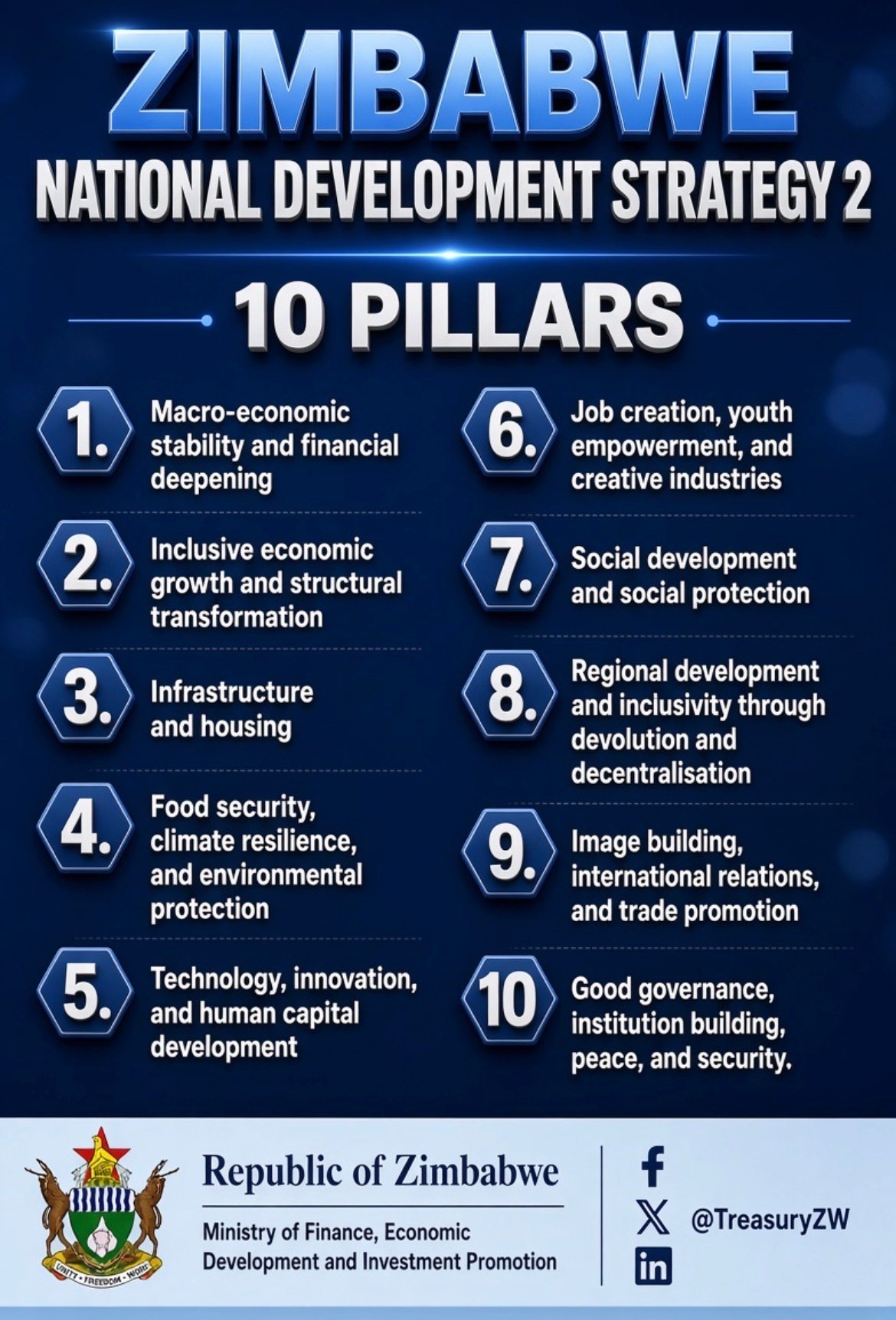
Zimbabawe National Development 2 10 Pillars
This then means this newly minted ministry becomes the fulcrum for the country's push towards upper middle income targets articulated within Vision 2030 through the coordinated oversight of the Zimbabwe Investment and Development Agency (ZIDA), Mutapa Investment Fund (MIF) and associated institutional instruments, ensuring that the transmission mechanisms of capital allocation are optimised for long term equilibrium.
Does this make MinEDIP more important than the Ministry of Finance?
From a finance standpoint, it must be explicitly clarified that the newly established ministry operates in a complementary rather than a superior capacity. The bifurcation simply isolates the previously subordinated function of growth promotion from the (successful) fiscal stabilisation priorities that historically dominated the combined ministry, thereby allowing both mandates to operate within their respective comparative advantages without structural interference. Of course, from a political significance perspective that's a whole other dimension, beyond the scope of this macroeconomic and institutional policy analysis.
This structural bifurcation, thus, only effectively separates the fiscal guardian function, which successfully delivered sustained single digit inflation averaging 4.2% in the first half of 2026 following peaks above 90% in 2025, 8.3% in real Gross Domestic Product growth in 2025, FX receipts of US$16,2bn (up ~60% from 2024), reserves of literally nothing to current 4 months import cover, etc, away from a dedicated promoter mandate, which MinEDIP will now cover.
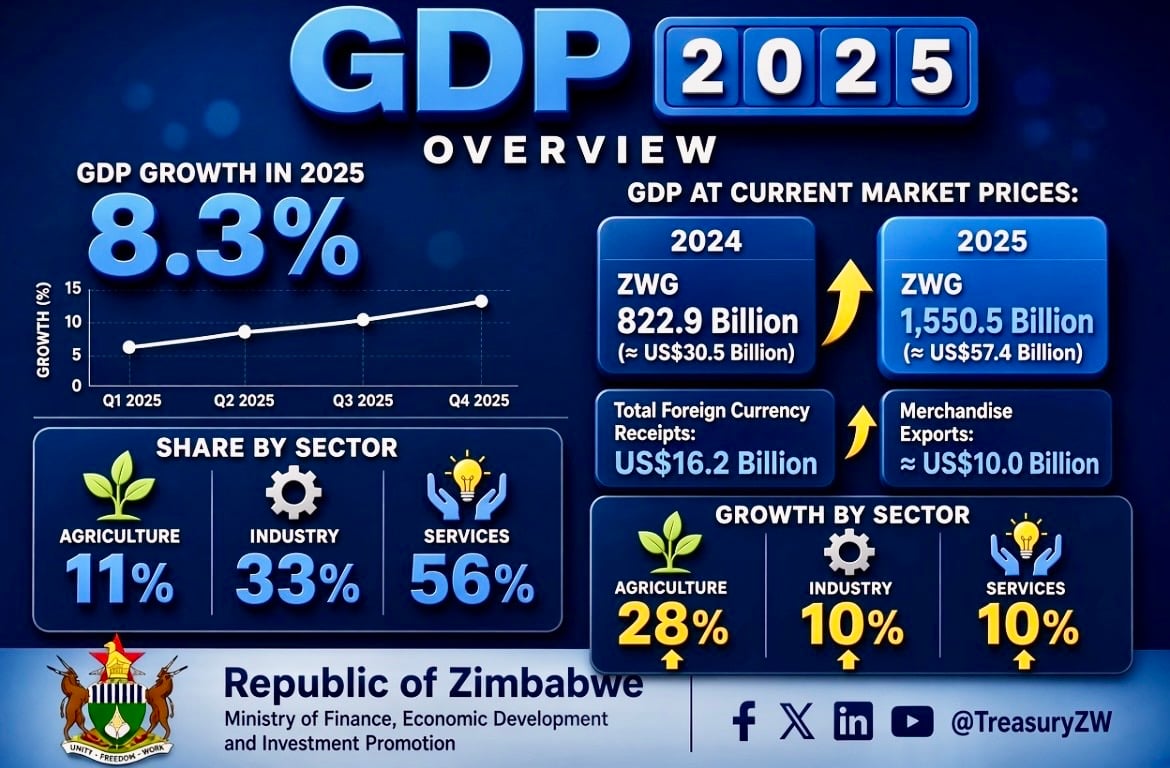
2025 Zimbabwe Economic Metrics
This promoter mandate specifically targets to improve monitored investment commitments conversion from the current 31% realisation rate, observed since 2022, where actual inflows reached US$1.55 billion against higher projections (alongside the US$2.45 billion in 2025 diaspora remittances), into productive capital formation.
It goes without saying then that the new ministry is envisaged to raise FDI realisation, building upon the increase from US$597mn to US$965mn recorded between 2024 and 2025 under the combined Ministry of Finance.
Additionally, MinEDIP has to be tasked with accelerating the pipelines for Special Economic Zones (SEZs) and Public and Private Partnerships (PPPs), deepen mineral value addition, and elevate the structural transformation metrics of the NDS2, specifically employment creation, exports value increase and diversification, as well as capacity utilisation. These efforts, if executed as intended, will transcend the historical crowding out of investment facilitation caused by Treasury cash management and debt stabilisation priorities, prior to this bifurcation of the ministry.
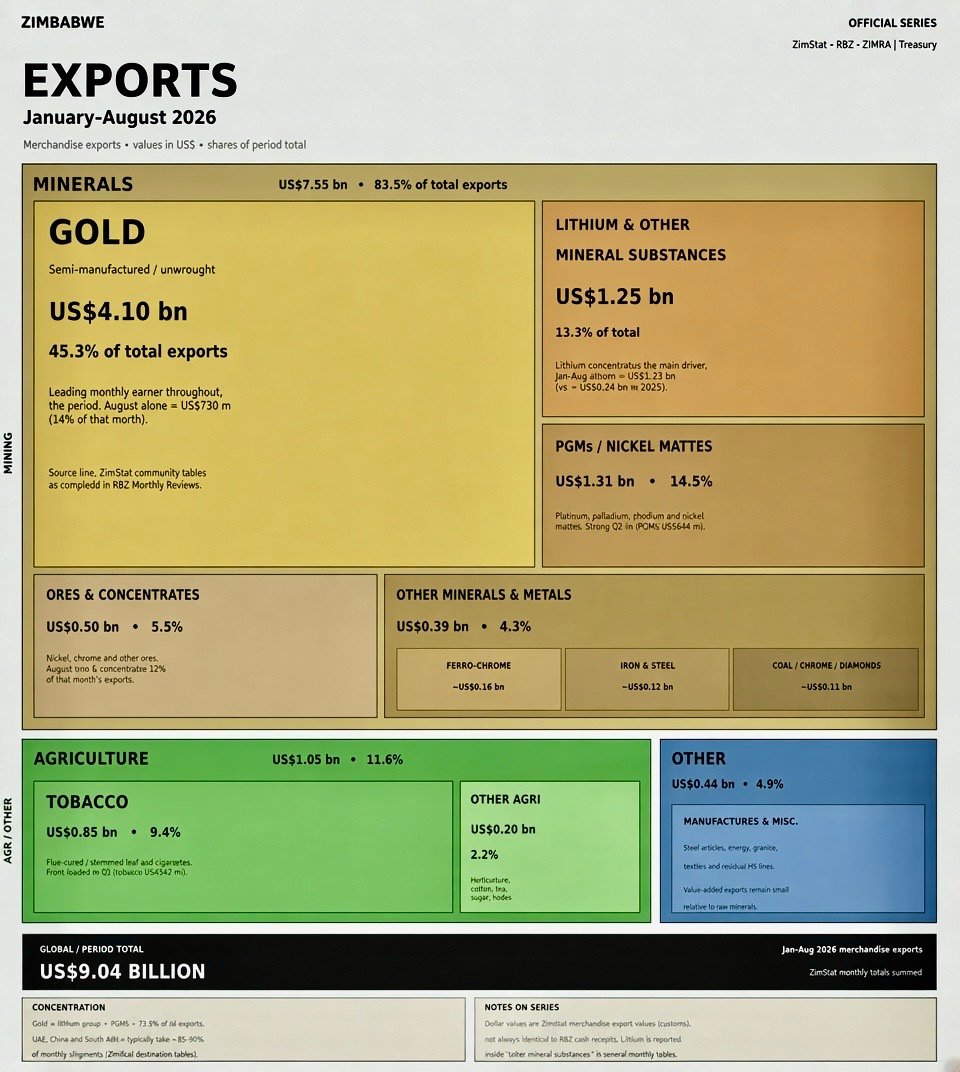
Zimbabwe 2026 Jan-Aug 2026 Exports Composition
The current modus operandi where government attempts to fund development from revenue collections is acutely limiting. How far can US$10bn go where roughly half goes to salaries, 20% so social and human needs,10% to debt, 10% "other" and only the residual 10% is left over for development and infrastructure needs (percentages rounded up)? That was never sustainable medium and long term for a country of under 20 million people to tax itself to a higher economic classification.
Ministries and Development Agencies (MDAs) last year, collectively submitted funding bids amounting to ZiG828.5bn (~US$31.2bn), against the final approved expenditure envelope of ZiG290bn within the 2026 National Budget, which was calibrated against a revenue target of ZiG288bn (~US$11bn). That discrepancy is a structural funding gap of approximately ZiG538.5bn (US$20.3bn), representing roughly 65% of the requested resources, or a staggering two years' worth of revenue collections!
Such a fiscal architecture signalled a stupendous handicap which, by necessity, made the combined Ministry of Finance deliberately prioritise fiscal consolidation and primary balance over expansive public investment. So the economic fundamentals became great, which is an exceptional achievement considering where Zimbabwe has come from in 2 decades, but paradoxically, also meant recurrent and social votes absorb the bulk of the available fiscal space, whilst capital and development programmes remain severely rationed.
Cue in the new ministry we have long been advocating for, to tap external capital and point it towards the country - the Ministry of Economic Development and Investment Promotion.
These constraints just alluded to above imply that the new complementary ministry's delivery brief must shift from seeking to secure large direct fiscal injections, but to catalyse the whole economy by availing it to other government sources of funding and, for the state, foster off-budget capital formation, while liberating treasury from long term obligations like infrastructure development, which traditionally needs "patient capital", and not governmental one year funding cycles.
This will also free Zim.Treasury to spare about 5% of the revenue towards savings towards a traditional Sovereign Wealth Fund, not the current MIF HoldCo - one of the many other outstanding macroeconomic adjustments we have been advocating for.
As for now, the structural transition is to be achieved primarily by maximising the dividends and commercial returns of the MIF, expanding the licensing and facilitation fees generated by the ZIDA (as well as the projects financed under its pipeline), stimulating internal private capital enough for a diversified export merchandise list and a bigger FX receipts quantum, structuring FDI envelops and PPPs that generate self-financing project cash flows, and generally reduce overall net claims on the fiscus.
Observably, this structural shift inherently necessitates the careful calibration of external capital inflows to ensure sovereign debt sustainability is not compromised. In simple terms, the new ministry's value role is to ensure it creates and enables inflows from either earnings from export merchandise or other, or alternatively fresh capital in form of equity or other value terms, including "knowhow" and Intellectual Property (IP), while minimising the need for the sister ministry's need to take inflows in form of debt, or other collateral that beholden national assets.
New Ministry. New Thinking? Maybe... Simple? Certainly not.
Investment promotion landscape in the Southern African Development Community (SADC) countries show dedicated agencies in these countries, such as the Botswana Investment and Trade Centre, InvestSA and the Zambia Development Agency, being centralised facilitators for FDI, Special Economic Zones, aftercare and export diversification.
These entities are almost all exclusively institutionalised separately from pure treasury functions, to reduce the bureaucratic crowding out of project origination. That is the similar route Zimbabwe has taken but save for a few of these peer entities, the majority have hardly made significant strides in achieving their mandate. The point here being adjustment on its own does not guarantee success.
Be that as it may, the beneficiation drive within Zimbabwe, evidenced by the 1 January 2027 deadline to ban all lithium concentrate exports, alongside earlier raw ore restrictions, aims to shift mineral exports from low value concentrates, which is an internally derived foundation for the Zimbabwe entity peer countries have limited success in.
This strategic pivot is designed to raise domestic value capture and reduce reliance on primary commodity price cycles. So, the newly constituted Ministry of Economic Development and Investment Promotion is positioned to implement this agenda by coordinating the ZIDA, SEZ regulation, partnership pipelines between public and private entities, and investor aftercare, all based off of factor improvement in value capture for all exports, and not necessarily quantity increase.
The objective is to ensure that licensing converts into functional processing capacity rather than remaining at the 31% monitored realisation rate already referred to early. Dominant macroeconomic frameworks, including endogenous growth theory emphasise this technology spill-over and absorptive capacity, new structural economics focusing on latent comparative advantage in midstream processing, and dual sector labour reallocation, as well as public finance distinctions between fiscal guardian and growth advocate roles, as unshakeable foundations for long term growth.
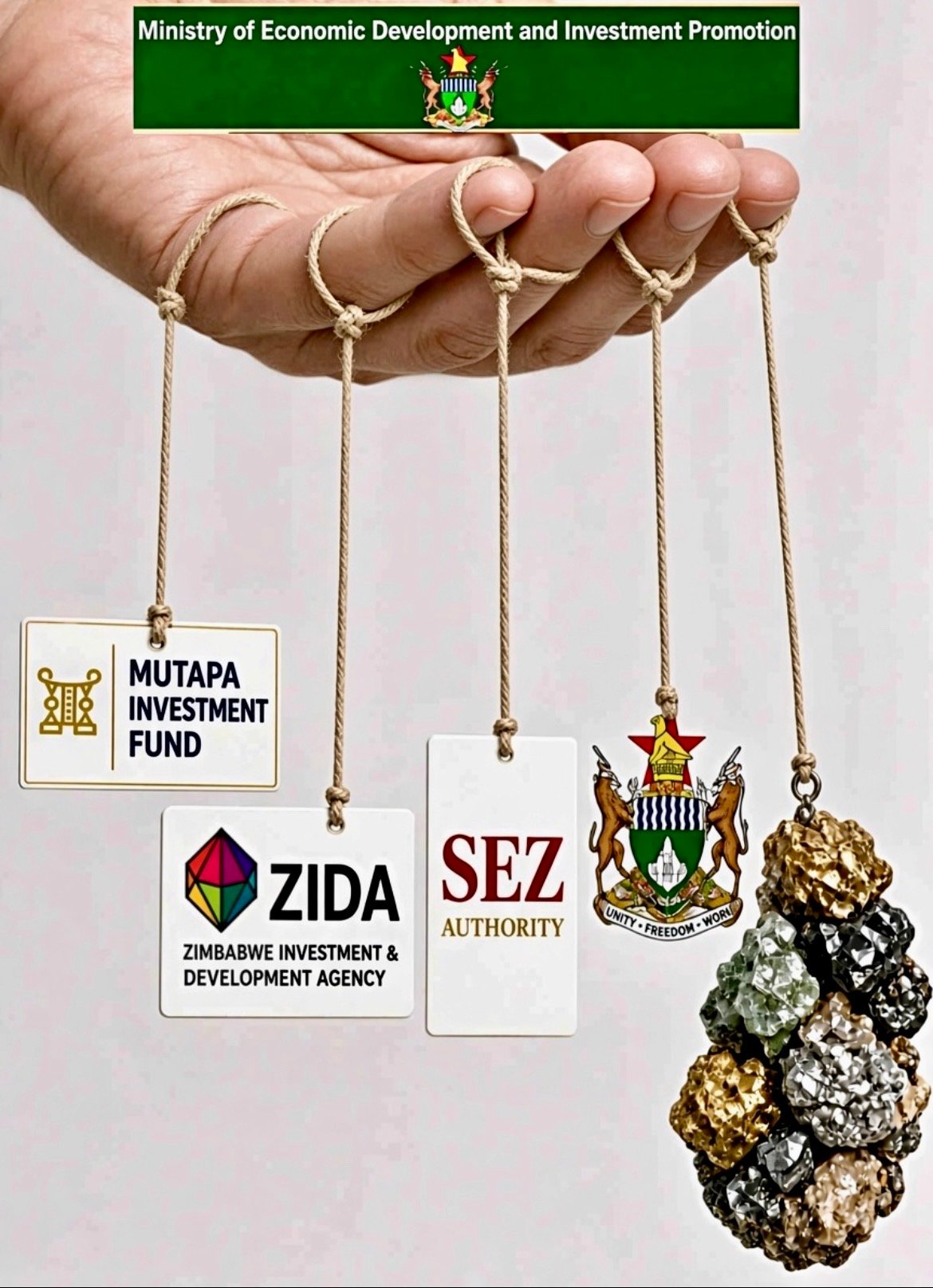
The Zimbabwe New Ministry for Economic Development & Investment Promotion And The Cash Rich Agencies It Now Controls
The Key Result Areas for the new ministry that I already envisage, which are Specific Measurable Achievable Relevant and Time constrained objectives, include:
- First, the ministry must raise actual realised investment from "secured/promised" investment agreements, whose conversion rate us currently a lowly 31% currently, to at least 50% of projected commitments by December 2028. Why anyway are agreed deals faltering before they commence at such a concerning rate of 7 out of 10 agreements? Ministry has to investigate the reasons then work on the recommendations that study proffers.
- Second, it must secure final investment decisions for at least 3 lithium sulphate or equivalent midstream plants like lithium hydroxide plants, by 1st January 2027. Why are Chinese and other investors still exporting concentrates rather than committing to local sulphate or hydroxide capacity? The ministry has to diagnose binding constraints on power, water, logistics and offtake certainty and then structure the de-risking measures or tolling arrangements the analysis identifies
- Third, the ministry must work closely with Ministry of Mines and Mining Development, the Ministry of Industry and Commerce, the Ministry of Energy and Power Development and indeed the Ministry of Finance itself to stimulate the share of processed mineral exports from total mineral earnings by 15% by the end of 2030. Seeing as minerals constitute about 85% of all exports, a modest upliftment of 15% has a potential of increasing FX receipts by as much as 60% since moving beneficiation just one rung higher has been seen to increase value by a factor of 5x. The ministry has to quantify the value-capture gap by commodity and then enforce the conditional licensing, SEZ incentives and export-tax triggers required to shift the composition.
- Fourth, the ministry has to be tasked to facilitate US$3bn a year earnings from Special Economic Zones and partnership capital formation and infrastructure by 2029. Why do licensed SEZ and PPP projects remain stalled at the memorandum-of-understanding stage? Why isnt the government guaranteeing 5% gap or first mile funding for projects of national interest so that private players can fund surveying, assaying, feasibility impact assessment and so forth and so on, to enable such projects be brought up to international level shovel readiness which can attract funding? The ministry has also to map the specific land, utility, regulatory and financing bottlenecks and then clear them through single-window facilitation and commercial structuring.
- Fifth, it must formulate Zimbabwe policy and state a case where policy around this very significant constituency is dealt with under one house, not whats obtaining at the moment where the Ministry of Foreign Affairs, the Reserve Bank of Zimbabwe, the Ministry of Finance, among others, each have a "diaspora desk," which all is not an ideal scenario. MinEDIP must create attractive instruments to convert at least 10% of annual diaspora remittances, which amounts to circa US$250mn on a US$2.5 billion base, into productive equity or project finance instruments by 2028. Why do these inflows remain almost entirely consumption-oriented rather than investment capital? The ministry has to identify and build the trust, instrument-design and repatriation barriers and then launch the ring-fenced diaspora bonds, equity vehicles or matched-investment schemes the diagnostics recommend.
Despite all the hope and promise of this transition, it doesnt mean implementation will be a walk in the garden. Potential adverse outcomes associated with the newly constituted Ministry of Economic Development and Investment Promotion include heightened risks of policy capture and elite collusion, particularly given the private sector footprint of the minister appointed to the new ministry, Dr. Kudakwashe Tagwireyi, and his sanctions exposure.
There's also potential for coordination frictions with the residual Finance portfolio that'll delay incentive alignment or projects that will eventually be approved under this new setup. There is also a tangible risk of an inability to function for a full 6 months before the Ministry gets allocated seed allotment from the national budget, since it has been formed mid-cycle of the current budget.
Also, even after it eventually begins to get cash votes from the fiscus, ZIDA already fails to currently fails to fulfill investment realisation as well as "deal aftercare" functions. Meanwhile, the Special Economic Zone enforcement also remains under resourced within the ZiG290bn (US$11mn) fiscal ceiling. The ministry might have to sale off one of two family jewels so as to develop its capacity and that of its agents, as its fiscal vote will never be adequate.
Additionally, matters around land management, as I have discussed at length in other papers, may need to be removed from this ministry and be bestowed wholly under the rightfully constituted ministry for this, the Ministry of Lands and Rural Development. Then, I'll repeat, ad nauseam perhaps, that MIF's mandate must be morphed from sovereign wealth to a proper State Owned Enterprises HoldCo, so that a traditional Sovereign Wealth Fund can be formed in the Ministry of Finance.
MIF can then remain in that form under MinEDIP - not withstanding the conflict of interest spectre raised by that the Minister himself is a purported beneficial owner in some entities under the MIF umbrella or that have done business with MIF. That will be cleared at a legal level, and certainly doesnt take away the benefits of the ministry as a pivotal ministry on this tapestry.
In light of the foregoing, the ultimate test of MinEDIP will not be the elegance of its institutional design or the ambition of its KRAs, but whether it can demonstrably shift Zimbabwe from a stabilised state, thanks Prof. Mthuli Ncube and his team at the Ministry of Finance, but still commodity-dependent, low-realisation economy, into one that systematically converts external capital, mineral endowments and diaspora flows into durable domestic productive capacity before the window of current macroeconomic stability narrows.
What is instructive, and almost a guiding principle going forward for the new Ministry of Economic Development and Investment Promotion, is a quote by Dani Rodrik (2007), a Turkish-American economist and the Ford Foundation Professor of International Political Economy at Harvard University’s John F. Kennedy School of Government, that;
“The challenge of economic development is to move from a set of activities that are good at producing what is currently being produced to a set of activities that are good at producing what the country will need to produce in the future.”
Meanwhile, we wait with bated breaths.