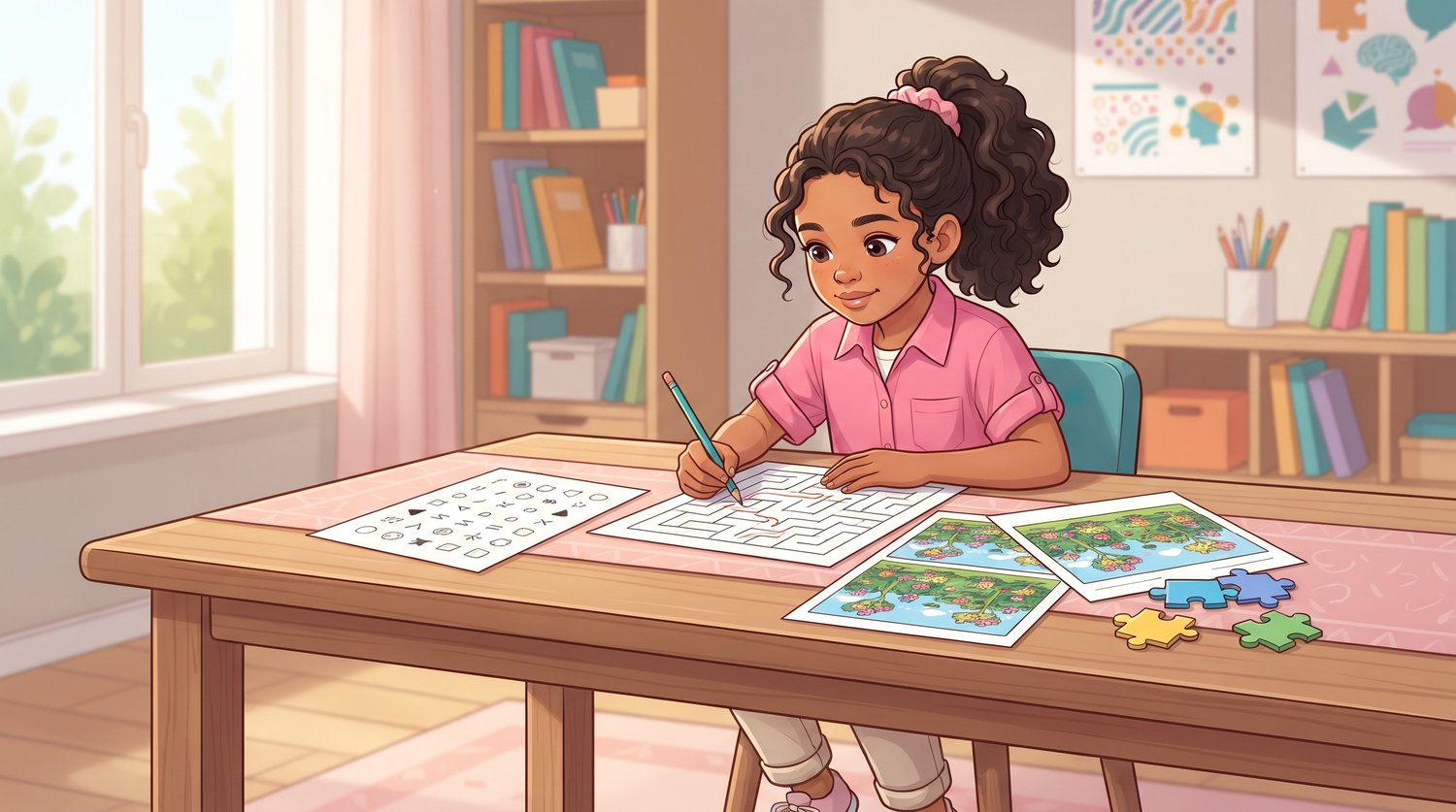
Children naturally love challenges. Give them a puzzle, a maze, or a tricky activity, and many will keep trying until they discover the solution.
What looks like simple play can actually involve a surprising amount of thinking. Children need to observe, compare, remember, make decisions, test ideas, and sometimes start again when their first attempt does not work.
That is one reason puzzles can be such a useful part of learning through play.
What Do Children Learn When They Solve Puzzles?
A puzzle gives children a clear goal: find the answer, complete the picture, find the correct path, or discover what belongs where.
To reach that goal, children have to think about what they see and decide what to do next.
This simple process can help them practice several important skills.
1. Problem-Solving
Problem-solving means finding a way from a challenge to a solution.
When children work on a puzzle, they often need to ask themselves questions such as:
- Where should I start?
- Which piece belongs here?
- Which path should I take?
- What doesn't fit?
- What should I try next?
They are learning to break a larger challenge into smaller steps.
Even when they make a mistake, they receive useful feedback. If something does not work, they can try another approach.
This teaches an important lesson: a wrong answer does not always mean failure — it can be part of finding the right answer.
2. Logical Thinking
Many puzzles require children to look for relationships and patterns.
For example, a child completing a matching activity might need to decide which object belongs with a particular picture. A maze requires the child to consider different paths. A word puzzle requires them to recognize letters, patterns, or relationships between words.
These activities encourage children to think:
"If this is true, what should I try next?"
That kind of reasoning is useful not only for puzzles but also for everyday learning.
3. Learning Through Trial and Error
One of the most valuable parts of solving a puzzle is trying something that might not work.
A child may choose the wrong piece, take the wrong path through a maze, or select an incorrect answer.
Instead of simply being told the solution, the child can observe what happened and try again.
This creates a natural learning process:
Think → Try → Check → Change → Try Again
Over time, children can become more comfortable with challenges because they learn that solutions are often discovered through experimentation and persistence.
4. Focus and Concentration
A puzzle gives children a specific task to concentrate on.
They need to pay attention to details, remember what they have already tried, and keep their attention on the activity long enough to complete it.
For example, when searching for differences between two pictures, a child has to carefully compare visual details. When completing a word search, they need to scan the letters and look for specific patterns.
These small moments of focused attention can make learning feel more like a game than a lesson.
5. Patience and Persistence
Not every puzzle is solved immediately.
Sometimes children need several attempts before they find the answer. That can be frustrating — but it can also be an opportunity to practice persistence.
Completing a challenging activity can give children a sense of achievement:
"I couldn't do it at first, but I kept trying and solved it."
That experience can encourage them to approach the next challenge with more confidence.
6. Visual Thinking and Attention to Detail
Many puzzles require children to notice small differences, shapes, positions, or patterns.
Activities such as mazes, matching games, spot-the-difference puzzles, and picture puzzles encourage children to look carefully rather than simply glance at an image.
They may need to notice:
- a small change in shape
- a missing object
- a different position
- a matching pair
- a particular pattern
- the correct route through a maze
Learning to notice details is an important part of many areas of education.
Puzzles Don't Have to Be Complicated
A puzzle does not need to be difficult to be educational.
For younger children, a simple matching activity or an easy maze can provide an appropriate challenge.
As children become more confident, activities can gradually become more complex.
The important thing is to choose a challenge that is interesting without being overwhelming.
If an activity is far too difficult, a child may quickly become frustrated. If it is far too easy, they may lose interest.
A good puzzle sits somewhere in the middle: challenging enough to make children think, but achievable enough to give them a sense of success.

Different Puzzles Can Practice Different Skills
One of the great things about puzzles is the variety available.
Mazes
Mazes encourage children to plan, follow paths, make decisions, and think ahead.
Spot-the-Difference Activities
These activities encourage careful observation and visual comparison.
Word Searches
Word searches can combine puzzle-solving with vocabulary and spelling practice.
Crosswords
Crosswords encourage children to think about clues, letters, words, and relationships between ideas.
Matching Activities
Matching games help children recognize similarities, categories, and relationships.
Counting Puzzles
Counting activities can turn basic number practice into an enjoyable challenge.
This means that "puzzle time" does not have to mean doing the same type of activity every time.
How Parents Can Make Puzzle Time More Fun
You do not need to turn every puzzle into a formal lesson.
In fact, children often learn naturally when they are simply enjoying the challenge.
Instead of immediately giving them the answer, try asking questions such as:
"What do you think you should try next?"
"Can you find another way?"
"What do you notice?"
"Why do you think that piece belongs there?"
"Can you find a clue?"
These questions encourage children to explain their thinking rather than simply looking for the correct answer.
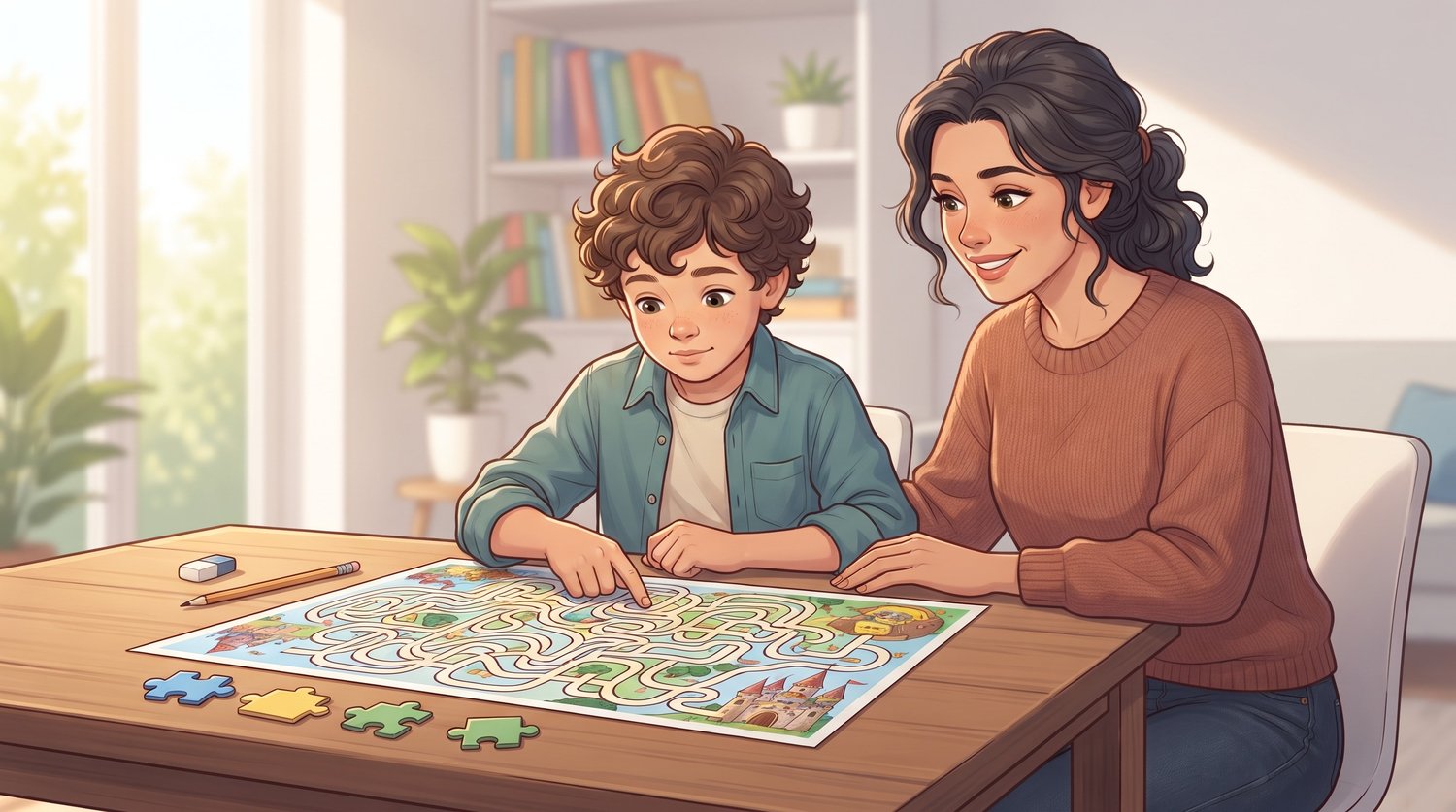
You can also solve puzzles together. Working side by side gives children an opportunity to talk about their ideas, compare strategies, and celebrate the solution together.
Learning Through Play
Puzzles are a great example of how learning does not always need to feel like schoolwork.
Children can practice thinking, concentration, observation, vocabulary, numbers, and problem-solving while simply enjoying an interesting activity.
Research on early childhood problem-solving activities has included puzzles, mazes, building activities, and other hands-on challenges, showing why these types of activities can be useful tools for encouraging children's thinking skills.
The goal is not to make every activity harder.
The goal is to give children opportunities to think, explore, make decisions, and discover solutions for themselves.
Make Learning Fun With Printable Activities
Printable activities are an easy way to introduce children to different kinds of puzzles at home.
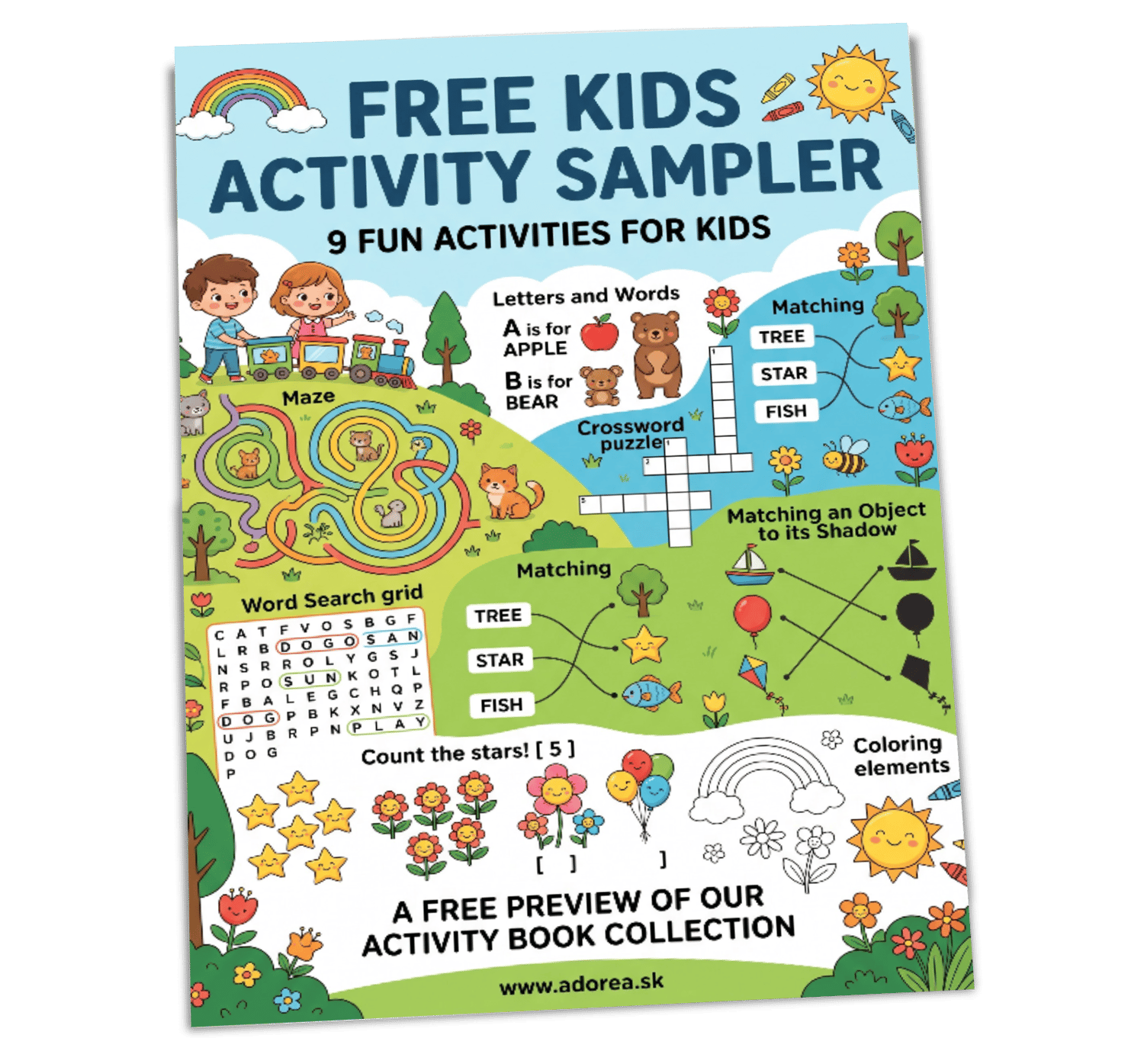
A few minutes with a maze, word search, matching activity, crossword, or picture puzzle can create a simple screen-free learning opportunity.
At ADOREA, we create printable activities designed to combine learning and fun, giving children opportunities to practice different skills through engaging challenges.
Whether your child enjoys finding hidden words, solving mazes, matching pictures, counting objects, or spotting differences, there is always another puzzle to explore.
Because sometimes the best way to learn is simply to have fun while figuring things out.
Final Thought
Every puzzle gives a child a small problem to solve.
They look.
They think.
They try.
They make mistakes.
They try again.
And eventually, they find the solution.
Those small moments can help children become more confident problem-solvers — one puzzle at a time.
Ready for a Puzzle Challenge?
If your child enjoys solving puzzles and finding their way through challenges, our Maze – 40 Fun Puzzle Pages offers plenty of opportunities to practice concentration, logical thinking and problem-solving skills while having fun.
The activity book includes 40 printable maze pages in English, with both PDF and individual PNG files included.
Explore the Maze Activity Book →