
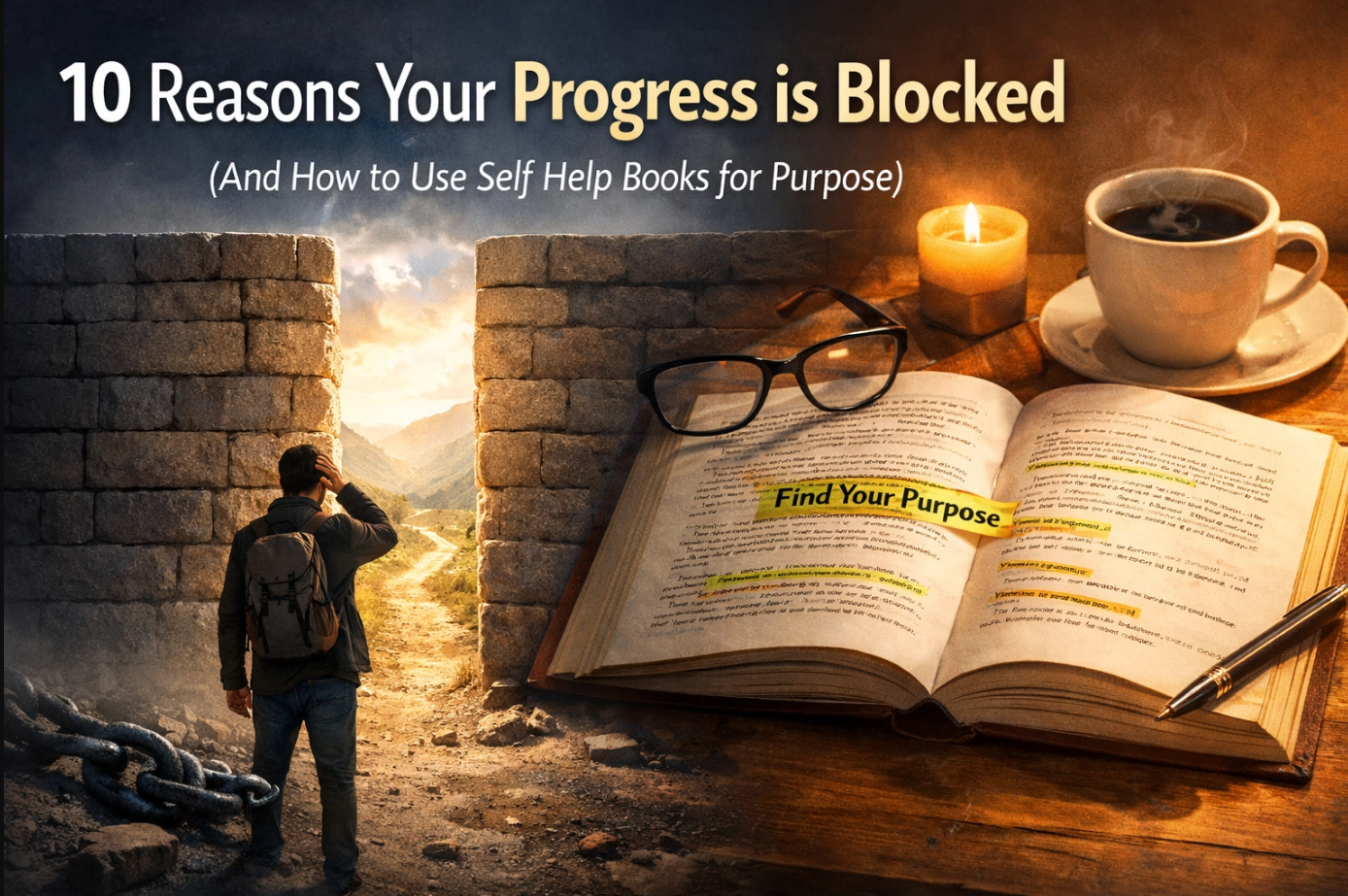
Ever feel like you’re running a marathon on a treadmill? You’re sweating, your heart rate is up, and you’re putting in the work, but when you look around, you’re still in the exact same spot in your living room. It’s frustrating, right? We’ve all been there: staring at a goal that feels miles away while our feet seem glued to the floor.
When we talk about "getting stuck," we often blame external factors: the economy, our boss, the weather, or that one neighbor who always parks in our spot. But more often than not, the block is internal. It’s a mix of habits, mindsets, and a lack of clear direction. The good news? You aren't permanently stuck; you’re just in a holding pattern.
Understanding why your progress is blocked is the first step toward breaking free. By combining self-awareness with the right self help books for purpose and biblical study guides, you can identify these roadblocks and finally move forward. Let’s dive into the ten most common reasons your progress has hit a wall and how to tear that wall down.
1. You’re in "Doing" Mode Instead of "Being" Mode
We live in a society that obsessed with "the hustle." We think that if we aren't constantly moving, we aren't progressing. However, there is a massive difference between movement and momentum. You can be incredibly busy doing things that don't actually matter.
When you operate solely in "doing" mode, you’re reacting to the world around you. You’re putting out fires, answering emails, and checking off trivial tasks. You haven't taken the time to be: to sit with your purpose and ensure your actions align with your calling. As Proverbs 16:3 says, "Commit to the Lord whatever you do, and he will establish your plans." If you don't commit the "being" part to Him first, the "doing" part will always feel empty.
2. The Excuse Factory is Open for Business
"I don’t have enough time." "I don’t have enough money." "I’ll start once the kids are out of the house." Sound familiar? Excuses are the nails used to build a house of failure. We often use excuses as a safety net because change is scary. If we tell ourselves we can't do something, we don't have to face the risk of actually trying and potentially failing.
If you find yourself constantly rationalizing why today isn't the "right" day, you’re effectively blocking your own path. Real progress happens in the "nots": when you don't feel like it, when you don't have the perfect tools, and when the timing is definitely not right.
3. The "Busy-ness" Preoccupation
This is a cousin to the "doing" mode trap. Some of us use a packed schedule as a shield to avoid the hard work of self-reflection. If your calendar is so full that you don't have ten minutes to sit in silence, you’re likely preoccupied with staying busy so you don't have to deal with the areas of your life that need growth.
Genuine change requires space. It requires you to put down the phone, turn off the TV, and evaluate where you are. If you’re too busy to grow, you’re too busy.
4. Fear of Failure (and Success)
Fear is a powerful immobilizer. We fear failure because it bruises our ego, but surprisingly, many people also fear success. Success brings new responsibilities, higher expectations, and a different version of yourself that you might not be ready to meet yet.
This fear often manifests as procrastination. You aren't "lazy"; you’re just terrified that if you actually give it your all and it doesn't work out, you’ll have no more excuses left. Self help books for purpose often highlight that fear is just "False Evidence Appearing Real."
5. Lack of Self-Discipline
We like to wait for "motivation" to strike, but motivation is a fickle friend. It shows up when you’ve had a good night's sleep and a strong cup of coffee, but it disappears the moment things get difficult. Progress isn't built on motivation; it’s built on discipline.
Discipline is doing what needs to be done even when you’d rather be doing literally anything else. Without it, your goals remain nothing more than wishful thinking.
6. That Pesky Inner Critic
Your internal monologue has a massive impact on your external reality. If you’re constantly telling yourself that you aren't smart enough, experienced enough, or "holy" enough to succeed, your brain will look for evidence to prove you right.
Negative self-talk creates a ceiling for your potential. To break through, you have to replace that critic with the truth found in biblical study guides. Remember Philippians 4:13: "I can do all this through him who gives me strength." Your strength isn't the point: His is.
7. You’re Living Someone Else’s Life
Are you working toward your goals, or are you working toward the goals your parents, your spouse, or your social media feed set for you? When you try to achieve someone else's version of success, you’ll naturally feel a lack of drive.
Getting caught up in other people's problems or expectations is a major progress-blocker. You cannot run a race effectively if you’re looking at the person in the next lane the entire time.
8. Lack of Self-Confidence
If you don't believe in the vision God has given you, no one else will. A lack of confidence causes you to hesitate, and in the world of personal growth, hesitation is a dream-killer. You miss opportunities because you're waiting for someone to give you permission to be great.
Spoiler alert: You already have permission. Confidence isn't about knowing you won't fail; it's about knowing you’ll be okay even if you do.
9. Chronic Stress and Burnout
You cannot pour from an empty cup. If you’ve been pushing yourself to the brink of exhaustion, your brain will eventually shut down as a defense mechanism. This "brain fog" makes it impossible to think creatively or make progress.
Sometimes, the most productive thing you can do is rest. If you’re blocked, check your stress levels. Are you running on fumes?
10. A Disconnect from Your Purpose
This is the big one. If you don't know why you are doing what you are doing, you will eventually stop doing it. Purpose is the fuel that gets you through the "messy middle" of any journey. Without a clear sense of purpose, every obstacle feels like a sign that you should quit.
How to Use Self Help Books for Purpose
So, how do we fix this? One of the most effective ways is to change the input you’re giving your brain. This is where self help books for purpose come into play. But don't just read them: study them.
- Read with a Journal: Don't just consume the words; interact with them. When a chapter hits on a "block" you recognize in yourself, write it down.
- Use Biblical Study Guides: For a believer, "self-help" is really "God-help." Use study guides to see what the Creator of your purpose has to say about your potential.
- Identify the "What": Books like What’s Blocking Your Progress? by Brenda Diann Johnson are designed specifically to help you identify the specific invisible walls you've built around yourself.
- Implement One Thing at a Time: Don't try to change all ten items on this list at once. Pick the one that resonates most and focus on that for thirty days.
Progress isn't a straight line, and it certainly isn't always fast. But by identifying these ten blocks and utilizing the wisdom found in purposeful literature, you can start moving again. You weren't created to stay in one place; you were created for growth.
References for further study:
- Atomic Habits by James Clear (for self-discipline)
- The Purpose Driven Life by Rick Warren (for finding your "why")
- What’s Blocking Your Progress? by Brenda Diann Johnson
- Mindset: The New Psychology of Success by Carol S. Dweck
To order books by Brenda Diann Johnson visit: aswifttbooks.com