
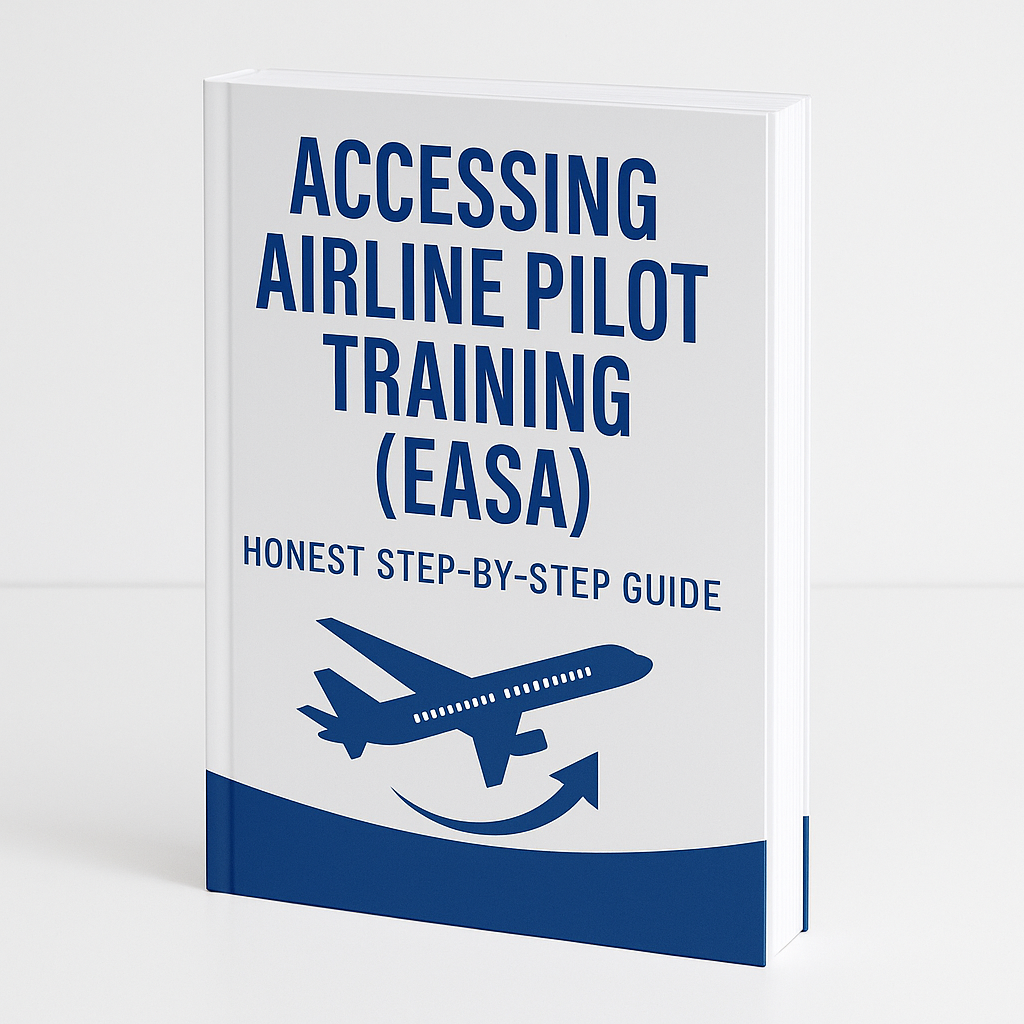
Accessing Airline Pilot Training (EASA) – Honest Step-by-Step Guide by a Student Pilot (60+ pages)
Dreaming of becoming an airline pilot in Europe but completely lost between cadet programmes, flight schools, licenses (PPL, CPL, ATPL), medicals and €100k training costs?
This 60+ page guide is a clear, honest and structured introduction to EASA airline pilot training (Europe, excluding the UK).
It is written by a student pilot who is currently in the middle of this path – not by a school trying to sell you a course.
It does not promise you a job, a cadet spot or a shortcut.
It helps you understand the system, avoid classic mistakes and decide whether this project really fits your life, finances and health.
🔍 What you’ll learn inside
- What an airline pilot really does, beyond the Instagram image: responsibilities, safety, irregular schedules, recurrent checks and the reality of the lifestyle.
- The main pilot careers in and beyond the airlines (aerial work, business aviation, instruction, medical flights, dispatch/ops), so you don’t think “airline or nothing”.
- The three main paths to the cockpit:
- highly selective national academies,
- airline cadet programmes,
- and the private route, which is the core focus of this guide.
- A simple 7-step roadmap of the private/modular route:
- Class 1 medical
- → PPL → hour building → ATPL theory → CPL + IR/ME + MEP + UPRT → MCC/APS MCC → Type Rating + airline selections.
- A clear explanation of the different licenses and ratings (PPL, CPL, ATPL, MPL) and qualifications (IR/SE, IR/ME, MEP, MCC/APS, UPRT, Type Rating) and how they fit together.
- How the ATPL theory really works: the 14 subjects, exam rules (sittings, attempts, 18-month limit) and what it means in practice.
- The Class 1 medical: what is checked, approximate costs, renewal rules and why you should do it before spending tens of thousands of euros on training.
- A frank look at money:
- where the big costs really are (flight hours, exams, equipment, cost of living, selections),
- strategies to reduce costs without compromising safety or quality,
- and realistic ways to finance training (loans, work between modules, grants, savings).
- How to think about the cyclical job market (good years vs bad years), why you need a “Plan B” and how to see your career as a flexible path, not a straight line.
- A structured checklist to evaluate flight schools (ATO approval, fleet, safety culture, contract, reputation, training quality, etc.) so you don’t choose based only on marketing.
👤 Who is this guide for?
- High-school and university students who are seriously considering an airline pilot career.
- People in career change who want a clear view of the EASA system before committing money and time.
- Parents who want to understand what their child is getting into (costs, risks, training path, job reality).
You don’t need any aviation background: everything is explained in plain English, with diagrams and simple summaries.
✈️ Who wrote this (and what I am not)
My name is Hugo, I’m 22 and I am currently a student pilot in the EASA system.
- I’ve flown and obtained my PPL,
- passed my ATPL theory,
- worked in airline operations,
- and I am now progressing through CPL / IR / ME training.
I am not:
- an airline captain,
- a flight instructor,
- a doctor, lawyer or financial advisor,
- or a representative of EASA, a CAA or any airline / school.
This guide is a pedagogical synthesis, not an official document:
it combines my own experience as a student, publicly available information (EASA regulations, national CAAs, school documentation) and countless discussions with other students and pilots.
🧾 What this guide is not
To stay fully transparent:
- It is not official guidance from EASA, a CAA, an airline or a flight school.
- It is not medical, legal, financial or recruitment advice.
- It does not guarantee admission to any school, cadet programme or airline.
- It is not a “secret shortcut” to become a pilot faster than others.
It is an information tool to help you ask better questions, spot red flags and structure your project.
💸 Why it’s a paid guide
You can absolutely spend weeks gathering information through forums, YouTube, TikTok and PDF documents from different authorities.
This guide exists for people who prefer to:
- save time with everything organised in one place,
- read explanations adapted to today’s EASA environment,
- get a realistic, experience-based view from someone who is currently walking that path.
If you’re about to invest tens of thousands of euros into training, spending a small amount to understand how the system works is a very rational step.
⚠️ Important disclaimer
- Information in this guide is based on publicly available sources and the author’s current experience. It may change over time (regulations, costs, hiring needs, school policies, etc.).
- You must always double-check key points with official sources (EASA and national CAAs, AeMC/AME, schools, airlines, banks, tax professionals).
- Any decision to start training, apply for a loan or sign a contract is your own responsibility.
If you want a clear, honest and up-to-date overview of the EASA training path from someone who is in it right now, this guide is for you.