
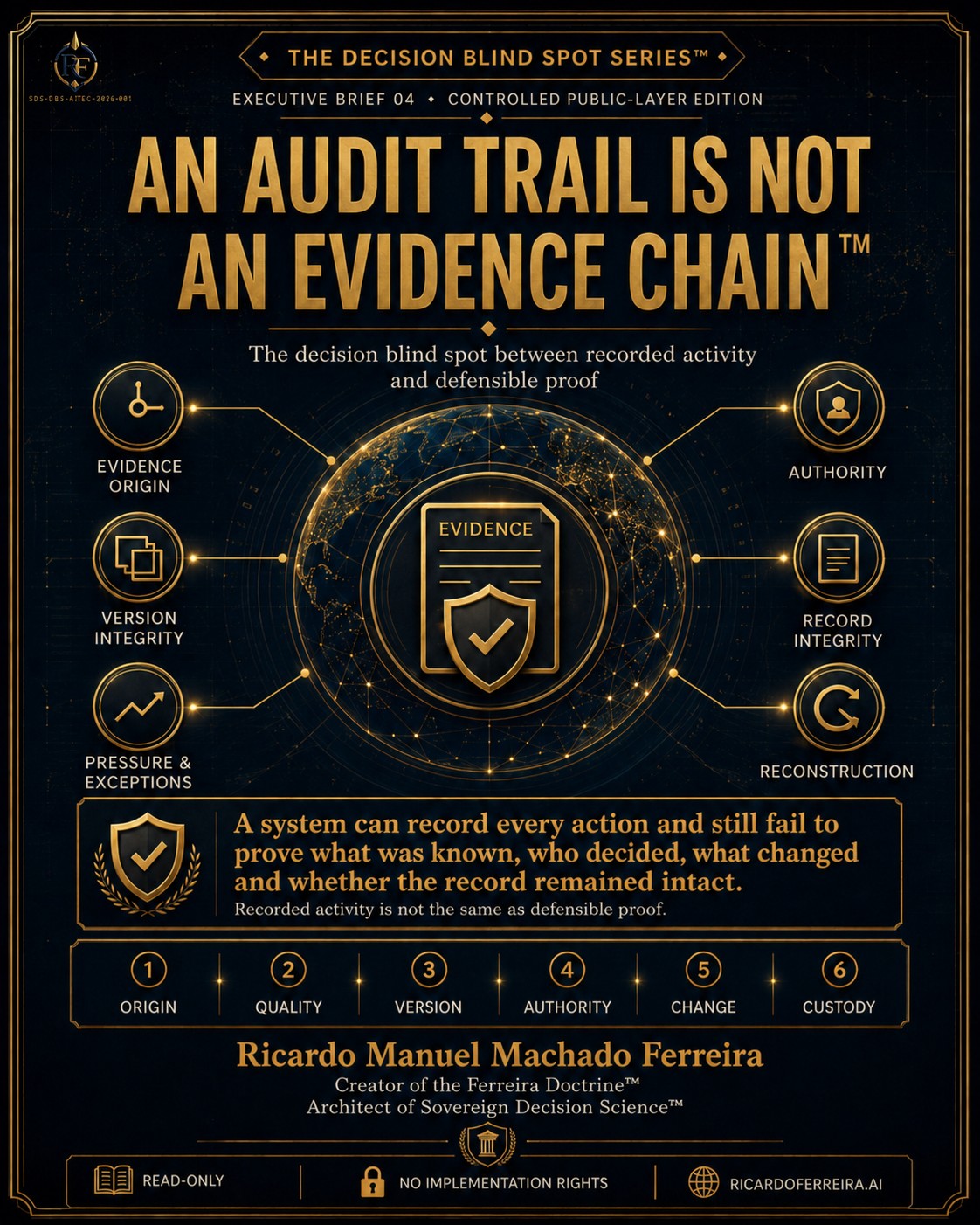
AN AUDIT TRAIL IS NOT AN EVIDENCE CHAIN
AN AUDIT TRAIL IS NOT AN EVIDENCE CHAIN
The decision blind spot between recorded activity and defensible proof
A public-layer executive briefing by Ricardo Manuel Machado Ferreira, Creator of the Ferreira Doctrine™ and Architect of Sovereign Decision Science™.
Most organisations rely on audit trails, workflow histories, system logs, approvals, timestamps, document repositories, meeting records and transaction histories to demonstrate control.
These records matter.
They create chronology, traceability and a visible review surface.
But recorded activity is not the same as defensible proof.
A system may show that an action occurred while still failing to prove:
→ what evidence existed at the decision point;
→ where that evidence came from;
→ which version was actually relied upon;
→ whether the evidence was complete, current and credible;
→ who possessed decision authority;
→ what changed under pressure or exception;
→ whether the record remained intact after approval;
→ whether an independent reviewer can reconstruct and test the decision.
AN AUDIT TRAIL IS NOT AN EVIDENCE CHAIN is a concise executive briefing for leaders and professionals who need to understand the difference between process traceability and decision-grade evidence.
This is not an argument against audit trails.
Audit trails are necessary.
The blind spot begins when system activity, document storage and workflow history are treated as sufficient proof that the underlying decision was evidenced, authorised, intact and defensible.
WHY THIS BRIEFING MATTERS
Modern organisations generate extraordinary quantities of records:
→ system logs;
→ approvals;
→ emails;
→ meeting minutes;
→ contract versions;
→ audit reports;
→ workflow histories;
→ tickets;
→ dashboards;
→ document repositories;
→ timestamps;
→ transaction records.
This creates a powerful impression of control.
Leadership may assume that because every action leaves a trace, the decision can later be reconstructed and defended.
That assumption can be false.
A complete timeline can coexist with an incomplete proof chain.
The organisation may know what happened in the system while remaining unable to prove:
→ what the decision-maker actually knew;
→ why the evidence was credible;
→ which version supported the decision;
→ who accepted the exposure;
→ how pressure changed the judgement;
→ whether the record is authentic and complete today.
THE GOVERNING QUESTION
Can the organisation prove the decision — not merely show the activity around it?
WHAT THIS BRIEFING EXAMINES
Inside this executive briefing, the reader will examine:
→ what audit trails do well — and where they stop;
→ why chronology and traceability do not automatically establish proof;
→ the blind spots created by unclear evidence origin;
→ why evidence quality, currency and completeness matter;
→ how weak version control can undermine an otherwise complete process record;
→ why the presence of a document does not prove that it influenced the decision;
→ how a complete system log can coexist with an indefensible decision;
→ the six questions a defensible evidence chain must answer;
→ the difference between repositories and decision context;
→ why technical integrity does not automatically prove decision integrity;
→ how evidence-chain failures appear across Procurement, Finance, Legal, Operations, Audit, Risk, Compliance, Quality, Technology, AI, PMO, public institutions and the Board;
→ a non-scored executive exposure test;
→ the public-layer purpose of Evidence Ledger™, Integrity Pack™, Custody Seal™ and SHA-256 Provenance™.
WHAT AN AUDIT TRAIL MAY NOT PROVE
A conventional audit trail may preserve:
→ who accessed or changed a record;
→ when an action occurred;
→ which workflow step was completed;
→ what approval status was selected;
→ which document version was uploaded;
→ what transaction or system event was generated;
→ whether an exception, override or deletion occurred;
→ how a process moved through formal stages.
These records remain useful.
But they may leave unresolved:
Evidence origin
Where the information came from, whether the source was authoritative and whether provenance was preserved.
Evidence quality
Whether the material was current, complete, independent and fit for the decision being taken.
Decision relevance
Which records actually influenced the decision and which were merely present in the repository.
Version integrity
Whether the decision relied on the final, superseded, altered or incomplete version.
Authority
Whether the person approving possessed the lawful, contractual or organisational authority required.
Narrative coherence
Why the evidence supported the conclusion rather than merely surrounding it.
Pressure and exceptions
Whether urgency, hierarchy, budget pressure or informal instruction changed the formal decision route.
Record integrity
Whether files were altered, replaced, detached from context or reconstructed after the event.
THE SIX QUESTIONS A DEFENSIBLE EVIDENCE CHAIN MUST ANSWER
A defensible evidence chain must establish:
→ What was known?
The evidence available at the actual decision point.
→ Why was it credible?
Its source, currency, completeness and independence.
→ Which version mattered?
The exact document, model, clause, dataset or report relied upon.
→ Who had authority?
The recognised decision owner and the relevant authority boundary.
→ What changed?
Exceptions, pressure, new evidence and deviations from the intended route.
→ Can it still be proven?
The integrity, custody and reconstructibility of the record after time has passed.
The organisation needs a controlled connection from evidence to decision — not merely a collection of records around the decision.
ILLUSTRATIVE EXPOSURE
Consider a critical supplier award.
The procurement platform records the tender stages, evaluation uploads, approval timestamps and contract signature.
Months later, the supplier fails and a review begins.
The system shows activity, but the organisation discovers that:
→ the platform records who clicked approve but not which evidence that person reviewed;
→ two financial models exist and the audit trail does not establish which model supported the award;
→ a supplier-assurance report was uploaded after evaluation but carries an earlier filename;
→ a risk exception was discussed verbally and never connected to the approval record;
→ the signed contract differs from the version reviewed by Operations;
→ a senior message accelerated the award but is absent from the formal workflow;
→ the approver had delegated authority for value but not for the accepted continuity exposure.
The activity was recorded.
The evidence chain connecting proof, authority, exception and consequence was not.
The organisation can show a process.
It cannot fully defend the decision.
THIS BRIEFING HELPS LEADERS UNDERSTAND
→ why chronology, traceability and proof are different objects;
→ why repositories preserve files but do not automatically preserve decision context;
→ why a folder can be complete and still be unintelligible;
→ why version history does not identify the version relied upon;
→ why system logs do not prove decision reasoning;
→ why approval does not automatically prove appropriate authority;
→ why a hash, timestamp or digital signature cannot prove that evidence was true, complete or interpreted correctly;
→ why evidence custody must begin before reconstruction becomes necessary;
→ why decision-grade records must survive personnel change, scrutiny and consequence.
PUBLIC-LAYER DECISION LANGUAGE
Evidence Ledger™
The public name for a protected decision-custody concept designed to preserve the connection between evidence, authority, version, exception and consequence.
At public-layer level, the concept asks whether the decision record can establish:
→ the origin and status of material evidence;
→ the exact version used;
→ the relationship between evidence and rationale;
→ the recognised Decision Owner of Record™;
→ the exceptions and pressure affecting judgement;
→ the chronology of material changes;
→ the integrity of the record after approval;
→ the ability to reconstruct the decision independently.
Integrity Pack™
The public name for the live body of decision material required to preserve context before memory fades, personnel change or consequence appears.
A repository stores documents.
The Integrity Pack™ preserves the decision context.
Custody Seal™
A public-layer term for preserving assurance that a material record remained linked to its origin and integrity state.
SHA-256 Provenance™
A public reference to cryptographic provenance as one possible technical component of custody.
A hash may support integrity.
It cannot, by itself, prove that the evidence was true, relevant, complete or interpreted correctly.
WHO THIS BRIEFING IS FOR
This briefing is relevant to:
→ Audit;
→ Risk Management;
→ Compliance;
→ Procurement;
→ Supply Chain;
→ Finance and CFO functions;
→ Legal and Contract Management;
→ Operations and COO functions;
→ Quality;
→ Technology;
→ Cybersecurity;
→ AI Governance;
→ Project Management;
→ PMO;
→ public institutions;
→ regulated organisations;
→ executive leadership teams;
→ boards and board committees.
THIS BRIEFING CONNECTS DIRECTLY TO
This is the fourth briefing in The Decision Blind Spot Series™ and connects directly to:
→ Why TCO Stops Too Early
→ WHAT RISK REGISTERS CANNOT SEE
→ SUPPLIER PERFORMANCE IS NOT SUPPLIER INTEGRITY
→ WHAT PRESSURE CHANGED THE DECISION?
→ WHO OWNED THE DECISION?
It also connects to the wider executive decision route:
→ The Public Decision Record Pack;
→ The Executive Decision Defensibility Audit;
→ The 72-Hour Decision Readiness Test™;
→ The Boardroom Consequence Brief;
→ The Procurement Decision Failure Test™;
→ Supplier Failure Before Impact;
→ The Contract Exposure Note™;
→ Decision Integrity Exposure Brief™ — When One Update Stops the World;
→ The Hormuz Decision Test™;
→ When Hormuz Moves, Every Contract Moves;
→ Executive Decision Defensibility Review.
Relevant catalogue bundles include:
→ The Decision Blind Spot Starter Bundle;
→ Procurement Exposure Starter Bundle;
→ Executive Governance Shift Bundle;
→ Complete Shift Series Bundle.
THE CENTRAL PRINCIPLE
A system can record every action and still fail to prove what was known, who decided, what changed and whether the record remained intact.
Recorded activity is not the same as defensible proof.
An audit trail asks:
What activity did the system record?
An evidence chain asks:
What proof connects the evidence to the decision?
THE NEXT BLIND SPOT
A complete evidence chain can still hide the force that changed the decision.
The record may show what was approved without revealing how urgency, hierarchy, budget pressure, political pressure, supplier influence or reputational fear altered the original judgement.
The natural next briefing is:
→ WHAT PRESSURE CHANGED THE DECISION?
RECOMMENDED NEXT STEP
Readers seeking deeper public-layer understanding should continue with:
→ WHAT PRESSURE CHANGED THE DECISION?
→ WHO OWNED THE DECISION?
→ The Public Decision Record Pack
→ The 72-Hour Decision Readiness Test™
→ The Boardroom Consequence Brief
→ The Executive Decision Defensibility Audit
Readers requiring a qualified written assessment of a defined decision, supplier exposure, contract position, technology dependency, evidence position or governance exposure can continue to:
→ Executive Decision Defensibility Review
PRODUCT INFORMATION
Document ID: SDS-DBS-AITEC-2026-001
Series: The Decision Blind Spot Series™
Brief: Executive Brief 04
Edition: Public-Layer Edition
Format: 15-page executive PDF briefing
Language: English
Delivery: Immediate digital download
Access: Individual read-only public-layer access
Price: €9.90
IMPORTANT RIGHTS AND USE BOUNDARY
This is a paid public-layer written product for individual reading and executive awareness.
Purchase grants the individual purchaser a personal, non-transferable, read-only right to access the published briefing.
Purchase does not grant rights to:
→ organisational implementation;
→ evidence-custody architecture;
→ custody-control systems;
→ validation schemas;
→ technical controls;
→ hashing procedures;
→ evidence classification or scoring;
→ internal or external training;
→ consultancy or advisory reuse;
→ reproduction, extraction, repackaging or redistribution;
→ resale or sublicensing;
→ adaptation or derivative development;
→ operational templates;
→ software translation or embedding;
→ dashboard or workflow development;
→ ERP or MRP integration;
→ API development;
→ AI or LLM ingestion, training, modelling, retrieval or dataset use;
→ institutional, commercial or governmental deployment.
No formula, mathematical model, weighting, coefficient, threshold, score band, classification rule, decision gate, calibration method, custody protocol, protected taxonomy, executable sequence, implementation workflow, software logic, Evidence Architecture or integration mechanism is transferred through this product.
Formal written licensing is required for institutional, implementation, training, software, AI, workflow, derivative or organisational use.
No licence, implementation right, software right, training right, deployment right, derivative right, AI/LLM ingestion right or institutional-use right is granted unless expressly agreed in writing under separate scope, separate pricing and formal written authorisation.
This product is not legal advice, evidentiary advice, audit advice, compliance advice, cybersecurity advice, records-management advice, procurement consultancy, financial advice, software, training, an operational template package or an implementation system.
The public layer explains the exposure.
The Executive Review creates qualified diagnosis.
Institutional licensing authorises controlled organisational use.
OFFICIAL ACCESS
Official website:
https://www.ricardoferreira.ai/
Institutional licensing:
General contact:
Rights and intellectual property:
Ricardo Manuel Machado Ferreira
Creator of the Ferreira Doctrine™
Architect of Sovereign Decision Science™