
Self-Harm adult intervention toolkit
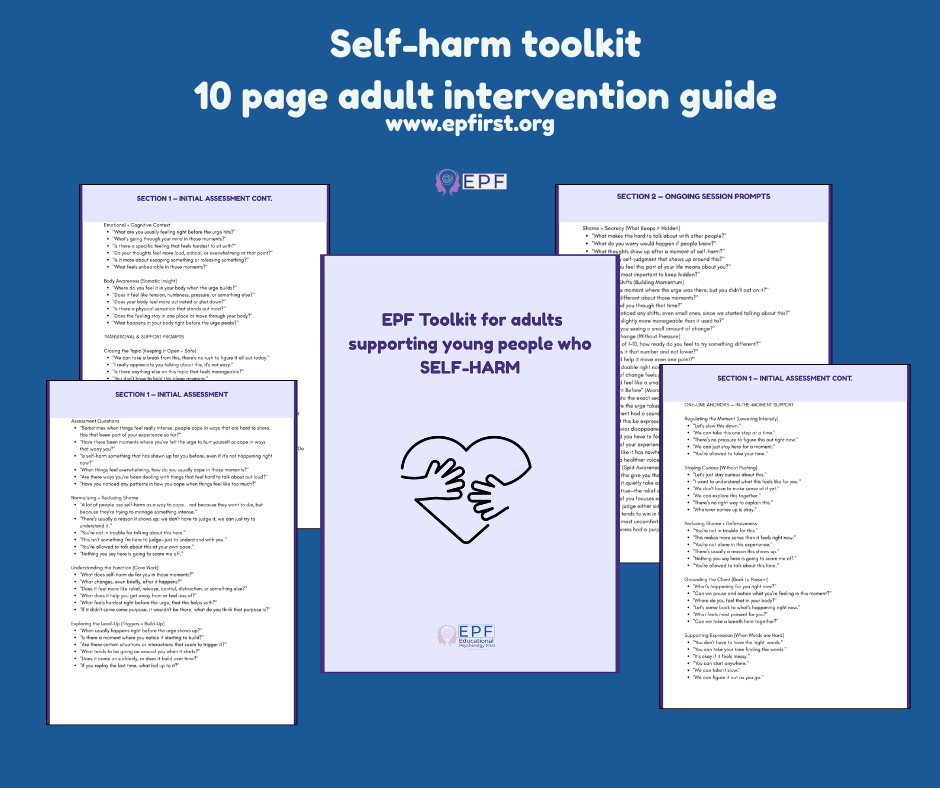
Supporting Young People Who Self-Harm: An Initial Assessment & Ongoing Session Toolkit
Empathetic, non-judgmental, and practitioner-ready scripts to navigate intense moments and support long-term healing.
When supporting a young person through self-harm, finding the right words in the moment can feel daunting. As a practitioner, you want to lower the intensity, reduce shame, and open a safe dialogue without making the client feel cornered or defensive.
Developed by Educational Psychology First (EPF), this comprehensive toolkit provides a structured framework of trauma-informed, shame-reducing verbal prompts, scripts, and reflection tools. It is designed to help practitioners confidently guide clients through initial assessments, ongoing therapeutic sessions, and alternative building—all while honoring the client's autonomy and pacing.
🛠️ What’s Inside the Workbook?
This digital toolkit is divided into actionable, easy-to-navigate sections designed for real-world clinical use:
1. Initial Assessment Framework
- Assessment Questions: Gentle, non-threatening entry points to ask about self-harm history and current coping mechanisms.
- Normalizing & Reducing Shame: Core scripts to reassure clients they aren’t in trouble and that their feelings are valid.
- Understanding the Function: Deep, curious prompts to identify what purpose self-harm serves (e.g., relief, control, release, or distraction).
- Triggers, Cognitive & Somatic Awareness: Tools to map out the physical and mental build-up before an urge peaks.
2. Transitional & In-the-Moment Support
- The "During" Moments: What to say when a client shuts down, becomes overwhelmed, or feels stuck.
- One-Line Anchors: Quick, powerful phrases to ground the client, release pressure, and restore safety instantly.
- Tolerating the Urge: Scripts that help clients separate a thought/urge from an action, creating space for self-compassion.
3. Ongoing Session Prompts
- Tracking Patterns: Help clients make the invisible visible by tracking micro-moments and early signs.
- The "Hidden Agreement": Prompts to gently unpack unspoken beliefs, split awareness (relief vs. cost), and emotional numbness.
- Readiness for Change: Scaled questions to assess a client's willingness to try something new without forcing compliance.
4. Building Alternatives (Without Forcing)
- Matching the Function: Strategies to replace or experiment with safety alternatives based on the individual's specific needs (e.g., redirecting punishment, replacing sensation).
- Peak Urge Planning: Realistic harm-reduction strategies for when the urge hits a $10/10$.
5. Between-Session Client Reflection Logs
- Printable, low-pressure awareness sheets for clients to notice difficult moments, celebrate small victories, and track what helped them get through the week—without judgment.
✨ Who is this for?
- Educational Psychologists
- Therapists & Counselors
- Clinical Psychologists
- School Mental Health Leads & Pastoral Staff
📂 Product Details
- Format: Instantly downloadable 10 page PDF workbook.
- Usage: Print it out as a desk reference, use the scripts directly in sessions, or duplicate the reflection pages for client homework.