
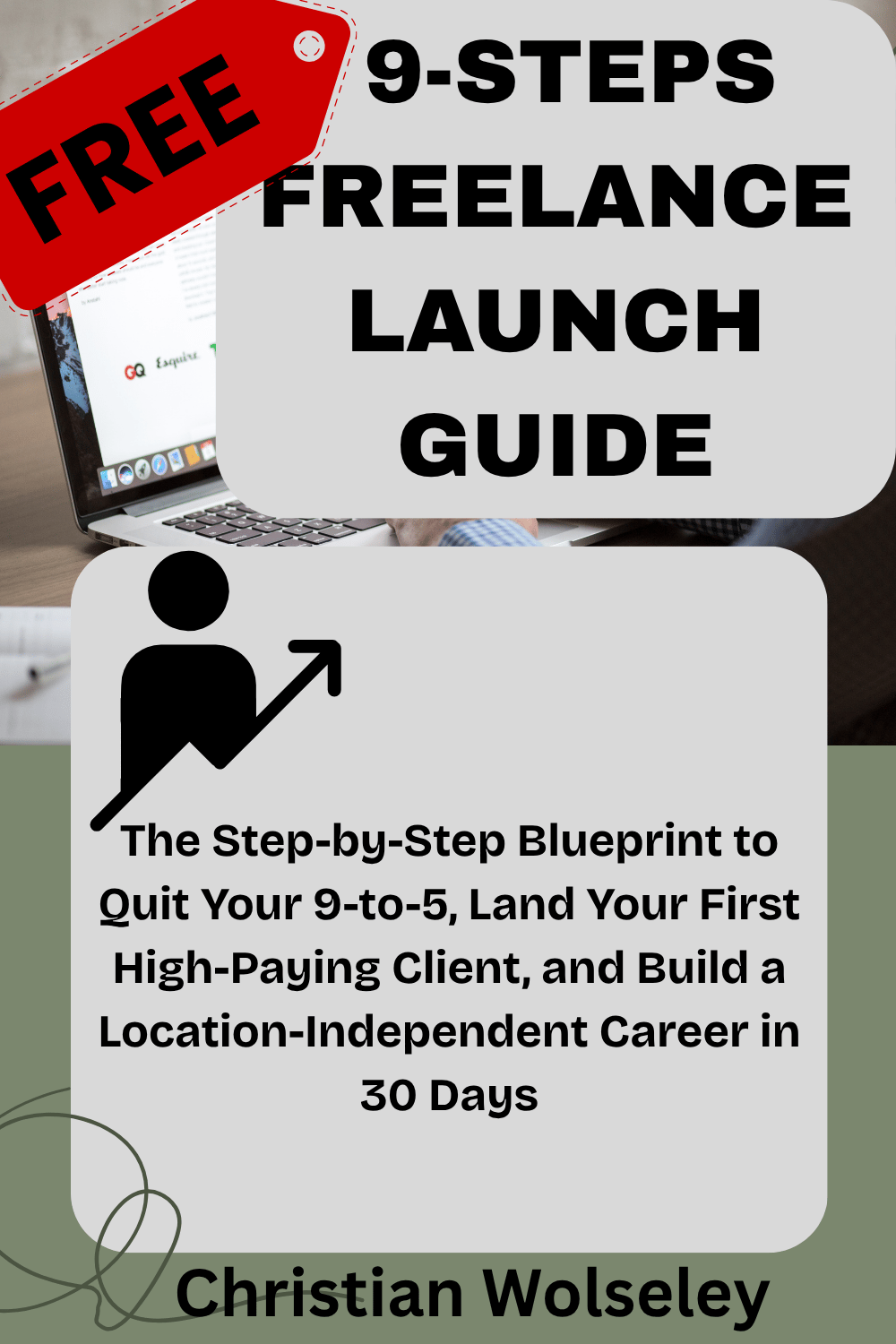
9-Steps Freelance Launch Guide
Corporate to Freelance Pivot
Turn the skills you already have into a freelance offer, find clients, and build a repeatable path from employment experience to freelance income.
You don't necessarily need another degree.
You don't necessarily need years of freelancing experience.
And you don't need to figure everything out before you start.
You may already have something valuable:
Skills you've developed through your work.
The problem is that most people don't know how to turn those skills into something a client will actually pay for.
You know how to do your job.
But can you answer:
- What exactly can I sell as a freelancer?
- Who would pay for it?
- How do I turn my experience into an offer?
- How much should I charge?
- How do I find my first clients?
- What should I say when I contact prospects?
- How do I use LinkedIn to attract opportunities?
- What do I do when someone says, "That's too expensive"?
- How do I move from one-off projects to a professional freelance system?
That's what Corporate to Freelance Pivot is designed to help you solve.
💼 Your Job Experience May Be More Valuable Than You Think
Your previous work isn't something you have to leave behind.
It's raw material.
Managing vendors can become an operations service.
Writing internal or marketing content can become a writing service.
Solving customer problems can become customer-support consulting.
Improving processes can become process-improvement work.
The key is learning to stop describing yourself only by your job title and start communicating the business value you can create.
This book shows you how to make that shift.
Inside the Complete Corporate to Freelance Pivot
1. Discover the Skills You Can Actually Sell
You'll learn how to examine your previous work and identify the skills, problems, and outcomes that can become freelance opportunities.
You'll work through a practical Value Inventory to uncover what you're already good at and where businesses may have a reason to pay you.
2. Turn Your Skill Into a Clear Offer
Knowing how to do something isn't enough.
You need an offer that a potential client can understand.
You'll learn how to define:
Who you help → What problem you solve → What result you deliver → What you actually provide.
You'll also learn how to make your deliverables, boundaries, and scope clear before a project begins.
3. Stop Guessing What to Charge
Instead of simply thinking:
"How much should I charge per hour?"
You'll learn to consider the value drivers behind your service, including:
- Revenue impact
- Cost reduction
- Time saved
- Risk reduction
You'll also learn how scope, revisions, timelines, client responsibilities, and implementation affect your pricing.
4. Build a LinkedIn Profile That Makes Your Value Clear
Your LinkedIn profile shouldn't simply say what you've done.
It should quickly communicate:
Who you help.
What you do.
What result you deliver.
The book gives you a practical one-week framework for improving your positioning, offer, Featured section, proof, and content.
5. Learn How to Find Your First Clients
Waiting for clients to magically discover you isn't a strategy.
You'll learn a repeatable approach involving:
- Cold outreach
- Warm-network outreach
- Previous employers
- Targeted prospects
- Follow-ups
- Prospect research
You'll also get a simple outreach framework designed to start conversations without sounding like you're sending desperate job applications.
6. Use Your Existing Network
Former coworkers, managers, clients, vendors, contractors, and other professional contacts can potentially become sources of introductions and opportunities.
You'll get a practical message you can adapt when reaching out to your network.
7. Handle Sales Conversations Without Feeling Pushy
What happens when a prospect says:
"That's expensive."
Or:
"I need to think about it."
You'll learn how to diagnose the real concern, clarify scope and timing, and follow up professionally without chasing or pressuring people.
8. Deliver Like a Professional
Getting the client is only the beginning.
You'll learn how to structure your kickoff process, clarify expectations, establish communication rules, manage feedback, and create an early visible win.
That's how you begin building the foundation for repeat work and referrals.
9. Get Moving With a Practical 48-Hour Start
Instead of spending months "preparing to freelance," you'll have a simple starting sequence:
Choose one buyer.
Choose one problem.
Write your offer.
Create your positioning.
Prepare your outreach.
Build your prospect list.
Start contacting people.
The guide's starting checklist is designed to turn planning into action.
🎯 WHO THIS BOOK IS FOR
This book is for you if:
✅ You're currently employed but considering freelancing
✅ You have professional skills but don't know how to monetize them independently
✅ You want to turn your existing experience into a freelance service
✅ You're struggling to define what you should offer
✅ You don't know how to find your first clients
✅ You want to use LinkedIn more strategically
✅ You're unsure how to approach prospects
✅ You struggle with pricing and negotiation
✅ You want a more structured approach instead of randomly applying for freelance jobs
❌ This Isn't a "Quit Your Job Tomorrow" Book
That's not the goal.
The smarter starting point is to build evidence, clients, and income before making a major career decision.
You don't have to burn everything down and hope freelancing works.
You can start by identifying what you already know, packaging it into an offer, testing it with real prospects, and learning from the market.
That's the approach this book is built around.
📦 WHAT YOU'LL WALK AWAY WITH
By the end, you'll have a framework for creating:
✓ Your freelance skill/value inventory
✓ Your specific freelance offer
✓ Your positioning statement
✓ Your LinkedIn brand signal
✓ Your prospecting strategy
✓ Your outreach message
✓ Your warm-network approach
✓ Your pricing considerations
✓ Your discovery-call approach
✓ Your follow-up process
✓ Your client onboarding checklist
✓ Your initial freelance action plan
And most importantly:
You'll stop looking at your corporate experience as something you have to leave behind—and start looking at it as something you can potentially package and sell.
🚀 Your Next Career Doesn't Have to Start From Zero.
Your experience already contains skills.
Your skills can become services.
Your services can become offers.
And your offers can be put in front of people who have a reason to buy.
Corporate to Freelance Pivot gives you the framework to start making that transition deliberately.
Get the complete book and start building your freelance path today.
👉 Get Corporate to Freelance Pivot now.
Freelancing income is not guaranteed. Results depend on your skills, offer, market, outreach, execution, and circumstances. This book is educational and does not promise a specific income or timeline.