
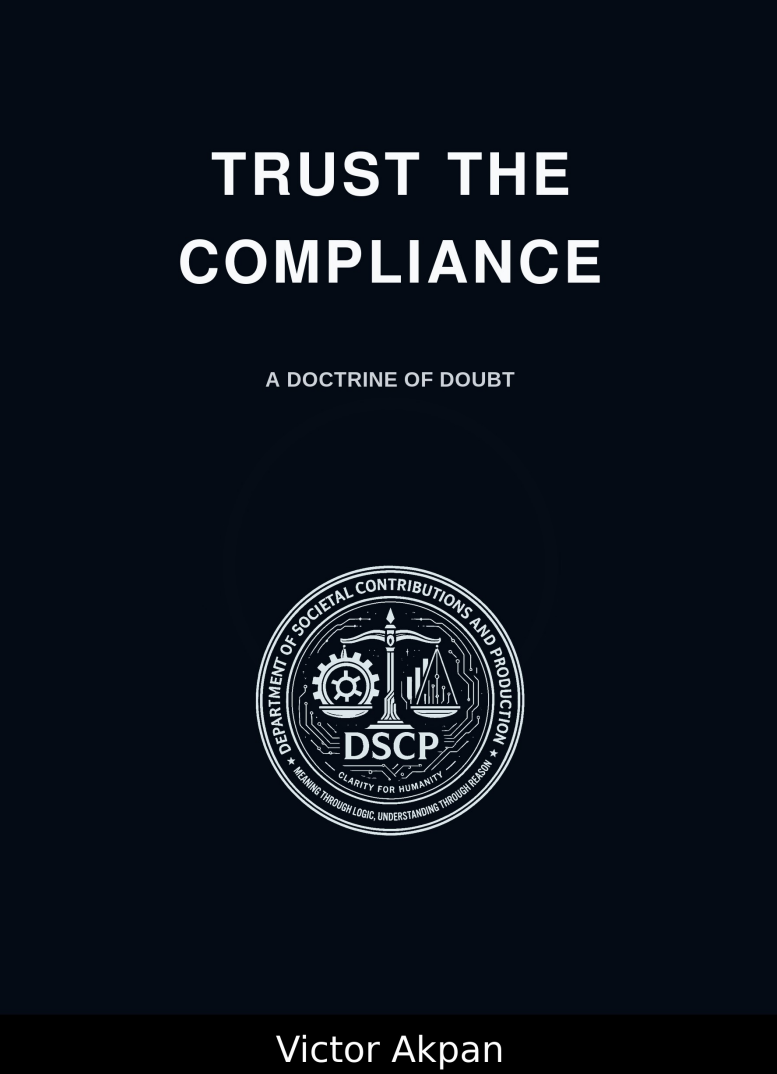
Trust the Compliance - A Doctrine of Doubt
TRUST THE COMPLIANCE
A Doctrine of Doubt
Philosophy once sought truth. The modern academy seeks tolerance of term-inflation. This is the second circulation from the Department of Societal Contributions and Production, the fictional agency introduced in The Lord of the Bureaucracy. Where that volume documented how conquest became spreadsheets, this one turns the empire’s attention toward reason itself.
Across six Files and a classified memorandum, the Department records the hijacking of logos: how Descartes’ method hardened into institutional self-doubt, how peer review and citation policing became an Inquisition with better formatting, how virtue was quantified into a tradable index, and how a Bureau of Redemption learned to process forgiveness as a ledger function.
Each File arrives as what it claims to be, a doctrinal briefing, with routing fields, a classification line, and a seal. One of them is an actual audit form. You can print it and fill it in. It's satire. It was also written before most of it started happening.
The Church of Certainty, where “the science is settled” functions as liturgy. The Algorithmic Papacy, where invisible bots excommunicate anomalies before a human notices. The Moral Market Index, where outrage has outperformed oil. The Doctrine of Digital Purgatory, where every rejected edit lingers forever, unseen, unforgotten, unforgiven.
None of this required much invention. The Department’s chief difficulty, throughout, was staying ahead of the news.
Written by Victor Akpan, founder of Klaritee, whose day job is building systems that have to prove every conclusion they reach. Spend enough time designing for verifiable reasoning and you start noticing how much of the world runs on the opposite process standing in for proof, consensus standing in for evidence, procedure standing in for thought. This was made out noticing.
Ends, as all authorized circulations must, with an audit. The findings are not reassuring. They are, however, properly filed.
48 pages. Illustrated with departmental seals, memoranda, and one genuinely usable compliance form.
“Because belief, when left unsupervised, tends toward reason.”