
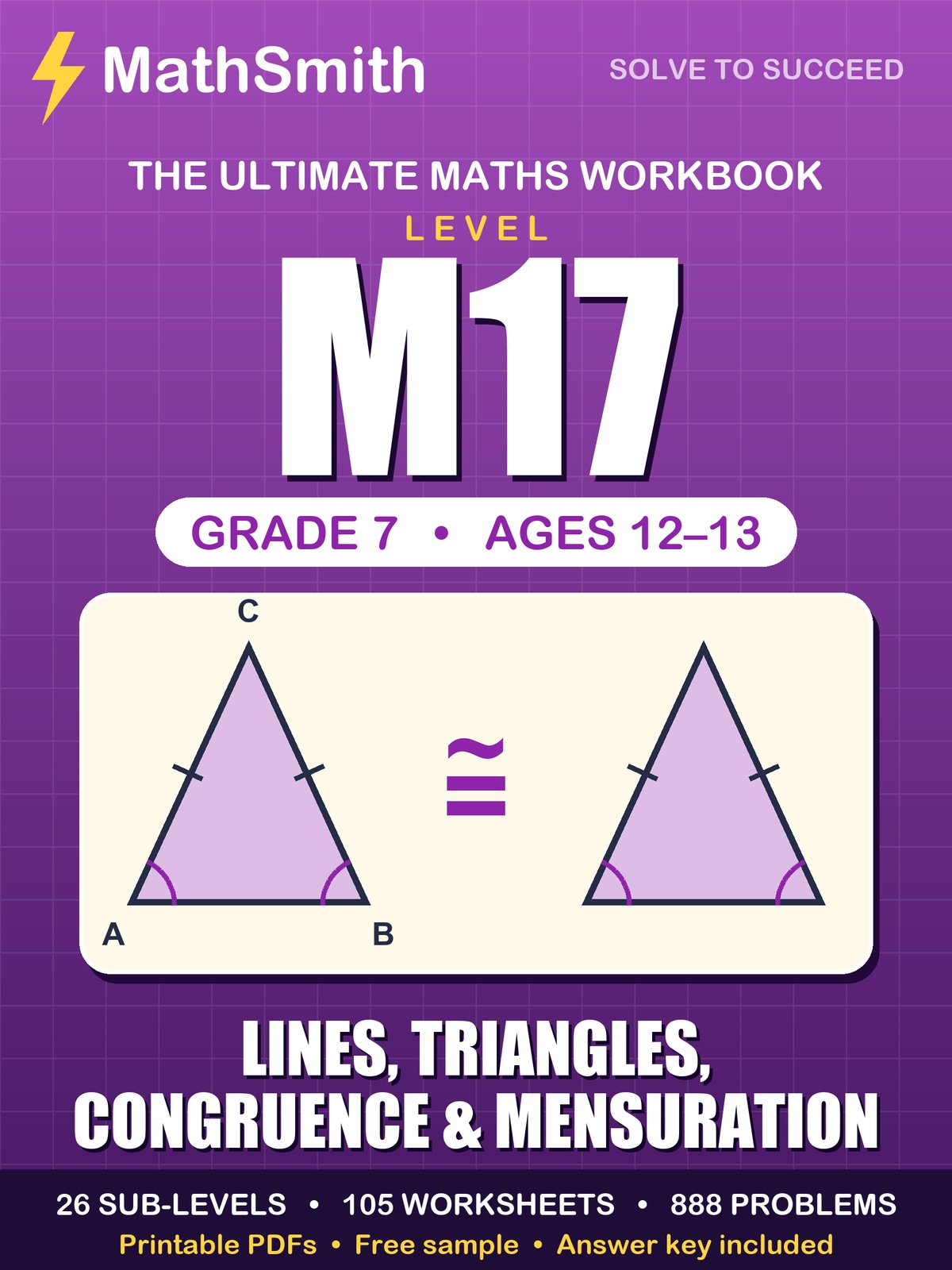
Gr 7 Maths Worksheets (Ages 12-13) | Level M17: Lines, Triangles, Congruence & Mensuration
🎓 Launch offer: 80% OFF every MathSmith workbook with code LAUNCH80 (first 1000 orders). Click Add to Cart, then enter LAUNCH80 in the discount box before you pay.
Not sure which level your child needs? Take the free 40-question placement test: https://ebooks.thecodecrafters.net/placement
See free sample pages first: https://ebooks.thecodecrafters.net/
Help your child build absolute confidence and mastery in mathematics. This comprehensive workbook from MathSmith takes a highly structured, "one-rung-at-a-time" approach to Lines, Triangles, Congruence and Mensuration, ensuring students fully understand concepts before moving forward.
Instead of overwhelming learners with random equations, this workbook uses a carefully scaffolded, predictable learning ladder. It is perfect for homework, structured independent study, or mastery practice.
📊 What Is Included?
1 Complete Level (Level M17)
26 Structured Sub-levels for gradual progression
105 Printable Worksheets
888 Total Problems for thorough practice
Full Answer Key online, unlocked by the order ID on your Payhip receipt, for quick, stress-free marking
🗺️ Curriculum Breakdown
This collection focuses deeply on mastering Lines, Triangles, Congruence and Mensuration through a carefully curated system:
Angles that are equal because of where they sit (6 Sub-levels): Six rungs, and not one of them measures anything. Two angles on a straight line add to a half turn; two lines crossing make two pairs of equal angles, which is not obvious at all - the two angles do not touch, they share only a point, and they are equal because each of them makes a straight line with the SAME third one. Then a line crossing two parallels, where all eight angles are one of two sizes and every one of them can be found from any other. The arrowheads on the drawing are what makes that true, which is why the strand ends by running the fact backwards: measure two angles, and decide whether the lines are parallel at all. That is how the fact is used outside a textbook.
What a triangle cannot help being (6 Sub-levels): The heart of the level. Three angles that always come to a half turn, so the third is never measured; an exterior angle that is always the two interior angles away from it, which is the same picture read backwards rather than a second rule; equal sides that always go with equal angles, said in ticks and arcs rather than in words. Then the two facts that are about lengths: three lengths only make a triangle if the two short ones beat the long one, and in a right-angled triangle the square on the longest side is the two other squares added. The second of those is the only thing in the level a child could not have guessed.
Whether what is known is enough (3 Sub-levels): The only topic in the book where the question is not what something is worth but whether the evidence settles it. Three pairs of equal sides settle it. Two sides and the angle between them settle it. Two sides and an angle that is not between them do not - and the two drawings look exactly the same, which is the whole difficulty and the reason the marks are the question. A child who can name four rules and cannot say what each one needs has learnt four acronyms.
Built with an instrument, checked with one (3 Sub-levels): A workbook cannot mark a child's drawing, so these three rungs mark what the drawing is about instead: which step comes next, what the compasses are set to and why they may not be moved, and - the one that matters - what may be measured AFTERWARDS to prove the construction worked. A triangle built from three sides is checked by measuring its angles, because those are the numbers nobody put in. That is the same discipline M13's constructions keep, and for the same reason.
Four shapes and the one length each of them takes (4 Sub-levels): A parallelogram's area is its base times its perpendicular HEIGHT, and the height is not a side of the shape - which is why it is drawn dashed with a right-angle square at its foot, and why the slanting side is labelled too. A page that labelled only the height would have done the choosing. A triangle follows immediately, because two of them make a parallelogram on the same base, so the rule is the last rule halved. Then the circle, which has no sides at all: what it has is a centre and a distance, and every formula is written in one of them.
Shapes looked at rather than worked out (2 Sub-levels): Two rungs that ask a child to see. How many mirror lines a shape has and how many times it fits onto itself in one turn are two different counts and they come apart: a parallelogram has no line of symmetry at all and still turns onto itself twice. And a solid drawn flat with its hidden edges dashed can have its faces, edges and corners counted - with the check that ties the three together, which holds for every solid on the page and is worth meeting as something that is true rather than as a formula.
Three middles that disagree, and one chance (2 Sub-levels): The mean, the median and the mode are three answers to the same question and they are not the same number. A list with one very large value in it has a mean that nobody in the list is near - which is not a fault in the mean, it is what the mean is for, and a child who has seen it once will not be surprised by an average wage again. The level closes on the first probability in the series, which is deliberately nothing but counting: how many ways it can happen over how many ways anything can.
🎯 Who Is This For?
Parents looking to provide structured math support at home.
Homeschoolers searching for a sequential curriculum to guarantee zero gaps in math skills.
Teachers & Tutors looking for bite-sized, scaffolded printables for classroom morning work or targeted intervention.
📖 How To Use This Workbook
Print the workbook, read each rung's method page, and let your child work inside the printed frame. Then check the answers your way: in the printable answer-key PDF included in this download, or online, one page at a time, with the order ID on your Payhip receipt (valid for six months). Please keep the answer key for the adult marking the work and do not share it with your child: the workbook only works if they have worked each answer out for themselves.
Step-by-step manual and video guide: https://ebooks.thecodecrafters.net/manual/
Check the answers: https://ebooks.thecodecrafters.net/answers
⚙️ Digital Delivery Details
Format: four instant-download PDFs (free sample, sample answers, workbook, full answer key). The answer key is also available online.
Print Ready: Easily printable on home or school printers.
Usage: Licensed for individual family or single-classroom use.