
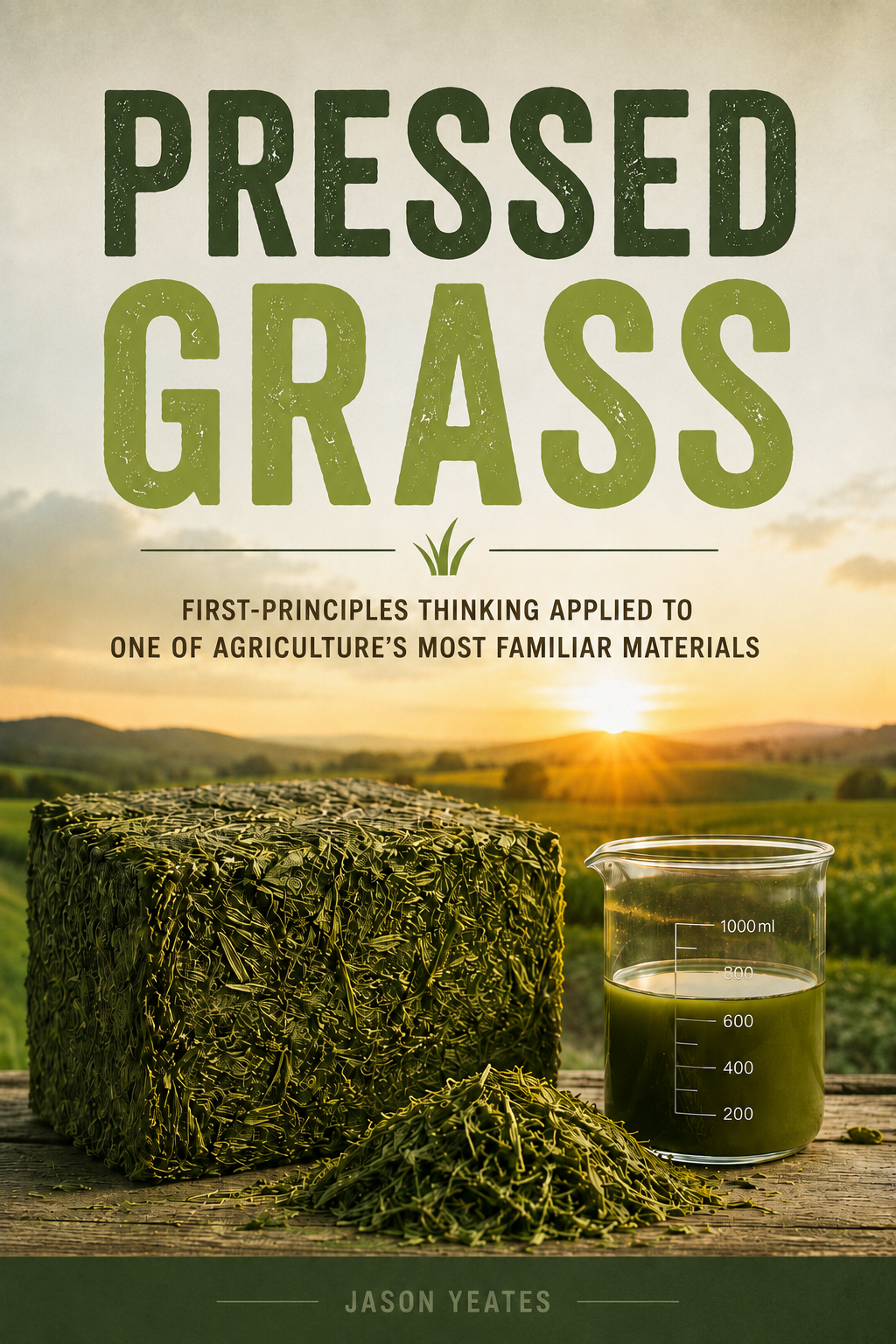
Pressed Grass
Pressed Grass
First-Principles Thinking Applied to One of Agriculture's Most Familiar Materials
What if we stopped thinking about grass as something that simply needs to be harvested and preserved—and started thinking about it as a raw biological material?
Grass is one of the most familiar things in agriculture. We see it every day. We grow it, graze it, mow it, bale it and turn it into silage.
But familiarity can make us stop asking questions.
Pressed Grass takes a step back and examines grass preservation from first principles.
A fresh crop of grass can contain around 80% water. That means harvesting a tonne of fresh grass can involve moving roughly 800 kilograms of water. Why do we accept this as simply part of the process?
Why do we mow grass, leave it lying in the paddock, wait for the weather to dry it, and then harvest it?
What are we actually trying to preserve?
Where is the real value in the plant?
And what might happen if we treated grass not simply as a crop to be stored, but as a raw material that can be processed?
The book explores these questions through five stages:
Part I — The Grass
We begin with the material itself.
What actually is grass?
Why is so much of it water?
Where is its value?
And who are we ultimately preserving it for?
This section explores dry matter, nutrition and the remarkable relationship between grass, rumen microbes and the ruminant animal.
Part II — Preservation
We then examine what happens after grass is harvested.
Rather than thinking of preservation as simply "keeping grass," we explore the biological processes that determine whether its nutritional value is retained or lost.
Microbes, fermentation, oxygen, dry matter, time and weather all become pieces of the same system.
Part III — Rethinking the System
This is where the central thought experiment begins:
What if grass didn't have to dry in the paddock?
Could mechanical force remove some of the water?
What does pressure actually do?
Could pressing create separate fibre and liquid streams?
And what happens to the grass when we change its physical form?
Part IV — Beyond Silage
Once we begin looking at grass as a raw material, new possibilities appear.
The fibre.
The liquid.
The microbes.
The feed.
The container.
The transport system.
The economics.
Instead of asking only how to make silage, we begin asking:
What useful things can we make from grass?
Part V — A Different Way of Thinking
The final section takes the idea beyond pressing.
What happens when we move from harvesting to processing?
From crop to raw material?
From silage making to feed manufacturing?
Could a "grass refinery" be more than an interesting idea?
And, ultimately:
What else have we assumed?
Pressed Grass is not an argument that traditional agriculture is wrong.
Nor is it simply a book about a machine.
It is an invitation to look at a familiar agricultural system with fresh eyes—to separate facts from assumptions, understand why the existing system works, and then ask whether there might be another way.
Because sometimes innovation doesn't begin with inventing something new.
Sometimes it begins with asking a very old question in a different way:
Why do we do it this way?
And then asking:
What if we didn't?